Most companies gather feedback. Far fewer run a voice of customer process, by which we mean a repeatable system with defined inputs, a cadence, named owners and a path from what a customer said to a decision someone made. The gap between the two is not effort. It is that the process most guides describe was designed for a world where feedback had to be requested, and most of it no longer does.
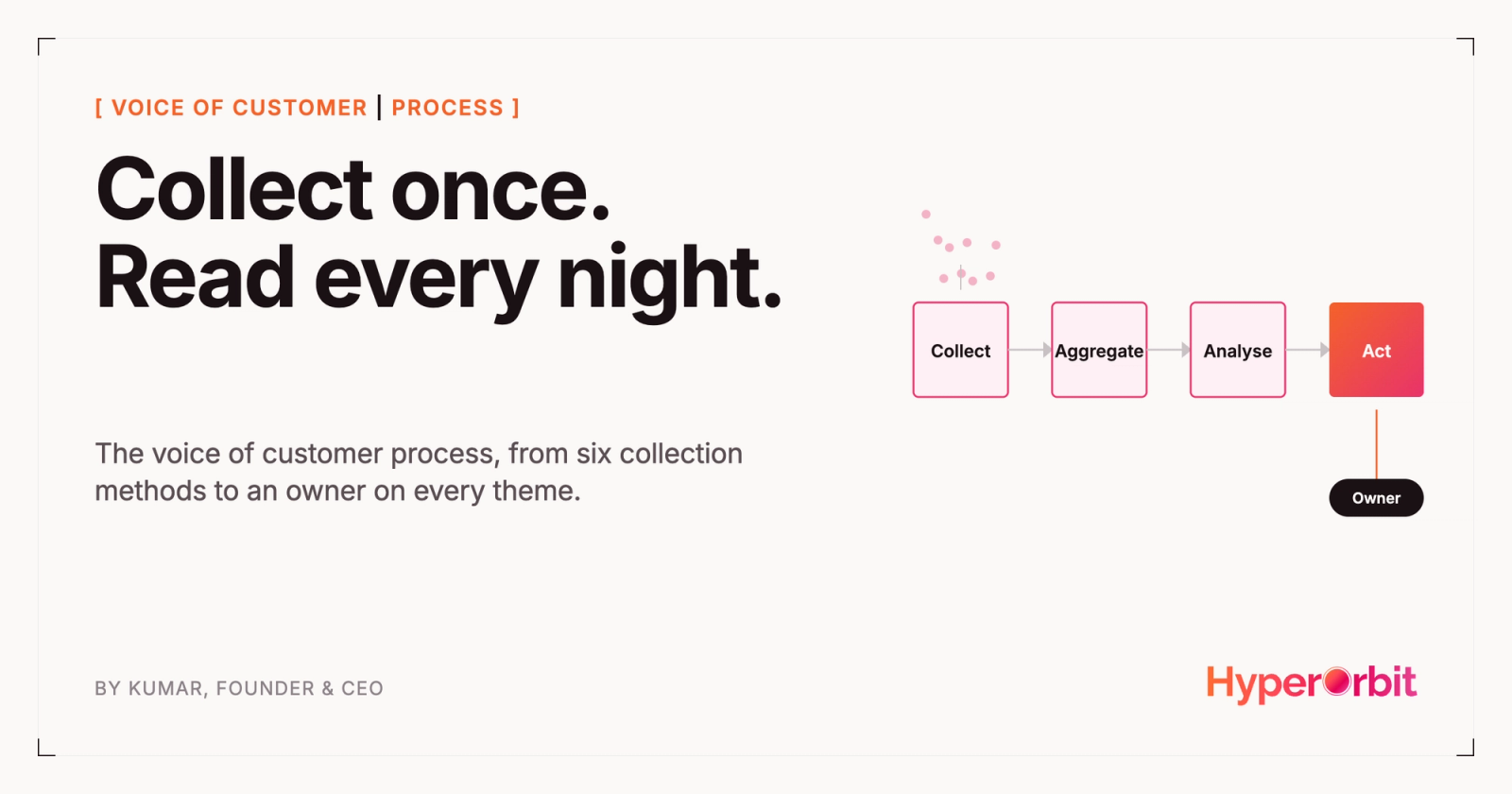
This guide keeps the four layers every good process has, collection, aggregation, analysis and activation, and walks through the six ways feedback arrives. Then it shows what changes when four of those six sources are read every night by an agent rather than sampled every quarter by a person.
Six ways feedback arrives
Surveys. Quantifiable and easy to trend, and the only source where you choose the question. Response rates fall every year, so use relationship surveys for the questions nothing else answers, and treat transactional surveys as one more signal to read alongside the rest.
Customer interviews. The richest qualitative source and the least scalable; a handful a month is realistic without dedicated staff. Use them to go deep on a theme the continuous read has already surfaced, not to discover themes.
Support tickets. A continuous, unprompted record of what breaks and what customers work around. Nobody has to be asked, and it is attached to a named account.
Reviews and ratings. Public, unprompted, and written in the customer's own words, on G2, Capterra, the app stores. They carry competitive positioning and feature gaps as well as sentiment.
Social and community. Reddit, LinkedIn, forums, Discord. The earliest signal on an emerging issue, and the hardest to attribute to an account.
Sales and success calls. The most under-read source in B2B: pre-purchase pain, competitor mentions, decision criteria and renewal objections, recorded and transcribed already.
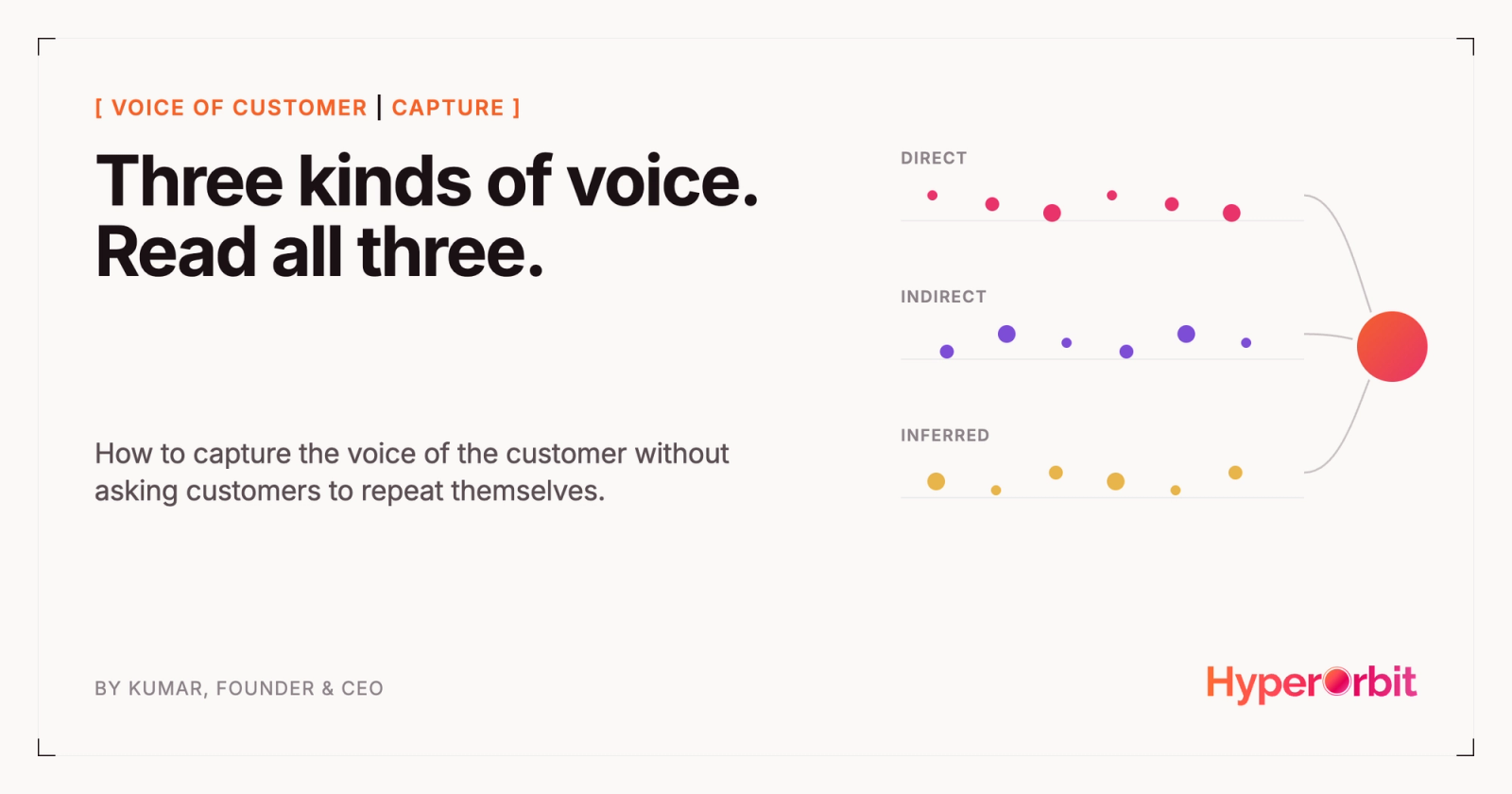
Four of the six need no one to ask a question. That is the fact the process should be built around.
Collection: connect, do not design
The traditional collection step is instrument design: which survey, which question, which cadence. When the bulk of the signal is unprompted, collection is a connection problem. Each source connects once over OAuth, and the read starts that night. HyperOrbit lists 76 connectors across calls, chat, contact centre, CRM, support, reviews, social, surveys, product analytics, project tools and data pipes; the connector guides for Gong and Zendesk show how to mine each source by hand if you want to see the shape of the signal first.
Aggregation: one record per customer
The manual process centralises feedback in a repository with consistent tags for source, segment, product area, sentiment and date. Keep the intent and drop the tagging. The step that matters is identity resolution: the ticket, the review and the renewal call from the same account become one record, so that a theme can carry the ARR behind it. Without that, aggregation is a bigger pile.
Analysis: themes by intent, ranked by worth
An analyst tags a sample against a fixed list and counts. Chorus reads every record and groups by intent: a hundred pieces of feedback become eight themes and thirty-five sub-themes, each with a mention count and the quotes behind it, and a new theme surfaces itself when customers start talking about something new. Sentiment is scored per aspect. Each theme carries the ARR it touches and how close those accounts are to renewal, which is the ranking that reaches the roadmap. Every line cites its source, and anything touching pricing or a near renewal is held for a person.
Activation: an owner on every theme
The manual guide assigns a named owner per channel, which prevents the ninety-day decay where a channel goes unread. We would assign the owner per theme instead. A channel owner reads; a theme owner decides. In the Signal Desk each theme that needs a person lands with an owner, a cause and the action, and Enterprise delivers into Slack, Jira, HubSpot, Intercom or Zendesk so the owner does not have to open a dashboard.
Own themes, not channels. A channel owner makes sure something was read. A theme owner makes sure something was done.
Cadence: nightly read, weekly review
Weekly channel reviews, a monthly cross-channel meeting and a quarterly synthesis is the standard rhythm, and it is the rhythm of a process that reads by hand. When the read is nightly, the meetings change purpose. The weekly review is about what the read found and what the owners did. The monthly meeting is for the themes that need a decision across teams. The quarterly synthesis becomes a review of decisions changed and renewals kept. Freshness stops being a rule to archive old data and becomes a property of the read.
What to run at each stage
- Early. One feedback source and one competitor source, read nightly, plus a monthly interview on the top theme. Starter runs exactly this at no cost: Chorus on one feedback source and Recon on one competitor source.
- Growing. Support, reviews and calls connected; the CRM joined so themes carry ARR; relationship surveys kept for the questions the read cannot answer; an owner per theme.
- Mature. Every source, every night, identity resolved, competitor moves on the same timeline as customer reactions, renewal windows watched, and the quarterly review measured in decisions and revenue.
Three ways the process fails
- Collecting without activating. If no theme has an owner, the process is a report.
- Reading one channel. Support alone sees what breaks; calls alone hear what sells. The same customer is in both.
- Running it as a project. A process that depends on one analyst's Fridays decays when the analyst changes teams. The read should not depend on anyone remembering to run it.
We wrote about what easy integration really means for the collection step, and about the features that matter if you are choosing the software to run this process on.
Frequently asked questions
What is a voice of customer process?
A repeatable system for turning customer feedback into decisions: defined sources, a regular cadence, a named owner for each theme, and an explicit path from what a customer said to an action someone took.
What are the main ways to collect voice of customer feedback?
Surveys, interviews, support tickets, reviews and ratings, social and community, and sales and success calls. Four of the six are unprompted and already exist; the process should be built around reading them continuously, with surveys and interviews for the questions they cannot answer.
Who should own a voice of customer process?
Assign owners to themes, not channels. A channel owner ensures a source was read; a theme owner ensures something was decided. Each theme that needs a person should land with its owner, its cause and the action.
How often should feedback be reviewed?
Read nightly, review weekly on what the read found and what owners did, meet monthly on themes needing a cross-team decision, and measure quarterly in decisions changed and renewals kept.