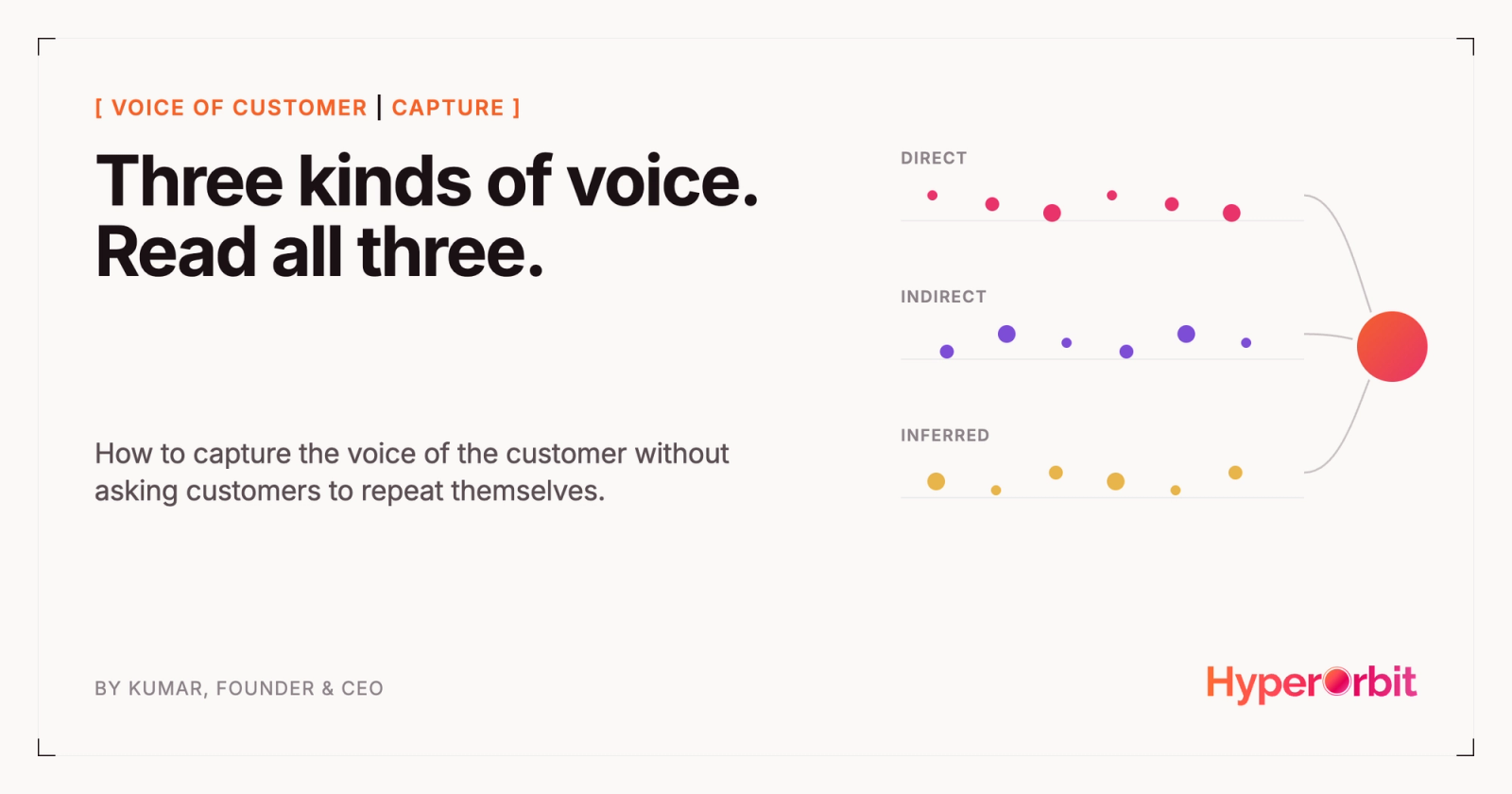
There are three kinds of customer voice. Direct is what customers tell you when asked: surveys, interviews, feedback forms. Indirect is what they say about you without being asked: reviews, social threads, support tickets, sales calls. Inferred is what they do: usage, support volume, renewal behaviour, the champion who stopped logging in. Most programmes invest heavily in the first, read the second when someone has time, and leave the third to a dashboard nobody opens.
That is backwards. Direct feedback is the smallest of the three and the only one that costs the customer effort. This guide is about capturing all three without asking customers to repeat themselves, and about what capture means once the voice is mostly unprompted.
Direct: ask less, ask better
Surveys and interviews keep their place for the questions nothing else answers: why a customer chose you, what they expected, what they would pay for. Two rules keep them useful. Ask only what the unprompted sources cannot tell you, so every question earns its place. And read the answers with the same tools as everything else, so a survey comment lands in the same theme as the ticket that said the same thing.
Indirect: the voice you already have
This is where most of the signal is. Support tickets record what breaks and what customers work around, attached to a named account. Reviews on G2, Capterra and the app stores carry positioning and feature gaps in the customer's own words. Sales and success calls hold pre-purchase pain, competitor mentions and renewal objections, recorded and transcribed already. Community threads surface issues weeks before a ticket does.
Capturing indirect voice means connecting, not asking. Each of HyperOrbit's 76 connectors connects once over OAuth, usually in five to ten minutes, and is read continuously from then on; the connector guides show how to mine Gong or Zendesk by hand if you want to see the shape of the signal first. For a quick read of one source, the free Feedback Analyzer Chrome extension turns a page of reviews into themes in a click.
Inferred: what customers do
Usage falling, tickets rising, a champion gone quiet, a renewal window opening: none of this is said, and all of it is voice. Inferred signal is the earliest warning you get and the hardest to read by hand, because it lives in product analytics, the helpdesk and the CRM at once. Atlas, in beta, fuses feedback, usage, support and CRM into one health score per account, watches every renewal window you set, and says why a score moved: renewal in 84 days, usage down 31%, champion gone quiet.
Capture is a reading problem
Once the three kinds are flowing, capture is finished and the real work starts. Three things have to happen for the captured voice to be worth anything.
One customer, one record. The ticket, the review, the call and the usage drop from the same account must resolve to one account, or the voice is four unrelated fragments and revenue cannot be attached to any of them.
Themes by intent, with the source. Chorus reads every record nightly and groups by what customers are trying to do, so a hundred pieces of feedback become eight themes and thirty-five sub-themes, each line citing the review, ticket or call it came from. A model that says "negative" with nothing behind it has not captured anything.
Ranked by what it is worth. Each theme carries the ARR of the accounts behind it and how close they are to renewal. That is what makes a captured voice a priority rather than a count.
Ask only what you cannot read. Read everything customers already say and do. Resolve it to one record per account before you count anything.
Personal data comes in with the voice
Tickets and transcripts carry names, emails and sometimes payment details customers pasted in. Capture without redaction is a security review waiting to happen. Personal data should be redacted before it is stored or analysed, connections should ask for read-only scopes where read is all they need, and you should be able to disconnect a source and remove its data cleanly. Our commitments are on the trust and compliance page.
Six steps to capture all three
- List where customers already talk and what they already do: helpdesk, call recorder, review sites, community, product analytics, CRM.
- Connect those sources first. Add a survey only for a question none of them can answer.
- Resolve every record to an account, and join the CRM for plan, ARR and renewal date.
- Read nightly, by intent, with every line sourced and sentiment scored per aspect.
- Watch the inferred signals per account, and let a risk score explain itself.
- Route what needs a person to an owner, in the channel they work in, before the next touchpoint.
The programme that captures all three kinds of voice hears a customer three times, in three languages, and reads them as one. The programme that only asks hears the customer once, when they were polite enough to answer. Starter runs the read on one feedback source and one competitor source at no cost if you want to hear the difference on your own data.
Frequently asked questions
What are the three kinds of voice of the customer?
Direct, what customers say when asked in surveys and interviews; indirect, what they say unprompted in reviews, tickets, calls and community threads; and inferred, what they do, such as usage falling, tickets rising or a champion going quiet.
How do you capture indirect voice of the customer?
By connecting the sources where customers already talk, such as the helpdesk, call recorder and review sites, and reading them continuously, rather than by asking. Each source connects once and the read runs nightly.
What is inferred customer feedback?
Signal in what customers do rather than say: product usage, support volume, renewal behaviour and champion activity. It is the earliest warning of churn and is best read as one health score per account with the reasons attached.
How should personal data in customer feedback be handled?
Redacted before it is stored or analysed, with read-only access to sources wherever read is enough, and with the ability to disconnect a source and remove its data cleanly.