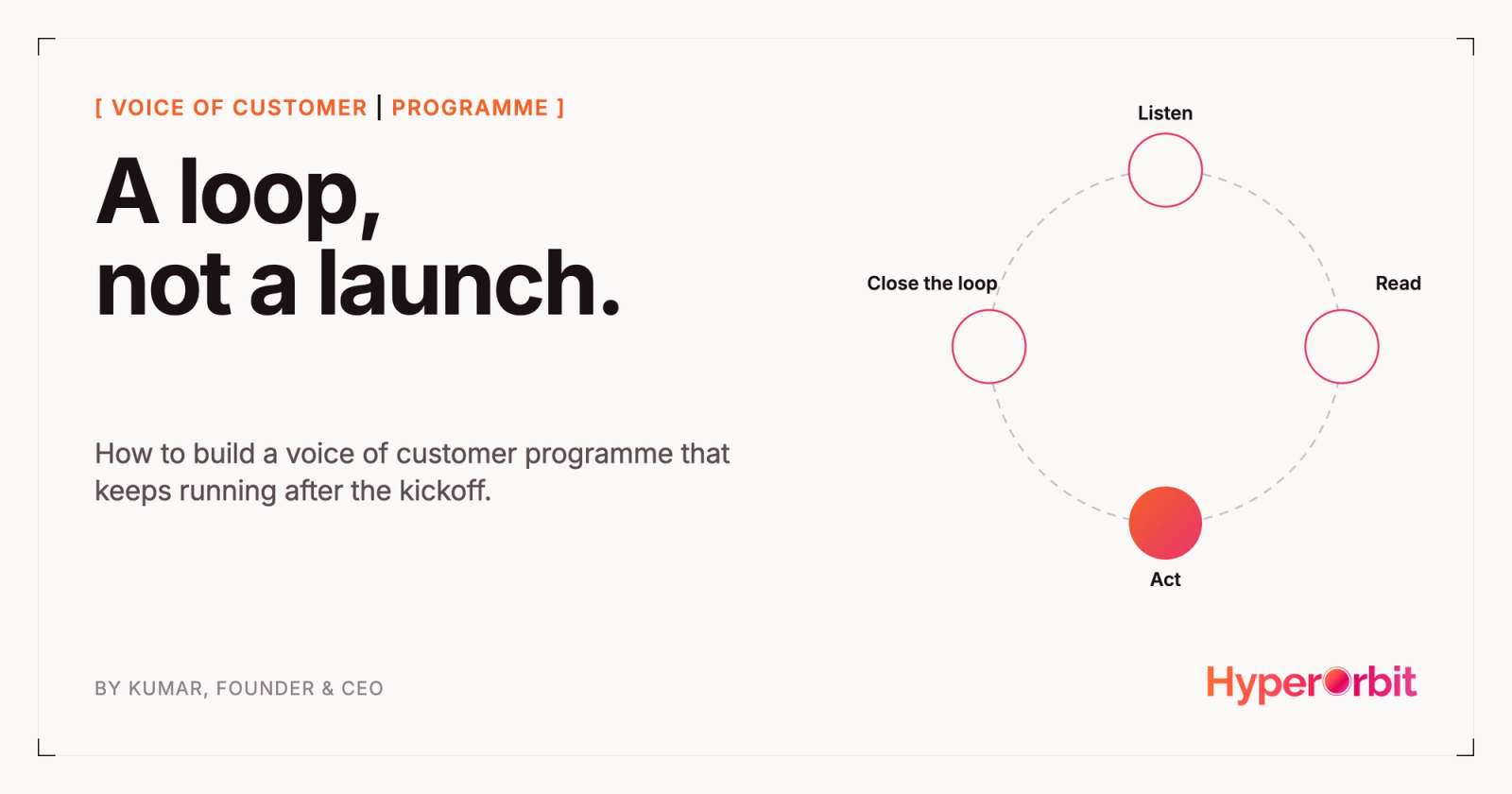
A voice of customer programme is easy to launch and hard to keep. The launch has a sponsor, a kickoff, a survey and a dashboard. Six months later the survey has a falling response rate, the dashboard has a stale date, and the sponsor has a new priority. What went wrong is usually not the tools. It is that the programme was built as a launch, a sequence of steps that ends, rather than as a loop that keeps running without anyone remembering to run it.
This guide is the standard eight-step programme with that correction applied. The steps are the same ones every guide lists. The order and the emphasis are different, because the aim is a programme that is still alive next year.
What a voice of customer programme is
The systematic capture, reading and use of what customers say about your product, across every channel they say it in, to make decisions that change what they experience next. Two words carry the weight: systematic, meaning it runs on a cadence with owners; and use, meaning a programme that only reports is not one.
Step one: decide which decisions it will change
Most programmes start with objectives such as "improve satisfaction". Start instead with the decisions: which roadmap items, which renewal plays, which pricing and packaging calls, which competitive responses. Write them down. A programme that knows which decisions it feeds can be measured; one that aims at satisfaction can only be surveyed.
Step two: find the touchpoints you already have
The usual advice is to map the customer journey and place a survey at each stage. Map the journey, but before adding a single question, list where customers already talk: support tickets, sales and success calls, reviews on G2 and the app stores, community threads, churn reasons, usage data. Most companies find that the unprompted sources cover more of the journey than any survey plan would, at no cost to the customer's patience.
Step three: connect before you design
Tools come third, and the tool question is mostly a connection question: can the programme read those sources without an integration project for each one? Each of HyperOrbit's 76 connectors connects once over OAuth and is read continuously; anything not listed comes in by webhook or CSV. Surveys and interviews keep their place for the questions the unprompted sources cannot answer.
Step four: read, do not sample
Analysis in most programmes means an analyst, a sample and a tag list. The loop needs a read that covers everything and runs on its own. Chorus groups feedback into themes by intent, scores sentiment per aspect, joins each theme to the accounts and ARR behind it, and cites the record for every line. Segment by plan, role and region before deciding anything, or the contradictions cancel out.
Step five: rank by what it is worth
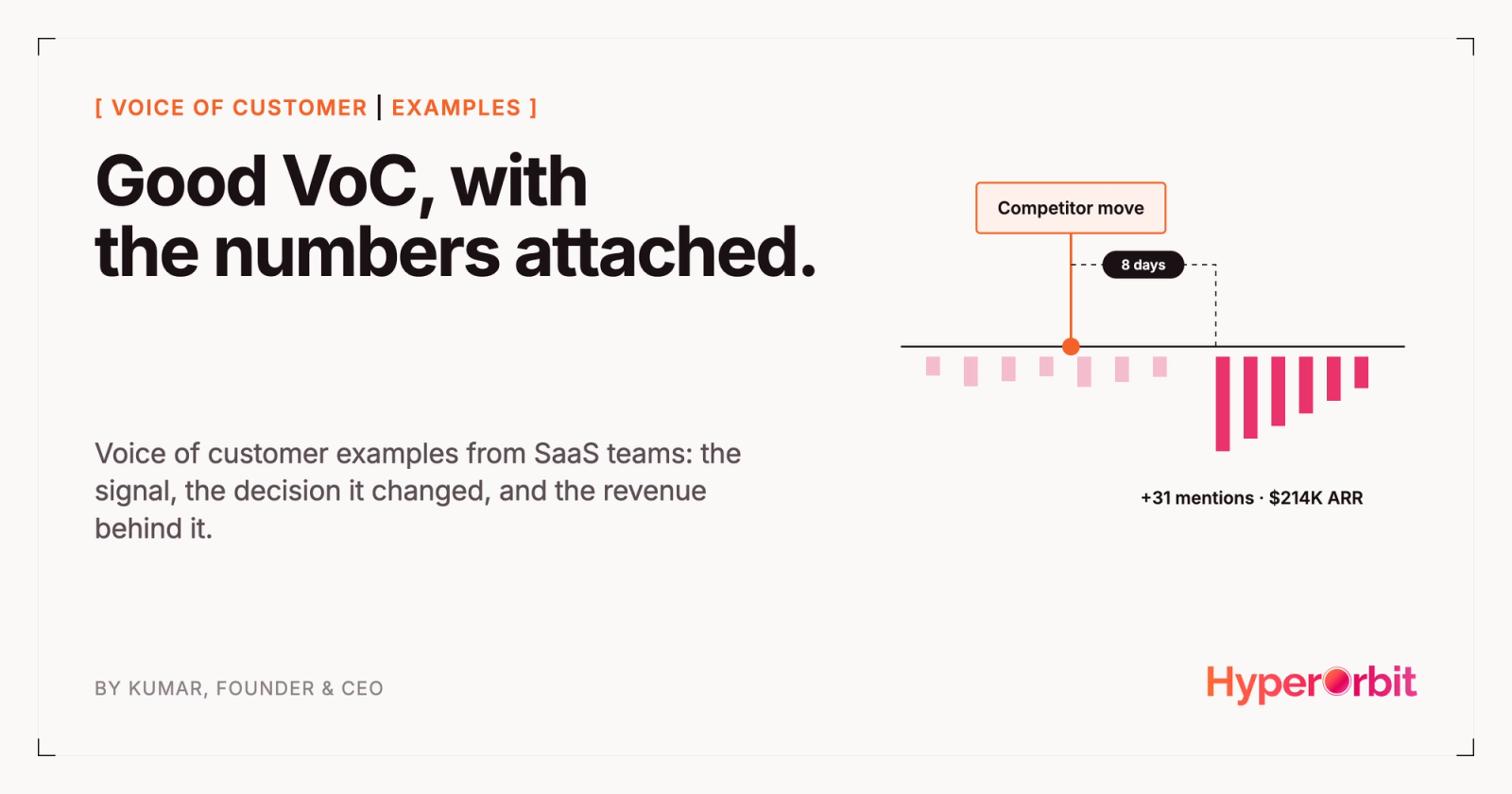
Prioritise by impact, the guides say, and then measure impact as mention counts. Measure it as revenue: the ARR behind a theme and how close those accounts are to renewal. Add the cause. A rise in pricing complaints means something different when a competitor cut its price eight days earlier, which is what Cause and Effect is for.
Step six: give every theme an owner
This is the step that turns a launch into a loop. Assign responsibilities, the guides say, and they mean a RACI for the programme. Assign an owner per theme instead, with the action and a date, in the tool the owner already works in. In the Signal Desk anything that needs a person lands with an owner, a cause and the action; Enterprise delivers into Slack, Jira, HubSpot, Intercom or Zendesk. Hold the judgement calls for a person and let the routine ones run: the autonomy modes are set per agent.
Step seven: close the loop with the customer
Tell customers what changed because of what they said. It is the cheapest retention work there is and the step most programmes skip. Track it as a rate: the share of accounts whose feedback led to an action that were told about it.
Step eight: measure decisions, then iterate
Monitor and iterate, the guides say, and they mean re-run the survey. Measure the programme by the decisions it changed and the renewals it kept: ARR touched by acted-on themes, renewals kept in windows where a risk signal surfaced, roadmap items with revenue attached. Atlas, in beta, watches the renewal windows and explains why an account's score moved, so the denominator is known. Iterate on the sources and the owners, not the questionnaire.
Listen everywhere customers already talk. Read all of it, every night. Rank by revenue. Give every theme an owner. Tell the customer. Measure the decisions. Repeat without anyone having to remember.
The five problems every programme meets
- Low response rates. Stop depending on responses. Read the sources that need no question asked, and keep surveys for what only a question can find.
- Too much data. A person cannot read it all, and should not try. The read is the agent's job; the decision is the person's.
- Silos. Support, product, sales and success each hold a piece of the same customer. One signal layer with identity resolution is the fix, not another meeting.
- No action. A theme without an owner is a report. Owner per theme, with a date.
- Bias. The loudest segment is rarely the most valuable. Weight by revenue and segment, and read unprompted sources so the vocal minority is not the whole sample.
Where to start
The VoC maturity assessment places your programme in a few minutes. The customer brain guide is the longer read on what the loop looks like inside a company. And Starter runs Chorus on one feedback source and Recon on one competitor source at no cost, which is enough to run the loop once, end to end, before any budget is committed.
Frequently asked questions
What is a voice of customer programme?
The systematic capture, reading and use of what customers say about your product across every channel, to make decisions that change what they experience next. Systematic means it runs on a cadence with owners; use means a programme that only reports is not one.
What are the steps to build a voice of customer programme?
Decide which decisions it will change; find the touchpoints where customers already talk; connect those sources; read everything rather than sampling; rank themes by revenue with the cause attached; give every theme an owner; close the loop with the customer; measure decisions changed and iterate.
How do you keep a VoC programme running after launch?
Build it as a loop: unprompted sources read nightly so nothing depends on a survey being sent, an owner on every theme so nothing depends on a meeting, and a measure in revenue so the sponsor keeps caring.
How should a voice of customer programme be measured?
By the decisions it changed and the renewals it kept: ARR touched by themes that reached an owner and became an action, renewals kept in windows where a risk signal surfaced, and roadmap items with revenue attached.