Most lists of voice of customer examples read the same way: a company sent a survey, the score went up, a logo is attached. They tell you that listening is good. They do not show you the shape of good listening: what the signal was, where it came from, what decision it changed and what revenue was behind it.
This post takes the opposite approach. Below are five patterns we see in programmes that work, each with a worked example. The examples are the illustrations from our own methodology page and product pages, so every figure is defined and the shape is the point, not the logo. Use them as templates for what your own examples should look like when you write them up. We also keep a separate list of twelve voice of customer examples from real SaaS teams, each tied to a public source.
Pattern one: the competitor move, and the reaction it caused
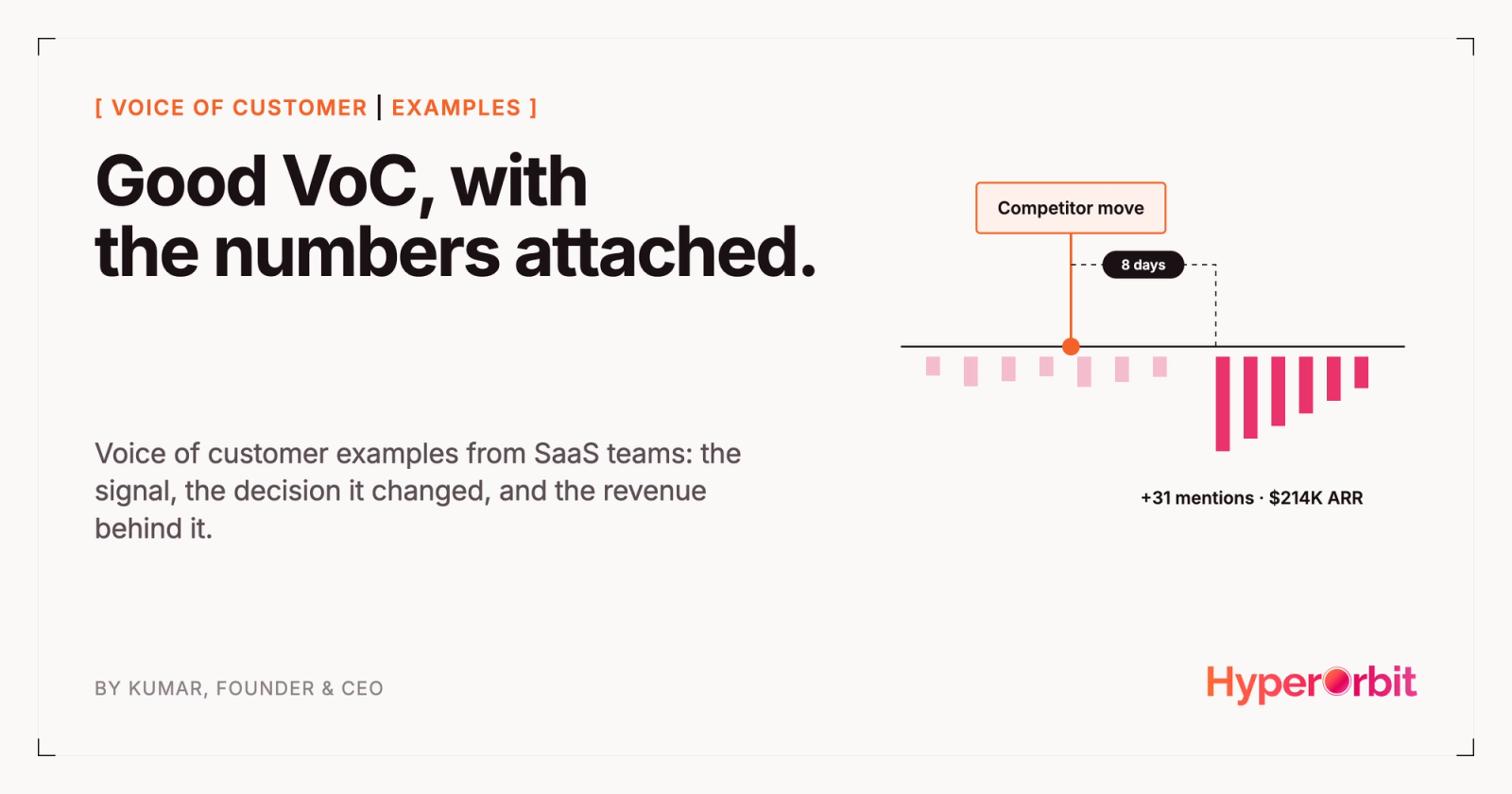
The signal. A competitor launches a free tier on 22 May. Eight days later, pricing complaints in the customer feedback are up by 31 mentions, across accounts worth $214K of ARR, with the link between the two scored at 68% confidence.
What changed. Pricing objections stopped being "a trend or a Tuesday" and became a dated response to a dated move, with the exposed accounts named. Product marketing had a counter to draft and revenue had a list of accounts to call before the objection came up on its own.
What to copy. Put competitor moves and customer reactions on one clock, and measure the lag. Cause and Effect does this continuously; a spreadsheet can do it once. Either way, a reaction with a cause is a decision, and a reaction without one is a mood.
Pattern two: a pile becomes a ranked list
The signal. A hundred pieces of feedback, from reviews, calls and tickets, become eight themes and thirty-five sub-themes, each with a mention count, the quotes behind it, and the ARR of the accounts that raised it.
What changed. The roadmap review started from a list ranked by what each theme was worth rather than by who had escalated most recently. Two themes near the top by revenue were near the bottom by volume; they came from a few large accounts close to renewal.
What to copy. Group by intent, not keyword, and join every theme to the CRM before ranking. Chorus runs this read nightly. If you do it by hand, do it on a month of feedback, once, and see how far the volume ranking is from the revenue ranking. That gap is your argument.
Pattern three: the renewal that looked fine at the QBR
The signal. An account is healthy at the quarterly review. Then seven tickets and one G2 review land in a few weeks, usage drops, and the champion goes quiet, with the renewal inside ninety days.
What changed. The account owner got the account's own voice, resolved into one record, with why the health score moved and a recommended play, before the renewal call rather than after the churn notice.
What to copy. Resolve identity across tickets, calls and reviews so an account's feedback is one record, and watch renewal windows continuously. Atlas, in beta, fuses feedback, usage, support and CRM into one score per account and explains each move. The customer success page shows the morning list this produces.
Pattern four: a competitor move becomes a battlecard before the deal
The signal. A competitor ships a free small-team tier in two of your core markets. It is detected the morning it lands, scored by the pressure it puts on you rather than the size of the announcement, and a counter is drafted with the evidence and a confidence score, held for review.
What changed. The reps met the move in the deal review with the counter already drafted, and the accounts most exposed to it were named, with their ARR.
What to copy. Score moves by pressure, attach the exposed accounts, and draft the counter for review rather than publishing a generic card. Recon sweeps competitor sites, changelogs, pricing pages and reviews daily; the revenue team page shows how it reads before a deal review.
Pattern five: praise becomes proof
The signal. The same read that finds complaints finds what customers love, by theme, with the quotes and the accounts attached.
What changed. Marketing stopped hunting for testimonials and started from a ranked list of what customers already say works, then asked the right accounts for consent to use it. Sales got the themes to lead with by segment.
What to copy. Read praise with the same rigour as complaints. Keep the two halves apart in use: signal prepares the team, and only consented proof is shown to buyers.
A good voice of customer example names the signal, its source, the decision it changed and the revenue behind it. If a write-up has a score and a logo but none of those, it is a testimonial, not an example.
Writing up your own
When you document a win from your programme, use the same four lines: the signal and where it came from; what changed; what it was worth; and what the team would do again. Keep the figures to ones you can define and check, the way our methodology page defines every number on this site. Then the examples do double duty: they prove the programme internally and they teach the next team what to look for.
If you want to see the first three patterns on your own feedback, Starter runs Chorus on one feedback source and Recon on one competitor source at no cost, and the first pass lands the same day you connect.
Frequently asked questions
What makes a good voice of customer example?
It names the signal and where it came from, the decision it changed, and the revenue behind it, with figures that can be defined and checked. A score and a logo without those is a testimonial.
Can you give a voice of customer example with numbers?
A competitor launches a free tier on 22 May; eight days later pricing complaints are up by 31 mentions across accounts worth $214K of ARR, with the link scored at 68% confidence. That is the worked example from HyperOrbit's methodology page, and it names the signal, the cause, the lag and the revenue.
How should we document our own VoC wins?
In four lines: the signal and its source, what changed, what it was worth, and what the team would do again. Keep the figures to ones you can define and check.
Do these examples come from named customers?
No. They are the defined illustrations on HyperOrbit's methodology and product pages, used because every figure in them is documented. The patterns are what to copy.