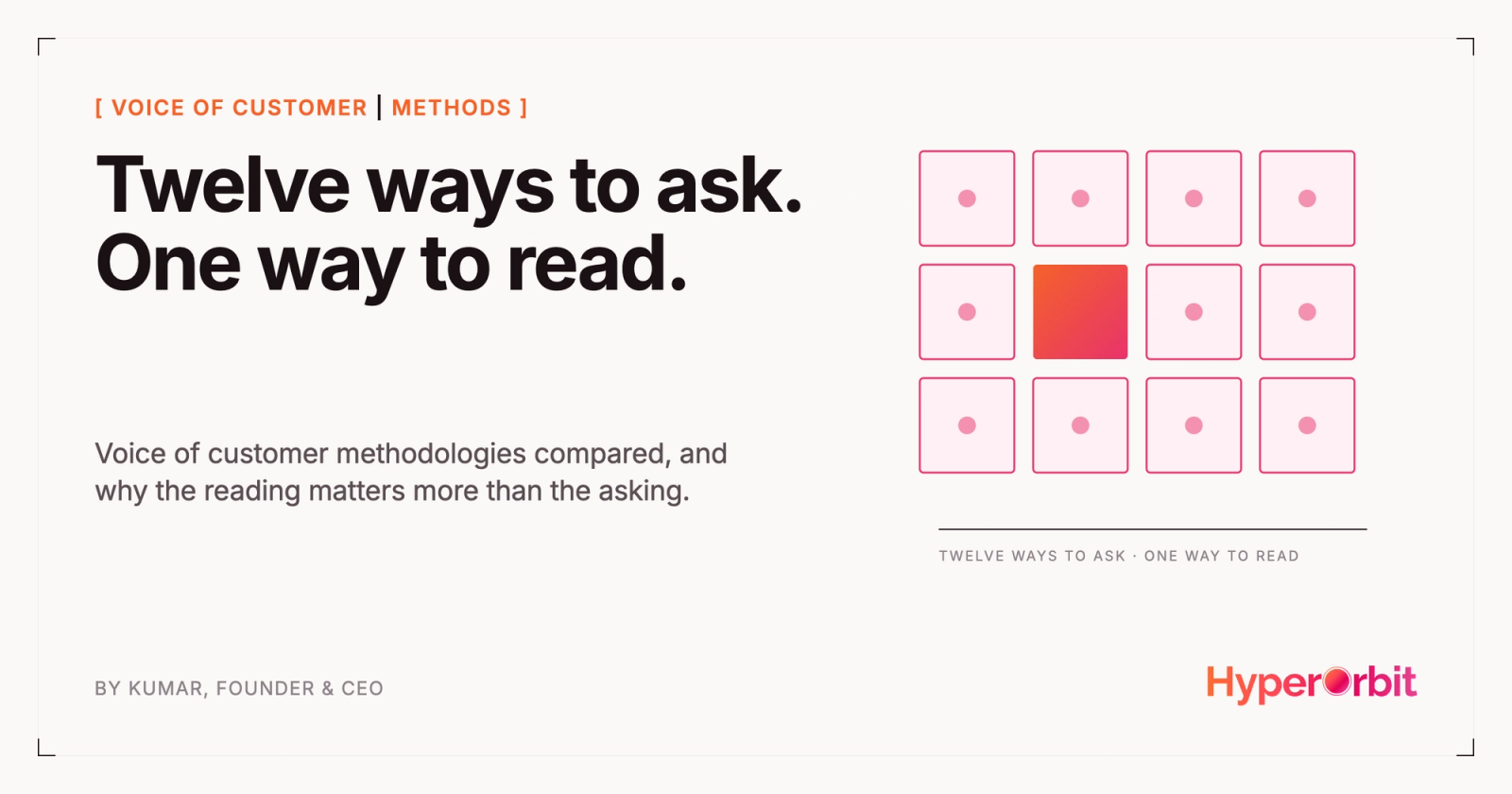
Lists of voice of customer methodologies tend to run to a dozen: interviews, surveys, NPS, focus groups, feedback forms, chatbots, email, in-person questions, reviews, social media, recorded calls, website behaviour. They are presented as a menu, and the advice is to use several. That is fine as far as it goes. What the lists miss is that the twelve are not twelve jobs. They are twelve ways to get feedback in, and one job after that, which is reading it well.
This guide sorts the twelve into the two groups that matter, says what each is for, and then spends its time on the part the lists skip.
Eight ways of asking
Customer interviews. The deepest source and the least scalable. Best used to go further into a theme you have already found, not to find themes.
Surveys. Scalable and trendable, and the only source where you pick the question. Response rates fall every year, so every question has to earn its place.
NPS. One question, a clean trend line, and a comment box that is often worth more than the score. Read the comments with the same tools as the rest of the feedback.
Focus groups. Useful for reaction to something new, expensive to run, and prone to the loudest voice in the room, which is the same problem as ranking feedback by volume.
Feedback forms and in-app prompts. Always available, low volume, high intent. Good for the moment something breaks.
Chatbots. Conversational capture at the point of need; the transcript is the feedback, and it should be read like a ticket.
Email. Personal, slow, and best for a specific question to a specific account.
In-person. Events and visits. Rich, rare, and hard to attribute unless someone writes it down the same day.
Four ways of listening
Reviews. G2, Capterra, the app stores: public, unprompted, in the customer's words, and full of competitor comparisons.
Social and community. The earliest signal on an emerging issue and the hardest to attribute to an account.
Recorded calls. Sales, success and support calls, transcribed already. The most under-read source in B2B: pain, competitors, decision criteria and renewal objections, all attached to a named account.
Behaviour. What customers do in the product: usage, feature adoption, the path they take before they leave. Not words, but voice.
The first eight sample. The last four are continuous, and they cover more of the customer's experience than any survey plan, at no cost to the customer's patience. A programme that uses several methodologies should start with the four it already has.
Asking gives you the answers to your questions. Listening gives you the questions you did not know to ask. Most programmes are built on the first and starve the second.
The one job after the twelve
However feedback arrives, the same four things have to happen to it before it is worth anything. This is where methodology lists stop and where the work actually is.
Resolve it to an account. The interview answer, the review and the call from the same customer are one voice. Until they are one record, no revenue can be attached and the ranking is by volume.
Group by intent. Customers ask for the same thing in fifty ways. Chorus reads every record and groups by what customers are trying to do: a hundred pieces of feedback become eight themes and thirty-five sub-themes, with a mention count and the quotes behind each, and a new theme surfaces itself when customers start talking about something new.
Score sentiment per aspect, with the source. One score per record hides that a customer loves the reporting and hates the exports. Every line should link to the review, ticket or call it came from, and carry a confidence.
Rank by what it is worth. Each theme carries the ARR of the accounts behind it and how close they are to renewal. That is what turns a theme list from any of the twelve methods into a priority list.
The seven questions your feedback already answers
The classic voice of customer questionnaire asks what customers look for in a provider, what matters most when they choose, what comes to mind about your brand, how you could improve, which competitor they would consider and why, whether they would recommend you, and where they bought last. Ask them if you like. But a continuous read of reviews, calls and tickets answers most of them without a questionnaire, for every account rather than the ones who replied, and it answers the competitor question with the competitor's actual moves on the same timeline as the customer's reaction, which is what Cause and Effect is for.
Trying the read before choosing methods
If you want to see what reading well looks like on one method before building a programme around twelve, three free tools do it by hand. The App Review Analyzer reads a set of app store reviews into a deck in about a minute. The Chrome extensions read a page of reviews or a Reddit thread for themes and buying signals. The Claude Skills turn pasted feedback into themes and priorities inside Claude. The agents do the same job across every source, every night, with the revenue attached; Starter runs that on one feedback source at no cost.
Choose methods by what they add that the listening sources cannot. Then spend the budget on the reading, because that is the part every method shares.
Frequently asked questions
What are the main voice of customer methodologies?
Interviews, surveys, NPS, focus groups, feedback forms, chatbots, email and in-person questions, which ask; and reviews, social and community, recorded calls and product behaviour, which listen. The asking methods sample; the listening methods run continuously.
Which voice of customer method should we start with?
The listening sources you already have: support tickets, recorded calls, reviews and product usage. They cover more of the customer's experience than a survey plan and cost the customer nothing. Add asking methods for the questions they cannot answer.
Do we still need surveys and interviews?
Yes, for the questions no unprompted source answers: why a customer chose you, what they expected, what they would pay for. Keep every question to one that earns its place, and read the answers with the same tools as the rest.
What happens to feedback after it is collected?
Whatever the method, it has to be resolved to an account, grouped into themes by intent, scored for sentiment per aspect with each line citing its source, and ranked by the ARR and renewal proximity of the accounts behind it.