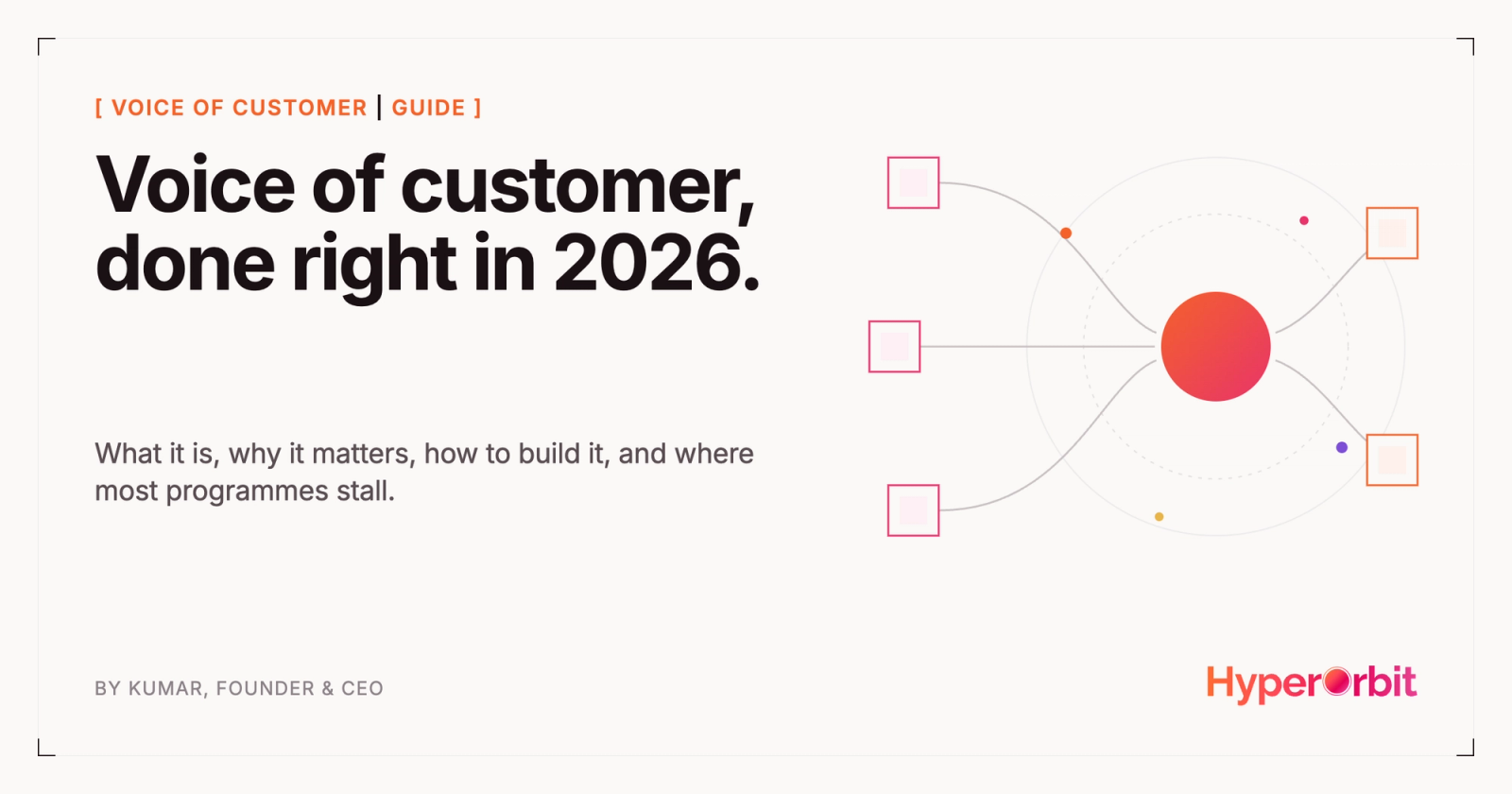
Voice of the customer is the practice of capturing what customers say and do about your product, reading it well, and acting on it. The definition has been stable for twenty years. What has changed is the economics: the saying now happens mostly without being asked, and the reading can run every night rather than every quarter. This guide is the whole practice, in the order you would build it, with the parts that changed marked.
What voice of the customer is
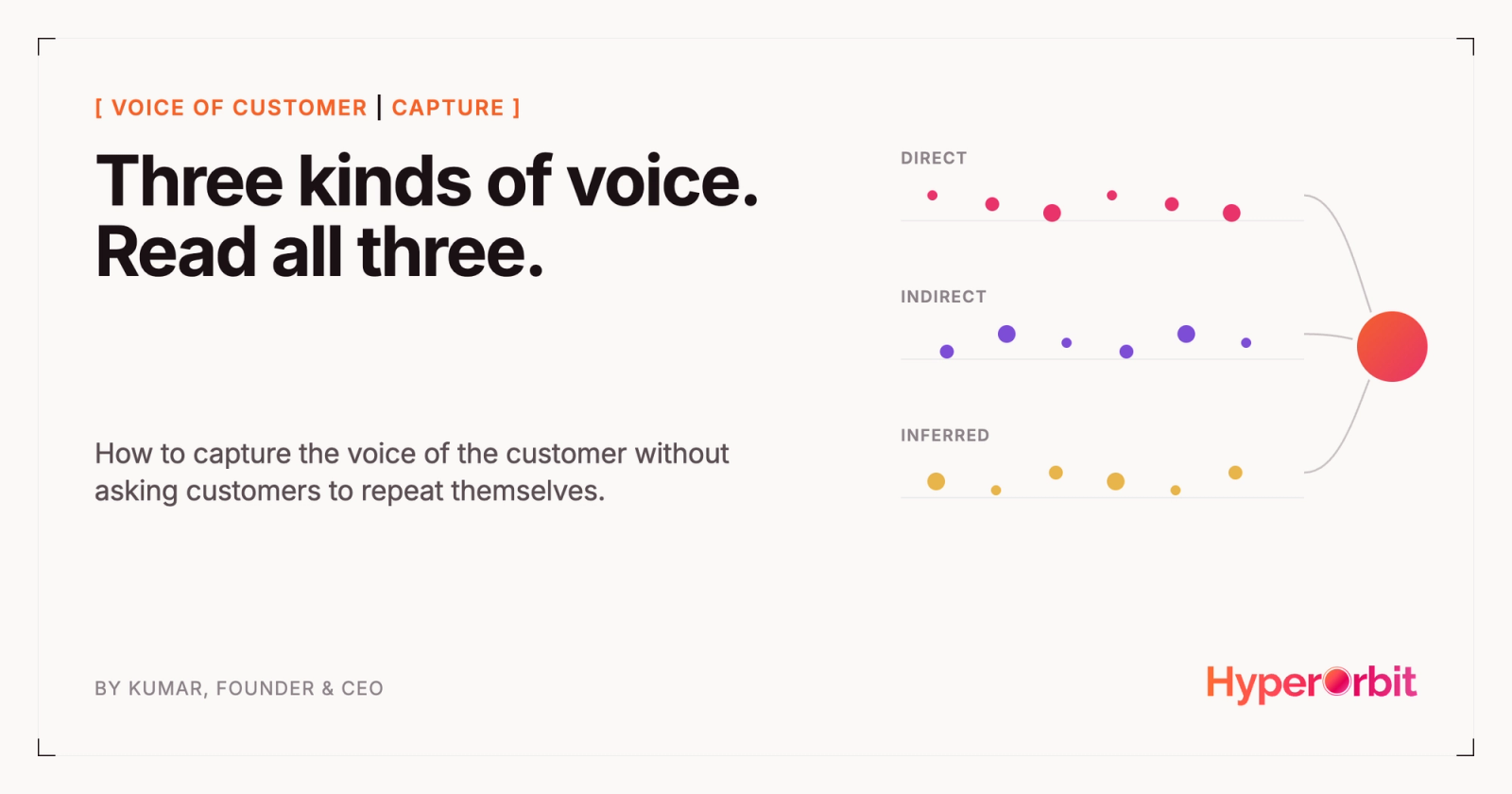
Three kinds of voice, read as one. Direct: what customers tell you when asked, in surveys and interviews. Indirect: what they say unprompted, in tickets, reviews, calls and community threads. Inferred: what they do, in usage, support volume and renewal behaviour. A programme that only asks hears the customer once, when they were polite enough to answer.
Why it matters
- Churn arrives in the feedback first. The account that looked fine at the quarterly review had seven tickets and a review between then and the renewal. Reading them in time is the cheapest retention work there is.
- The roadmap has an argument to settle. Volume, escalation and seniority decide priorities when feedback is scattered. A theme with the accounts and ARR behind it settles the argument with a number.
- Competitors move, and customers react. A pricing change across the market shows up in your tickets within days. Reading the reaction with the cause attached is how you answer before the deal.
- Proof comes from the same place. What customers love, by theme, with quotes, is the raw material for sales and marketing, once consent is on record.
How to build it, in seven steps
1. Decide which decisions it feeds. Roadmap items, renewal plays, pricing calls, competitive responses. A programme aimed at satisfaction can only be surveyed; one aimed at decisions can be measured.
2. Map where customers already talk. Helpdesk, call recorder, review sites, community, product analytics, CRM. List them before adding a single survey question.
3. Connect, then ask. Each source connects once and is read from then on. HyperOrbit lists 76 connectors across calls, chat, contact centre, CRM, support, reviews, social, surveys, product analytics, project tools and data pipes, plus webhook and CSV for anything else. Keep surveys and interviews for what the connected sources cannot answer.
4. Resolve one customer to one record. The ticket, the review and the call from one account are one voice. Join the CRM for plan, ARR and renewal date.
5. Read by intent, ranked by worth. Chorus groups a hundred pieces of feedback into eight themes and thirty-five sub-themes, scores sentiment per aspect, cites the source for every line, and ranks each theme by the ARR it touches and how near those accounts are to renewal. Add the cause: Cause and Effect shows competitor moves above the timeline and customer reactions below it, with the lag measured.
6. Give every theme an owner. In the Signal Desk anything that needs a person lands with an owner, a cause and the action, delivered where they work. Hold the judgement calls for a person and let the routine ones run; the autonomy modes are set per agent.
7. Measure decisions, and tell the customer. ARR touched by acted-on themes, renewals kept in watched windows, roadmap items with revenue attached. Then close the loop: tell accounts what changed because of what they said.
If your programme disappeared tomorrow, which decision would be made differently next week? If the answer is none, it is a reporting function.
Channels, and what each is for
- Support tickets record what breaks and what customers work around, attached to a named account.
- Sales and success calls hold pain, competitors, decision criteria and renewal objections, transcribed already.
- Reviews on G2, Capterra and the app stores carry positioning and feature gaps in the customer's words.
- Community and social surface issues weeks before a ticket does.
- Product usage is the earliest churn warning, best read as one health score per account; Atlas, in beta, does that fusing and explains each move.
- Surveys and interviews answer the questions none of the above can: why they chose you, what they expected, what they would pay.
Seeing it: ask, do not browse
The traditional answer to visualisation is a role-based dashboard per team. Dashboards answer the questions someone thought to ask when they built them. The better pattern is a place to ask: in the Signal Desk any question, from "what are enterprise accounts in Europe saying about the API since the release" to "which accounts did last week's competitor move touch", is routed across every agent and answered with the signals cited. Keep a dashboard for the trend lines; make the questions conversational.
Where programmes stall, and the fix
- Low response rates. Stop depending on responses. Read the unprompted sources and ask only what they cannot answer.
- Too much data. The read is the agent's job, every night. The decision is the person's.
- Silos. Support, product, sales and success hold pieces of the same customer. One signal layer with identity resolution, not another meeting.
- No action. A theme without an owner is a report. Owner per theme, with a date.
- Inconsistent metrics. Define every figure the way our methodology page does: what it measures, from which records, how to check it.
- Tool sprawl. One read across every source beats a tool per channel. Check that the connectors exist before you buy, and that setup is minutes, not a project.
Where to start
The VoC maturity assessment places your programme in a few minutes, and the customer brain guide is the longer read on what a company looks like when this runs. If you would rather see the read than read about it, Starter runs Chorus on one feedback source and Recon on one competitor source at no cost, with the first pass landing the same day you connect. We also wrote separate guides on the features to look for in voice of customer software and on what easy integration really means.
Frequently asked questions
What is voice of the customer?
The practice of capturing what customers say and do about your product, across direct (asked), indirect (unprompted) and inferred (behavioural) channels, reading it well, and acting on it.
Why does voice of the customer matter?
Churn shows up in feedback before it shows up in revenue; roadmap arguments need the accounts and ARR behind a theme to settle; competitor moves show up as customer reactions within days; and the same read that finds complaints finds the proof sales and marketing need.
How do you build a voice of customer programme?
Decide which decisions it feeds, map where customers already talk, connect those sources before designing surveys, resolve each customer to one record, read by intent and rank by revenue, give every theme an owner, and measure decisions changed while telling customers what changed.
What is the biggest mistake in voice of customer programmes?
Collecting without acting. A programme whose themes have no owners and whose success is a satisfaction score is a reporting function. Owner per theme, measured in decisions and renewals, is the fix.