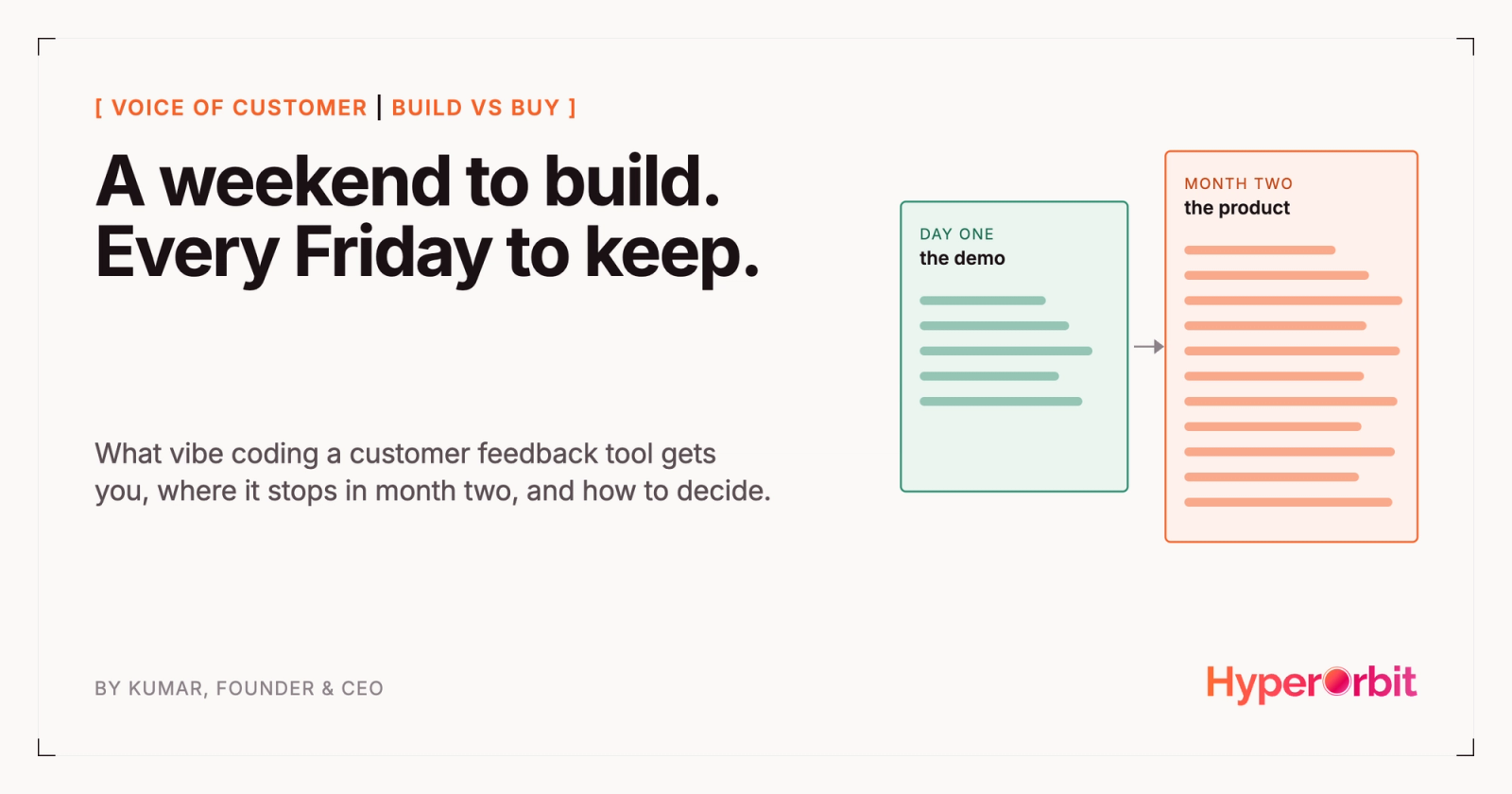
A product manager with Claude Code, Cursor or Lovable can now build a working customer feedback analyser in an afternoon. Pull a month of Zendesk tickets, hand each one to a model, cluster the summaries into themes, count them, put a chart on top. It works. It is often better than the spreadsheet it replaces, and it costs a weekend and some tokens.
So the build-versus-buy question for voice of customer tools has changed shape. It used to be "can we build this?" and the honest answer was no. Now the answer is yes, and the question that matters is whether the thing you can build in a weekend is the thing you need in month two. We build this category for a living, so read what follows with that in mind. We have also tried to be fair to the weekend build, because we ship a few of them ourselves.
What vibe coding gets right
Speed and zero procurement. No vendor calls, no security questionnaire, no budget line. You have themes from your own feedback before a vendor would have sent the deck.
Your taxonomy from day one. You name the themes in the words your team already uses. No tool to configure, no fixed tag list to fight.
You learn what good looks like. Reading a hundred tickets through a model teaches you what a theme is, where the model over-reaches, and what you actually want to know. That makes you a much sharper buyer later, if you buy at all.
Some jobs are only ever this big. A one-off read of last quarter's churn survey, a hackathon, a founder wanting to know what the first hundred customers said. The demo is the product. We publish tools for exactly this: the App Review Analyzer reads a set of app reviews into a deck in about a minute, the Chrome extensions read a page of feedback by hand, and the Claude Skills turn pasted feedback into themes and priorities inside Claude. All free, and all deliberately the weekend version.
Where the weekend build stops
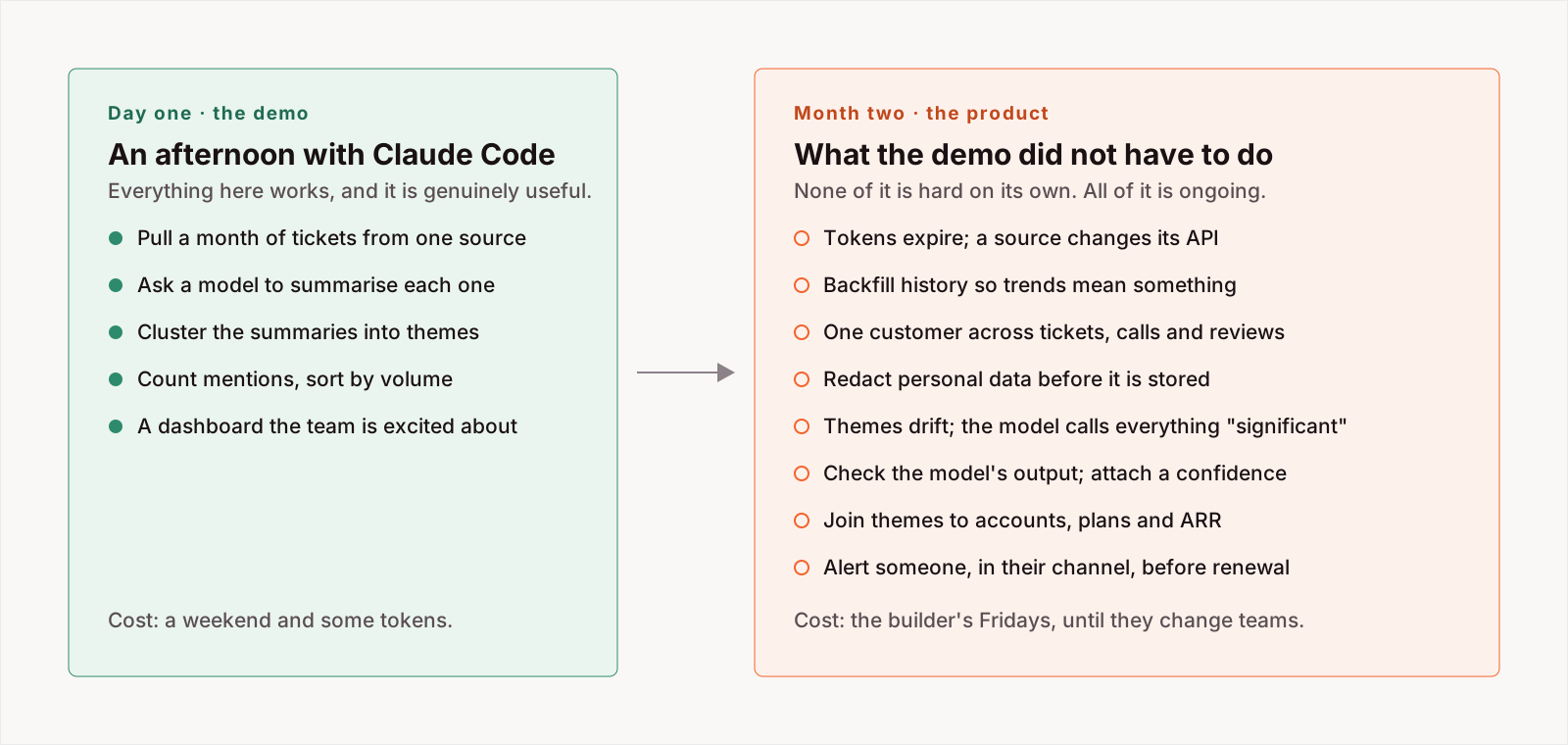
The demo is the easy half. Everything below is what a customer feedback tool has to do from the second month on, and none of it shows up in the first afternoon.
The connectors are the product
One source over a personal API token is a script. Six sources with OAuth, rate limits, pagination, changed fields and tokens that expire on a Sunday is an integration team. This is the part every DIY tool underestimates, and it is why most of them stay at one source forever. We wrote about what easy integration really means for the buy side; the same list applies to the build side, except you are the vendor.
One customer, many voices
The person who filed the ticket, left the review and complained on the renewal call is one account. A weekend build sees three unrelated records. Without identity resolution you cannot attach revenue to a theme, and without revenue the theme list is ranked by who talks most, which is rarely who pays most.
Personal data goes in with the feedback
Tickets carry names, emails and sometimes card numbers pasted by customers. The demo stored all of that in a database nobody reviewed. Redaction before storage, access control, retention and deletion are the questions your security team will ask the moment the tool matters, and answering them well is a project of its own.
The model needs supervising
Left alone, a summariser drifts. Themes split and merge between runs, and a prompt that was tuned in June calls every ticket "urgent" by September. A real tool checks its own output, attaches a confidence to each theme, and stays consistent as the product changes. Getting from "the model said so" to "here are the sources and the confidence" is most of the work. Our methodology page shows what that looks like for the figures on this site.
Nobody owns Friday
Every DIY tool has one owner, and the owner has another job. The tool is excellent until the owner is promoted, leaves, or simply stops having Fridays. Then the dashboard is stale, nobody trusts it, and the team is back to reading tickets, which is where the weekend build usually ends.
If the demo went away tomorrow, what would break? If the answer is "nothing, we would rebuild it", build. If the answer is "the roadmap review and two renewals", buy.
When to build
- One source, one team, one owner with time, and no need for revenue context.
- A one-off read: a survey, a launch, a quarter of churn reasons.
- You want to learn the shape of your feedback before committing budget.
- Security is not yet a question, because the data is already in a system you control and nobody outside the team will see the output.
When to buy
- More than two sources, or any source where the same customer shows up twice.
- Someone asks "how much ARR is behind this theme?" and expects an answer.
- A renewal, a roadmap review or a pricing decision depends on the read being right and current.
- The output goes to people outside the team that built it, so it has to be trusted without the builder in the room.
The middle path
Build the probe. Spend the weekend, learn your taxonomy, find out which questions your team actually asks. Then run the probe beside a free read on the same source. HyperOrbit's Starter plan puts Chorus on one feedback source at no cost, with 50 signals and 10 insights a month, so the comparison costs nothing but the connection. If the weekend build keeps up, keep it. If Chorus finds themes yours missed, ranks them by the ARR behind them and cites the source for every line, you have your answer, and you have learned enough to hold any vendor to that standard.
We made the same argument for competitive intelligence in build or buy competitive intelligence: collection is a commodity now, and the layer that changes decisions is knowing what your own customers did and what to do at which account. Feedback is no different. The weekend build reads the pile. The product reads the meaning, every night, with an owner attached.
Frequently asked questions
Can I build my own voice of customer tool with AI coding tools?
Yes. A script that pulls tickets from one source, summarises each with a model and clusters the summaries into themes is an afternoon's work with Claude Code, Cursor or Lovable, and it is useful for one-off reads and for learning your own taxonomy.
What does a DIY customer feedback tool miss?
The ongoing work: connectors that need maintaining, historical backfill, recognising one customer across tickets, calls and reviews, redacting personal data before storage, keeping themes stable as the model drifts, attaching confidence and sources, joining themes to accounts and revenue, and alerting someone in time. Most of all, an owner who is not doing it on Fridays.
When should we buy a voice of customer platform instead?
When feedback comes from more than two sources, when someone needs the ARR behind a theme, when a renewal or roadmap decision depends on the read being current and right, or when the output goes to people who did not build the tool.
How do we compare a home-built tool with a bought one?
Run both on the same feedback source for a month. HyperOrbit's Starter plan runs Chorus on one source free, with 50 signals and 10 insights a month, so the comparison costs nothing. Judge which themes each found, whether revenue is attached, and whether every line cites its source.