Most product teams do not have a customer feedback problem. They have a customer feedback management problem.
Feedback already arrives from everywhere: support tickets, sales conversations, customer interviews, surveys, product analytics, app reviews, community forums and customer success calls. The trouble is that these signals rarely come together.
Support hears the complaints. Sales hears the objections in the deal. Customer success sees dissatisfaction in strategic accounts. Product sees feature requests and usage. Each team has a partial picture, and nobody has the whole one.
The result is predictable. Teams spend their time on the loudest feedback, decide from anecdotes, and notice recurring problems late. A weekly customer-signal review helps, and it does not have to be another long meeting or another reporting exercise. With a consistent process, 30 minutes is enough to spot the shifts in customer sentiment, understand the likely impact and agree what happens next.
Here is a practical framework.
Why product teams need a weekly customer-signal review
Customer feedback is not a set of separate comments. It is a constant flow of evidence about the customer experience, the points of friction and what customers expect to happen next. Read in isolation, it leads to poor decisions. Read together, it says more:
- Five support tickets on the same issue probably point to a recurring usability problem.
- A drop in feature adoption, together with negative customer comments, could signal a deeper problem with the product experience.
- Repeated objections in sales conversations may point to a competitive weakness.
- One complaint from a high-value account can carry far more business risk than a number of similar complaints from low-value accounts.
The difference that matters is between gathering feedback and interpreting customer signals. A weekly review gives you a regular operating rhythm for connecting those signals to product and business decisions.
The 30-minute customer-signal review
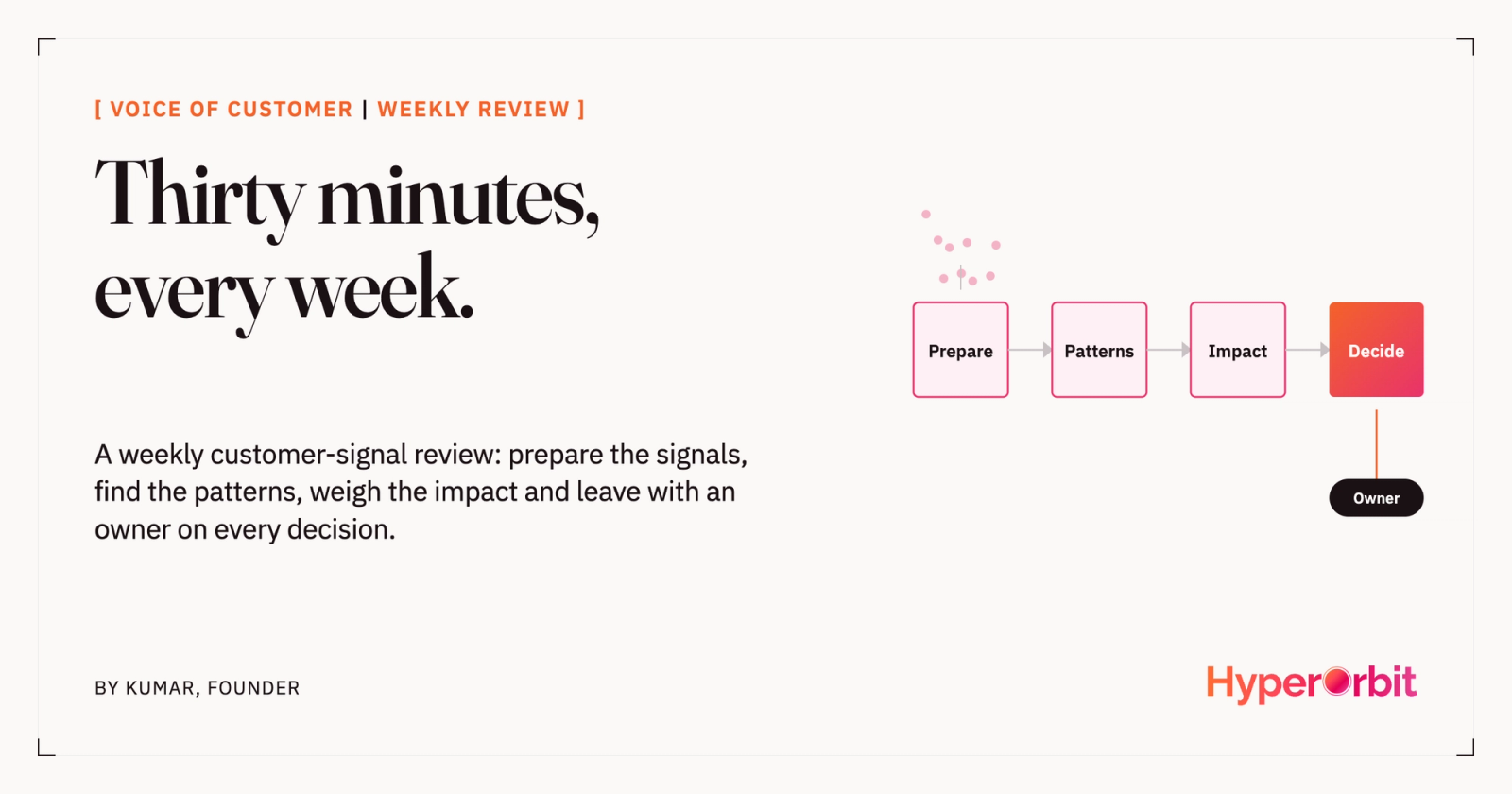
The aim is simple: leave the meeting with a shared understanding of what has changed, what matters and who is responsible for acting on it.
1. Prepare the signals (5 minutes)
Before the meeting, gather the most recent customer evidence from the channels your organisation uses:
- Customer support tickets and conversations
- Sales calls and lost-deal feedback
- Customer success interactions
- Surveys and customer interviews
- Product usage and adoption analytics
- App store reviews and public feedback
- Community discussions and social channels
Do not bring every individual comment. Start with a short list of the significant changes, the recurring themes and the odd signals. The preparation should answer three questions:
- What is new in this week's feedback?
- Which of the current issues is occurring more often?
- What has changed in customer behaviour or product usage?
Output: a short list of new and evolving customer signals.
2. Identify recurring patterns (7 minutes)
Next, separate isolated feedback from feedback that forms a pattern. A single complaint can be significant, but the same point raised by different customers in different channels is usually the clearest sign of a real underlying problem. Group signals by theme:
- Product usability and onboarding
- Feature gaps and enhancement requests
- Performance and reliability
- Pricing and packaging
- Customer support experience
- Competitor comparisons
- Adoption and engagement
Then look for links between sources. A support ticket about a confusing workflow, a customer interview describing the same issue and a later drop in usage of that feature could all share one root cause. Do not treat each as a separate issue.
Output: three to five themes worth a closer look.
3. Assess customer and business impact (8 minutes)
Not every recurring issue needs immediate attention. A good review weighs the strength of the evidence and the potential business impact. For each theme, ask six questions:
- Frequency. How often is this issue appearing?
- Customer impact. How seriously does it affect the customer experience?
- Account importance. Are strategic or high-value accounts affected?
- Revenue exposure. Could it affect retention, expansion or new sales?
- Urgency. Is the issue getting worse or spreading?
- Confidence. Do several independent signals support the conclusion?
Two examples show why the weighing matters.
Example A: a common usability issue. Several customers are stuck on the same onboarding step. It shows up in support conversations and in customer interviews, and it could affect activation and time to value.
Example B: a strategic account concern. One enterprise customer has a workflow issue that is holding back wider adoption. The number of complaints is low, but the implications for renewal and expansion could be substantial.
Both deserve attention, for different reasons. The goal is not to rank feedback by volume. It is to work out which signals will have the most effect on the customer and the business.
Output: a prioritised list of customer issues and opportunities.
4. Agree decisions and actions (7 minutes)
This is where the review earns its place. Every priority signal should lead to one of four decisions:
- Investigate: more evidence is needed before deciding.
- Prioritise: the issue belongs in the product backlog or the roadmap discussion.
- Escalate: it needs the immediate attention of Product, Engineering, Customer Success or Sales.
- Monitor: the signal is worth tracking but does not yet warrant action.
For every action, record the issue or opportunity, the supporting customer evidence, the decision taken, the accountable owner, the next step and the date it will be completed or reviewed.
Avoid entries such as “Product to look at this” or “Customer Success to follow up”. Assign one accountable owner and define what progress looks like.
Output: a short action list with clear ownership.
5. Close the loop (3 minutes)
The last step makes sure decisions do not vanish after the meeting. Share a concise summary with the relevant teams that covers what you learned, what was decided, what was assigned, what is still under investigation and what to look at next week.
Where it fits, close the loop with the customers who raised the original issue. This matters most when customers have given the same feedback repeatedly and seen no visible response.
Output: a shared record of decisions and next steps.
A simple weekly review template
Use this structure to keep the meeting focused:
- New signals: the important feedback received this week.
- Emerging patterns: themes appearing across customers or channels.
- Customer impact: who is affected, and how seriously.
- Business impact: the retention, revenue, adoption or sales implications.
- Decisions: investigate, prioritise, escalate or monitor.
- Action owner: one accountable person.
- Next review: the date or milestone for follow-up.
If a signal comes up week after week and never gets an owner or a decision, the review is not doing its job.
We also publish a feedback theme template (a free CSV) if you want a starting point for the grouping step.
Five mistakes to avoid
Even a well-structured review fails if the team slips back into old habits.
- Treating feedback volume as priority. The issue raised most often is not necessarily the most important. Weigh customer impact, account context and revenue exposure.
- Reviewing only support tickets. Support feedback is valuable, but it is one view of the customer experience. Sales, customer success, research and product usage each offer a different lens on the same issue.
- Confusing feature requests with underlying problems. Customers often describe the solution they want. The product team needs to understand the problem behind it before deciding what to build.
- Discussing issues without making decisions. A review that produces a list of observations with no accountability is another reporting exercise.
- Failing to revisit earlier decisions. Customer intelligence is continuous. Check whether earlier actions resolved the issue and whether new evidence changes the original assessment.
From a weekly meeting to continuous customer intelligence
A 30-minute review is a useful starting point. It also exposes a bigger issue. As an organisation grows, the volume of customer signals grows with it, and they spread across more systems and teams. Collecting, categorising and linking them by hand every week gets harder each month.
The longer-term opportunity is to move from periodic feedback reviews to continuous customer intelligence: connecting the customer conversation, the support interaction, the product usage, the account context and the competitive signals, so teams can see meaningful changes as they happen.
It also means going beyond dashboards and summaries. Customer intelligence should help a team understand why something is happening, which customers or business outcomes it touches, and get the right information into the workflows where decisions are made. That is the idea behind agentic customer intelligence, and it is what Chorus is built to do: connect customer and competitive signals, add account context and take the team from insight to action.
The weekly review stays valuable. The work needed to prepare for it should get less manual over time.
The takeaway
You do not need another dashboard or a two-hour meeting to become more customer-centric. Start with 30 minutes every week. Bring together the right signals, identify patterns, assess customer and business impact, make decisions, assign owners and follow through.
Do this consistently and customer feedback becomes part of how your organisation operates, rather than something it reviews only when a renewal is at risk or a customer has already churned. Customer intelligence is not about collecting more feedback. It is about making better decisions with the evidence you already have.
If you want to see what a continuous version looks like on your own feedback, Starter runs Chorus on one feedback source at no cost, with 50 signals and 10 insights a month. Run your next review from it and compare the preparation time.
Editorial note: the examples in this article are illustrative workflows, not claims about measured customer outcomes.
Frequently asked questions
What is a customer-signal review?
A short, recurring meeting where a product team looks at the latest customer evidence from support, sales, customer success, research and product usage, decides which patterns matter, and assigns an owner to each decision.
How long should a customer-signal review take?
Thirty minutes is enough when the signals are prepared beforehand: five minutes to prepare, seven to find patterns, eight to assess impact, seven to agree decisions and three to close the loop.
Who should attend a customer-signal review?
Product, plus a representative from support, customer success and sales so each channel's view is in the room. Every priority signal needs one accountable owner, so the people who can act on it should attend.
How do you prioritise customer feedback?
Weigh frequency, customer impact, account importance, revenue exposure, urgency and confidence together. Volume alone favours the loudest channel and can hide a single high-value account at risk.
What decisions can a review produce?
Four: investigate when more evidence is needed, prioritise to put the issue in the backlog or roadmap discussion, escalate when it needs immediate attention, and monitor when it is worth tracking but not yet worth acting on.