For years, organisations have invested in collecting customer feedback. They run survey platforms, product analytics, customer support systems, CRMs, call-recording tools, review monitoring and a research repository. Each system works as intended and produces data, and most come with a dashboard to help the team make sense of it.
A fundamental problem remains. Organisations now have more customer data than ever, and it is still hard to link that data to real decisions.
A product manager may see the same issue in support tickets. The customer success leader may hear it from a strategic account. Sales may be losing deals to a competitor on that very feature. Product analytics may show customers dropping off at that workflow. All four signals could point to the same underlying issue, but they sit in different systems, managed by different teams, and are reviewed at different times.
The organisation has the information. It lacks the operating layer. That is why we believe customer intelligence is moving beyond the dashboard and becoming something closer to an operating system for understanding customers and acting on what matters.
The dashboard model has reached its limits
Dashboards have made customer information far easier to reach. They have not made it much easier to act on. A typical customer intelligence workflow still looks like this:
- Get feedback from a variety of sources.
- Export or consolidate the information.
- Categorise the comments and identify the themes.
- Prepare reports and presentations.
- Discuss the findings in internal meetings.
- Decide whether anything needs to change.
- Assign and track the resulting actions by hand.
Every step is a place for the work to stall. By the time the information has been gathered, sorted and shared, the customer's situation may already have changed.
Dashboards are not useless. They are good for monitoring and exploration. The problem is asking a dashboard to do the job of an intelligence and action system. Noticing that customers are unhappy is different from knowing why. Knowing why is different from knowing which accounts are at risk. And knowing which accounts are at risk is different from making sure someone acts on it.
Customer signals need to be connected, not just collected
You cannot build customer intelligence on a single channel of feedback. A more complete understanding connects four kinds of evidence:
- What customers say: interviews, surveys, support conversations, reviews and feedback.
- What customers do: product usage, adoption, engagement and behaviour.
- What customers buy: CRM records, account context, renewals, expansion and commercial history.
- What is changing in the market: competitor products, pricing, positioning, reviews and customer reaction.
Each is useful alone. Together they give a much clearer picture. Take an example.
A SaaS company sees adoption of a particular feature falling. Product analytics identifies the drop. Support conversations show that customers find the workflow difficult. Sales conversations indicate that a competitor offers a simpler alternative. CRM data shows that several of the affected customers are approaching renewal. A dashboard might show those metrics in four separate places. An intelligence system should connect them and help answer five questions:
- What is causing the fall in adoption?
- Which customer segments and accounts are affected?
- Is the competitor driving or influencing the change?
- Which accounts are at risk of significant churn?
- What should Product, Customer Success or Sales do next?
The value comes from connecting the dots and working out what they mean. Adding more information does not do that.
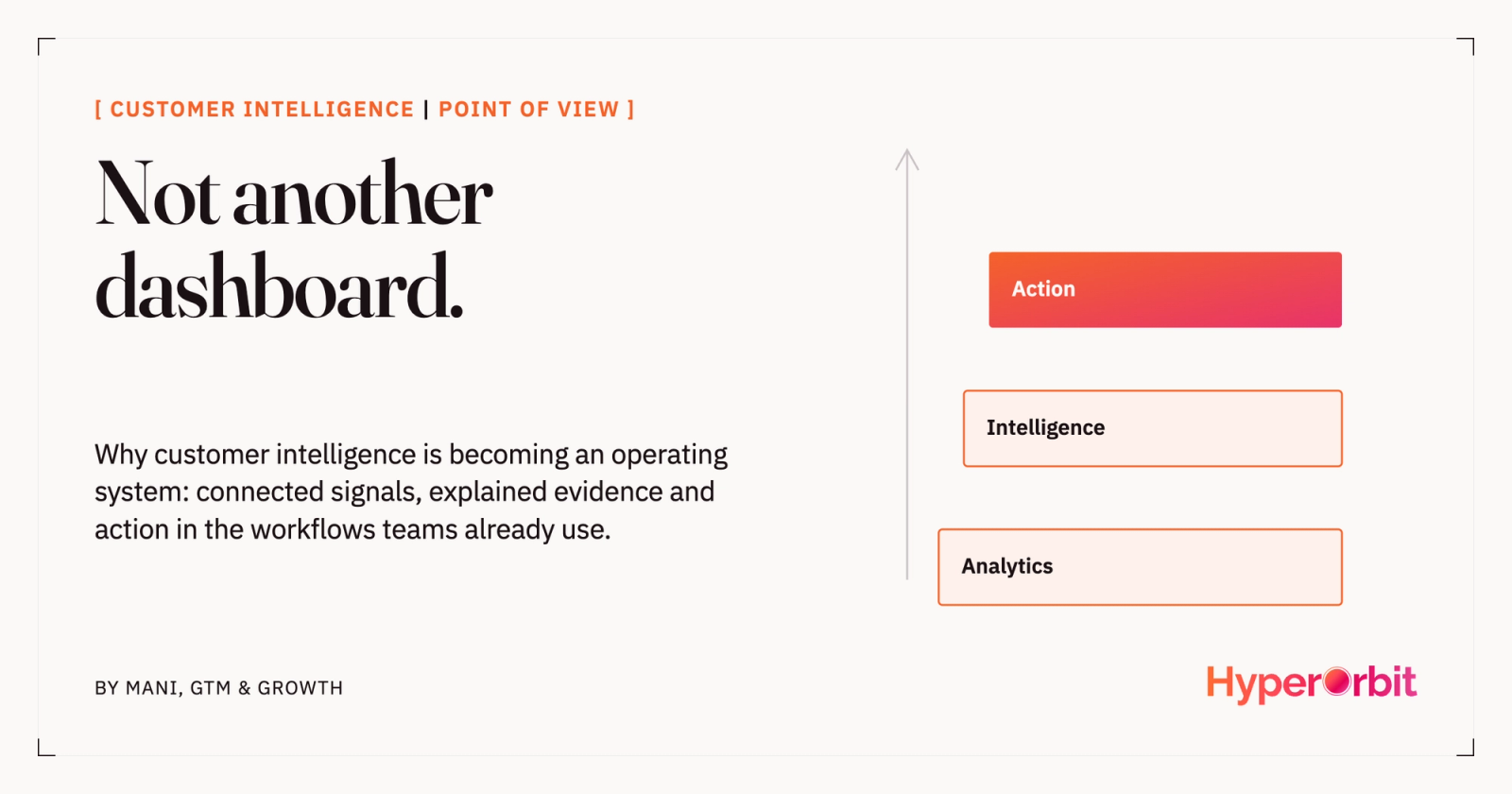
From analytics to intelligence to action
The shift happens in three stages.
Stage 1: analytics (what happened?)
This is where most organisations begin. They measure survey scores, review feedback, track product usage, monitor support volumes and analyse customer sentiment. The goal is visibility. Analytics answers questions such as how many customers reported an issue, which features are used most, what the most frequent complaints are and how sentiment has changed. These are necessary questions, and they are only the beginning.
Stage 2: intelligence (why does it matter?)
The next stage connects information across sources and adds context. Instead of reading individual comments or metrics, teams begin to understand patterns, causes and implications. The questions become more consequential:
- Why is this issue recurring?
- Is it isolated, or does it affect a whole customer segment?
- Is a competitor setting a new expectation?
- Which strategic accounts are affected?
- Could this affect retention, expansion or acquisition?
At this stage customer intelligence becomes valuable to the whole organisation, not only to the teams collecting feedback.
Stage 3: action (what should happen next?)
The last stage connects intelligence to the workflows where decisions and execution happen. That could mean a product investigation, a Jira issue, a customer success follow-up on an at-risk account, a sales enablement update for a recurring competitor objection, an executive escalation for a major customer issue, or a prioritised product opportunity backed by customer evidence.
The goal is not to automate every decision. It is to close the gap between noticing something important and acting on it. People should keep control of any decision that needs judgement, commercial context or accountability. They should not have to connect every signal, prepare every summary and route every action by hand.
Why agentic AI changes the equation
Traditional analytics tools rely on people to ask the questions, interpret the output and decide what to do. AI offers a chance to change that workflow. Instead of waiting for someone to search across several systems, agents can monitor information continuously, identify emerging patterns, investigate the relevant context and prepare recommended actions. An agentic customer intelligence system should be able to:
- Observe: monitor the relevant customer, product, account and competitor signals.
- Connect: bring related information together from across the sources.
- Investigate: look at the context behind a pattern or a change.
- Prioritise: assess customer impact, urgency and potential business implications.
- Recommend: present evidence-based next steps.
- Act: route approved actions into the systems and workflows teams already use.
That is a real improvement on asking people to use one more analytics tool. It makes customer intelligence an active part of how the business operates.
An AI-generated summary is not the same as intelligence, and an automated workflow does not guarantee a good decision. Evidence, traceability, context and human oversight are still essential.
What an operating system for customer intelligence should look like
We think the next generation of customer intelligence platforms should be built on six principles.
- Connected context. Customer feedback should not be read in isolation. It needs to connect to product behaviour, account information and competitive context.
- Continuous discovery. Important customer signals should not wait for a monthly report or a quarterly research exercise. Emerging patterns should surface as the evidence develops.
- Business-aware prioritisation. The loudest issue is not always the most important one. Prioritisation should weigh customer impact, account importance, revenue exposure, urgency and confidence in the evidence.
- Explainable intelligence. Teams should be able to trace an insight back to the evidence behind it, and understand why a pattern was identified and how a recommendation was reached.
- Action in existing workflows. Intelligence should connect to the systems where teams already work, whether that is product management, CRM, customer success, engineering or collaboration tools.
- Human accountability. AI can assist with discovery, investigation and recommendation. People remain responsible for key business decisions and actions.
Where HyperOrbit fits
This is the problem HyperOrbit is being built to solve. It brings customer and competitive intelligence together by connecting signals across business systems, so teams can understand what they mean for customers and accounts. Its agents are designed around distinct parts of the workflow:
- Chorus: understands the customer voice across feedback and conversation.
- Recon: monitors and investigates competitive intelligence.
- Atlas (Beta): connects intelligence to customer and account context.
- Cause & Effect: links competitor moves to customer reaction and what follows from it.
- Signal Desk: brings the important signals and emerging issues into focus.
The aim is to move past isolated feedback analysis and disconnected reports, and to help teams see what is changing, why it matters, who is affected and what should happen next. If you are weighing platforms against this list, our guide on how to evaluate agentic customer intelligence sets out a scorecard.
The takeaway
This field is still changing. What matters is not how many dashboards a platform can produce or how many AI features it shows off. It is whether the platform helps an organisation make better decisions and act faster. The next wave of customer intelligence will be judged by how well it drives action.
Earlier tools helped organisations gather and study customer feedback. Newer tools need to help them map the evidence, measure the business impact and act. Dashboards will stay in the technology stack, but they should not be the end goal. Customer intelligence should be built into how a company works, rather than being one more tool people have to check.
That is the move from analytics to intelligence, and from intelligence to action. We believe it is where the space is headed.
Editorial note: this article sets out HyperOrbit's point of view on the category.
Frequently asked questions
What is customer intelligence?
The practice of connecting what customers say, what they do, what they buy and what is changing in the market, so teams understand why something is happening, who it affects and what to do next.
How is customer intelligence different from a feedback dashboard?
A dashboard shows what happened. Customer intelligence connects signals across systems, explains why they matter, ties them to accounts and revenue, and routes the next step to an owner.
What does agentic customer intelligence mean?
AI agents that observe customer, product, account and competitor signals, connect them, investigate context, prioritise by business impact, recommend next steps and route approved actions into existing workflows, with people accountable for decisions.
Does an agentic system replace human decisions?
No. People keep control of any decision that needs judgement, commercial context or accountability. The agents take on the connecting, summarising and routing that people should not have to do by hand.