Sales battlecards reps actually use
Most battlecards are written for the competitor and read by nobody. They're long, they're generic, they live in a portal, and they're out of date by the time a rep needs them mid-call.
In Lesson 04 of Competitive Intelligence 101, we cover what a battlecard has to do to survive contact with a sales team: fit on one screen, answer the objection the rep is hearing right now, reflect the accounts in that rep's pipeline, and arrive before the call rather than after. We look at why the deal-specific version beats the master version, how to keep cards current without a quarterly rewrite, and what changes when an agent drafts the card for the account instead of a person drafting it for the category.
Goes with this lessonPostWhy your reps don't read competitive intel ›
What is said in this lesson
The spoken text from the video's captions, split into paragraphs. Read it in two minutes or search it for the part you need; the captions are automatic, so a word may be off here and there.
Show the transcript
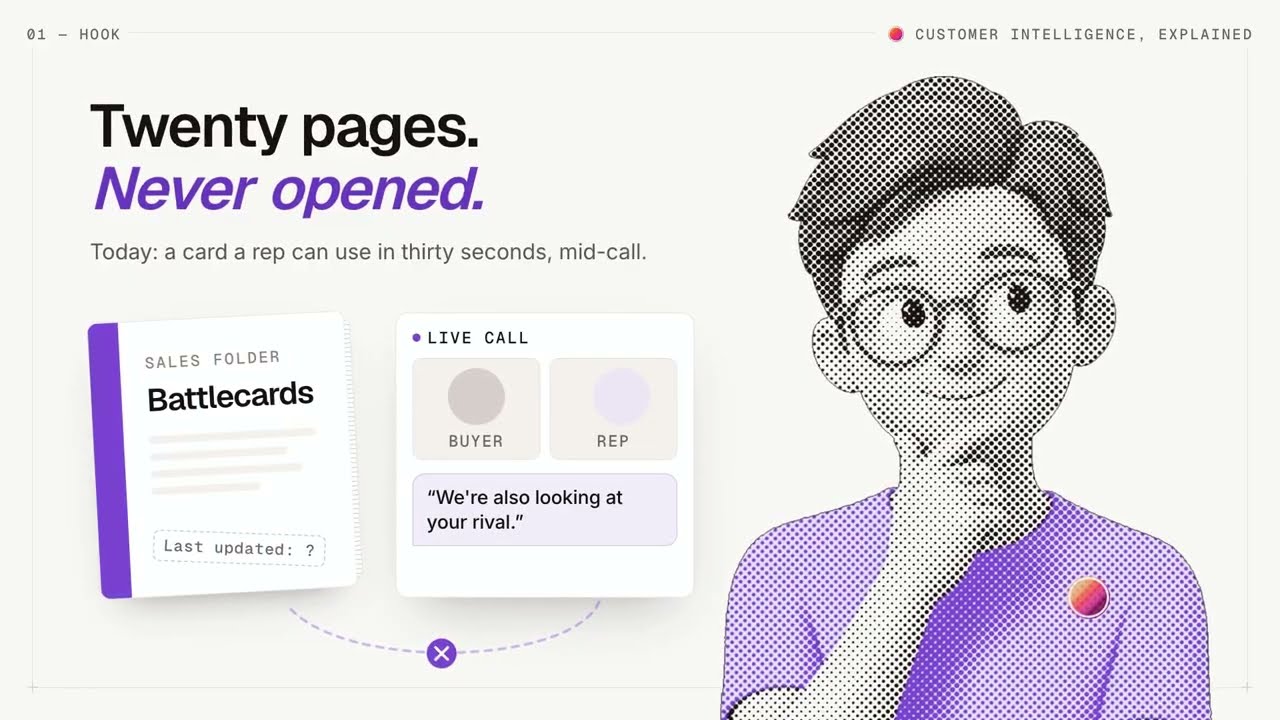
Somewhere in your company, there is a folder of battle cards, 20 pages each, last updated nobody knows when. And when a buyer names a rival on a live call, the rep does not open it. Today, why most battle cards go unread, and how to build one a rep can use in 30 seconds mid-call. Most battle cards fail for four reasons. They are too long to use during a call. They are written in our language, a feature list, not in the words buyers use. They carry no dates, so reps cannot tell a fresh claim from one the rival fixed last spring.
And they live in a folder, not where reps work. Fix those four, and cards get opened. Here is the structure. One competitor per card, one screen, no scrolling. Five blocks. One, when you meet them, which buyers and which deals. Two, why we win in customers' words. Three, why we lose honestly. Four, objections and answers, including the questions to ask that bring out a real difference. Five, what changed? Their latest moves, each one dated. At the top, an owner and the date it was last checked. Two rules make a card trustworthy.
First, the buyers' words. "Setup took us one afternoon." Beats faster onboarding because a rep can say it out loud. Take them from calls, reviews, and lost deals. Second, every claim gets a date and a source. And keep it fair. Say only what you can show from public information or your own customers. Reps who trash a rival lose the buyers' trust fast. Let us build the card for our rival. When you meet them, smaller teams replacing an older tool. Why we win in customers' words, we never have to rebuild our reports.
Why we lose honestly, their setup is quicker for small teams. What changed? The switching credit and the import from your product with the date we saw each one. The objection reps now here, they will move our data for free. The answer, agree that the move is easy, then ask what happens to their reports and workflows after the import. That question does the work. Give every card one owner. Review it every month and straight away when a move scores high, like in lesson three. Retire any claim that has not been checked in a quarter and ask reps one question after every competitive call.
What did the buyer ask that the card could not answer? Three mistakes to avoid. First, one card for every rival. Buyers compare you with one alternative at a time, so the card should, too. Second, writing for the product team. Reps need situations and answers, not specifications. Third, publishing and walking away. An undated card becomes a liability the day a rival ships. This week, pick your closest rival. Build one card on one screen in five blocks with an owner and a date. Send it to three reps before their next competitive call.
Ask what was missing and fix it the same day. Customer intelligence explained is presented by Hyper-Orbit, a Gentack customer intelligence. Build your first battle card with the free competitive intelligence engine guide at hyperorbit.ai.
Every signal, on one orbit
Connect your first source in an afternoon. The first pass lands before your next standup.
Book a demo