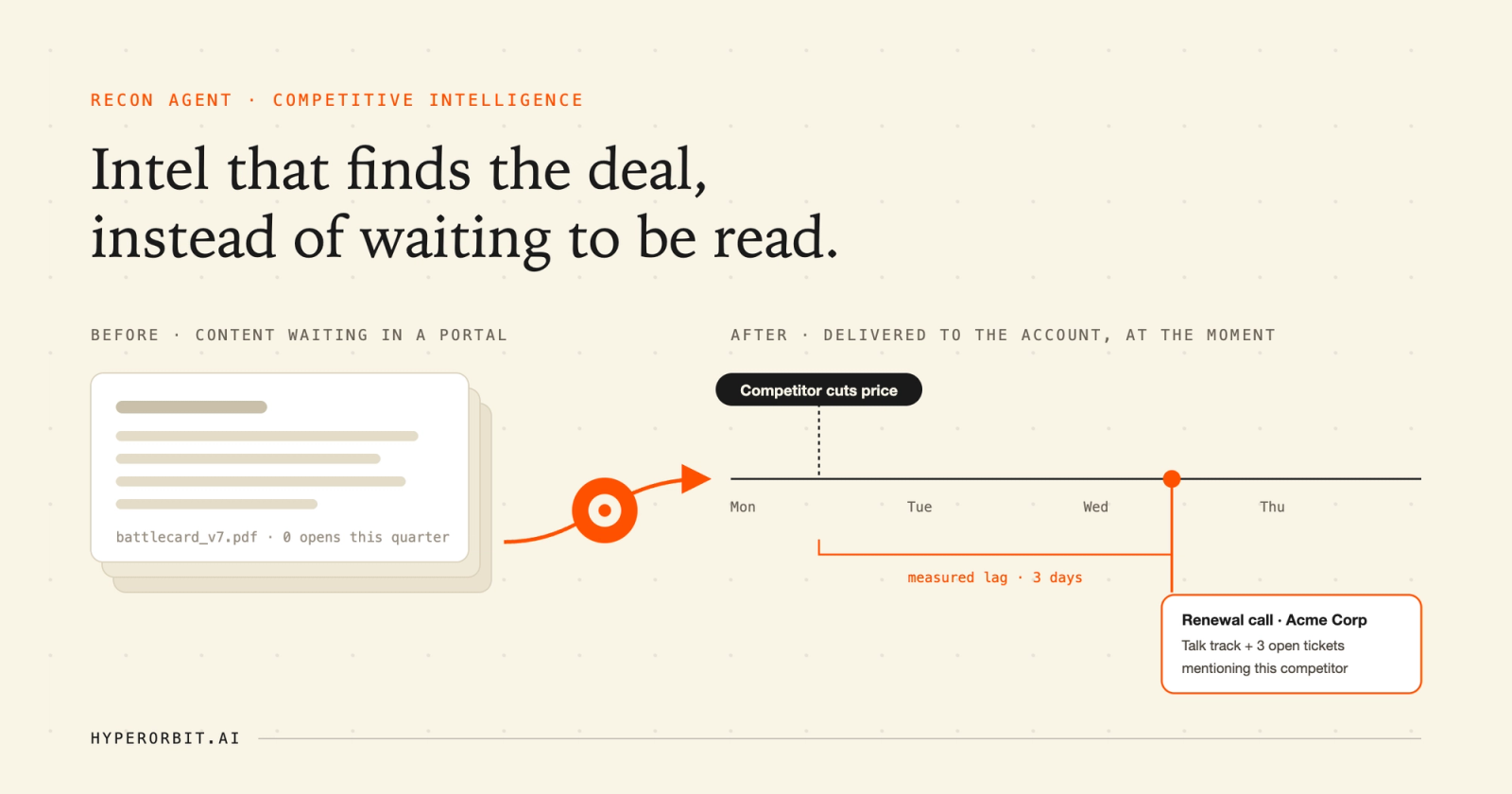
Every competitive intelligence team eventually has the same meeting. The battlecards are good. The win/loss analysis is thorough. The Slack channel is active. And when someone pulls the numbers, the reps who actually opened any of it in the last quarter fit in a small room.
The standard response is to treat this as a delivery problem. Put the intel in Salesforce. Push it instead of waiting for people to pull it. Set a weekly cadence. Ask reps for feedback so they feel ownership. All of that helps, and vendors in this category have built entire product lines around it under the name competitive enablement.
We think it addresses the symptom. The reason adoption is a metric at all is that competitive intelligence tools produce content, and content only works if a person consumes it. As long as that is the design, you will spend your programme's energy persuading busy people to read things.
Adoption is the wrong scoreboard
Consider what "adoption" measures. Battlecard views. Portal logins. Slack reactions. Every one of those counts a human engaging with a document. None of them counts a deal that went differently because the intel showed up.
A rep on a renewal call with an account that has mentioned a competitor three times in the last month does not need to have read a battlecard. They need the three tickets, the competitor's move that triggered them, and two sentences on how to handle it, delivered before the call starts. If that happens, the rep never "adopted" anything and the intel did its job completely.
So the first change we would make is to the scoreboard. The number that matters is how many competitive moments the intel reached with the right context attached, and what happened in those deals afterwards. Views are a proxy for that, and a poor one.
Where content-first programmes break
Content-first competitive intelligence has a structural problem that no amount of distribution fixes. A battlecard is written for a competitor, not for an account. It cannot know that Acme Corp has been asking about pricing since the competitor's free tier launched, or that the champion at Beta Inc left last month and the new contact came from the competitor. The rep has to hold all of that in their head and map the generic card onto the specific situation, live, on a call.
That mapping work is the real reason intel goes unused. It is not laziness and it is not a missing Salesforce integration. It is that the tool stopped one step short of the deal and left the hardest part to the person with the least time.
What an agent does differently
HyperOrbit's Recon agent starts from the account, not the competitor. It watches competitor moves the way any monitoring tool does, and it also reads your own customer signal: support tickets, call notes, reviews, churn reasons. When a competitor does something, the agent's first question is which of your accounts have mentioned that competitor recently, how much revenue they represent, and how long it typically takes your customers to react to this kind of move.
From there it does the mapping itself. It drafts the talk track for that competitor in the context of that account's open issues. It routes the brief to the account owner ahead of the next scheduled touchpoint, in the channel they already use. It updates the battlecard section, because someone will still want the reference version, and it does that as a by-product rather than the deliverable.
The rep still decides what to say. What they no longer do is search, read, and translate.
Keeping a human in the loop without making them the bottleneck
None of this means removing people from competitive response. It means moving them from the consumption end to the approval end. In Supervised mode, which is where most teams should start, the agent prepares everything and a product marketer or CS lead approves it before it goes to the rep. Approval takes seconds. Reading, synthesising and rewriting took the afternoon.
Over time, the approvals that are always rubber-stamped can move to Autopilot, and the ones that regularly get edited stay gated. The team ends up spending its judgement on the moves that are genuinely ambiguous rather than on distribution.
The question to ask your current tool
If your competitive intelligence tool reports adoption as a success metric, ask it one thing: for a given competitor move last quarter, which of our accounts did it touch, and did the rep have that context before their next conversation? A tool built around content will answer with a list of who viewed the battlecard. A tool built around the deal will answer with the accounts.
For one competitor move last quarter: which of our accounts did it touch, and did the rep have that context before their next conversation?
The adoption problem does not need to be solved. It needs to stop being the problem.
Frequently asked questions
Why is competitive intelligence adoption so low?
Because most competitive intelligence tools produce content, such as battlecards and portals, that only works if a busy rep reads it and then maps it onto a specific account during a live conversation. That mapping work is what gets skipped.
What should replace adoption as the metric?
The number of competitive moments the intel reached with the right account context attached, and what happened in those deals afterwards. Battlecard views are a weak proxy for that.
How does an agent deliver competitive intel differently?
It starts from the account. When a competitor moves, it finds which accounts have mentioned that competitor, how much revenue they represent and how long customers usually take to react, drafts a talk track for that account, and routes it to the owner before the next touchpoint. The battlecard is updated as a by-product.
Does this remove people from competitive response?
No. People move from the consumption end to the approval end. In Supervised mode a product marketer or CS lead approves each brief before it reaches the rep; routine approvals can later move to Autopilot while ambiguous ones stay gated.