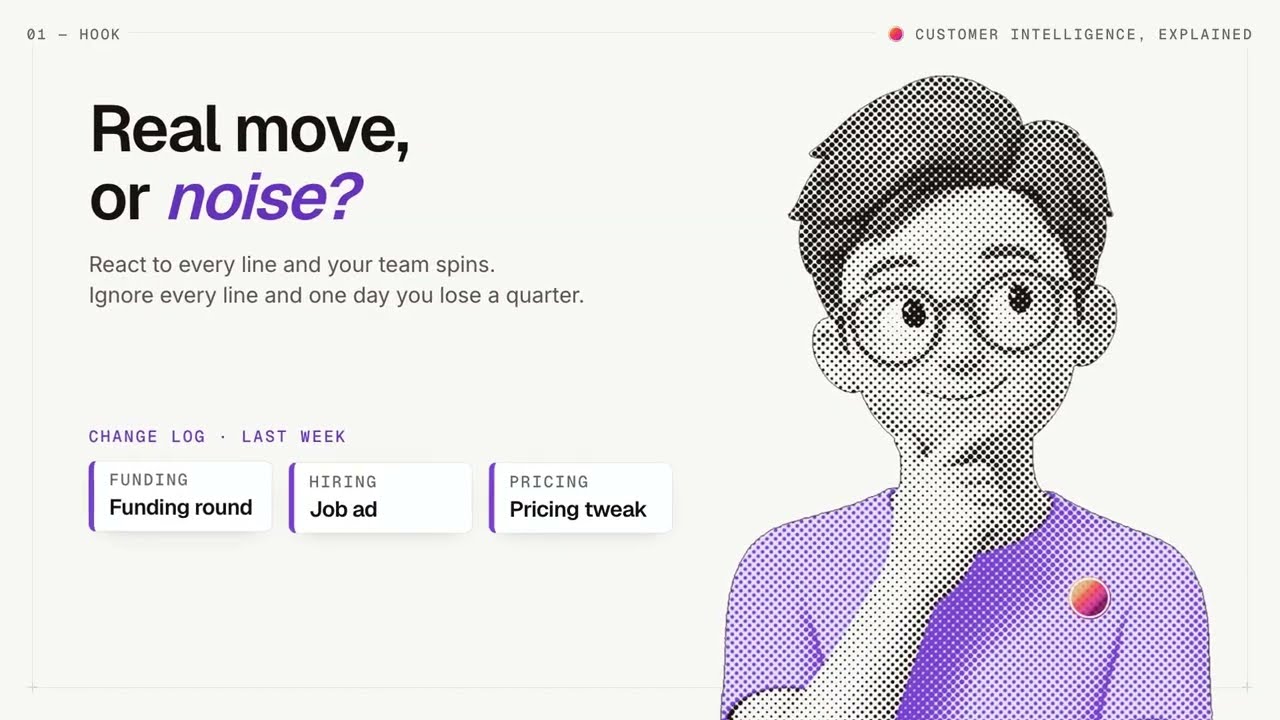
Real threat or Noise? reading competitor moves
A competitor raises funding. Another ships a feature you've had for a year. A third rewrites their homepage. Every one of those lands in the Slack channel with the same weight, and the team either reacts to all of them or stops reading.
In Lesson 03 of Competitive Intelligence 101, we build a way to tell the moves that matter from the ones that don't. The test is simple to state and hard to run: did your customers react? We cover how to check that against tickets, calls and reviews, how to measure the lag between a competitor's move and the reaction, why some launches generate press and zero customer response, and how to size a threat by the revenue it touches instead of the noise it makes.
What is said in this lesson
The spoken text from the video's captions, split into paragraphs. Read it in two minutes or search it for the part you need; the captions are automatic, so a word may be off here and there.
Show the transcript
Your change log from last week has a dozen lines in [music] it. A new headline, a funding round, a job ad, a pricing tweak. React to all of them and your team spins in circles. Ignore all of them and one day you lose [music] a quarter. Today, a simple way to tell a real move from noise and when to act. [music] Ask three questions about every move. Who does it affect? Nobody you sell to one segment or your core customers and open deals. How much [music] is it?
Cosmetic, a talking point, or a reason for a customer to switch. How fast will it bite someday, this quarter, [music] or right now? Give each question one, two, or three, and add them up. The best possible score is nine. Seven or more, act this week with a named owner. Five or six, brief the teams and look for a second signal. Four or less, log it and move on. Write one line of reasoning next to every score so anyone can challenge [music] it. One more test before you act.
Look for the echo in your own customers. [music] A rival's move is a claim. Your customers reaction is the evidence. If the move is real, it shows up in your calls, [music] your tickets, and your deals. Buyers asking about it, renewals asking for it. One signal is a hint. A move plus an echo is a decision. Let us score three moves from our rival. First, a big funding round with headlines everywhere. Who? [music] Nobody yet. How much? Cosmetic. Nothing changes for a buyer today. How fast?
[music] Someday. One. One. One. Three. [music] Log it. Second. Sales roles in your strongest region. Who? One segment. How much? A talking point. How [music] fast? This quarter. Two. Two. Two. Six. Brief. And watch. Third. The switching credit plus the [music] import from your product. Who your core customers? How much? A reason to switch. How fast right now? [music] Three 33 3 9 act. The move with [music] the most noise scored lowest. Acting does not mean copying them. It means one owner and a response for each team.
Sales gets a talk track for the switching offer. Product checks whether your own export gives customers a reason [music] to stay. Customer success calls the accounts most likely to be tempted and the owner sets a date to score the move again. [music] Three mistakes to avoid. First, scoring by volume. Press coverage measures a rivals marketing, not the threat. Second, matching every move. [music] Copy their price cut and you have made their strategy yours. Third, scoring once. Moves grow or fade, so rescore the middle band every month.
This week, take the change log from lesson two. Score every line on who, how much, and how fast. Check the top ones for an echo in your calls [music] and tickets. Then pick the single highest score. Name an owner and agree one action [music] for each team. Customer intelligence explained is presented by Hyperorbit, a Gentic customer intelligence. Go deeper with the free competitive intelligence engine guide at hyperorbit.ai.
Every signal, on one orbit
Connect your first source in an afternoon. The first pass lands before your next standup.
Book a demo