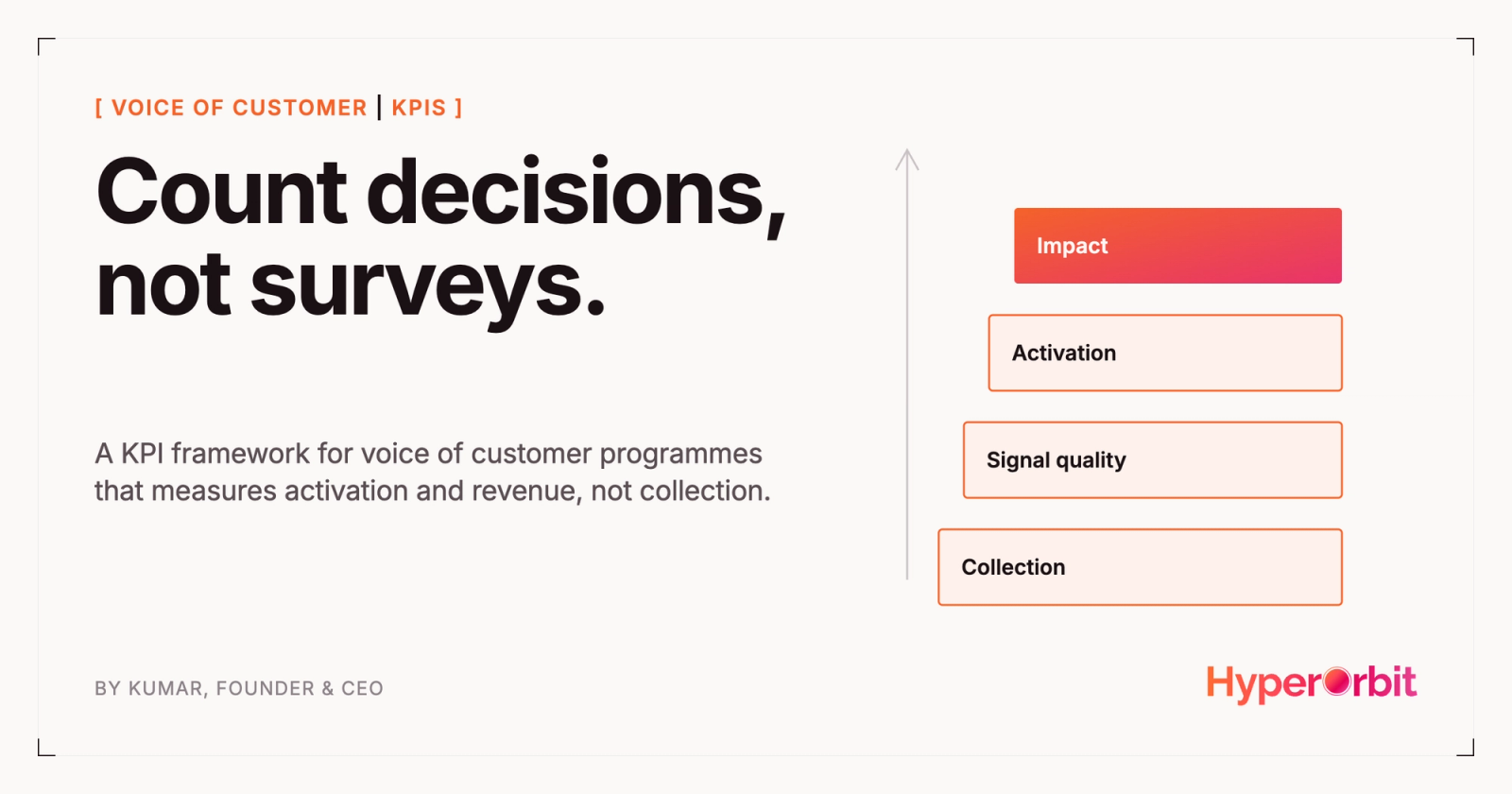
Ask most voice of customer programmes how they are doing and you get a satisfaction score, a response rate and a chart of both. Neither number says whether anything changed because a customer spoke. That is the gap a KPI framework has to close, and the fashionable answer is to layer the metrics: collection health first, then signal quality, then activation, then impact, added over two or three years as the programme matures.
The layers are the right idea. The sequencing is where we disagree. Waiting two years to measure activation and impact is how programmes become reporting functions. If the read is continuous and tied to revenue from the first source you connect, the impact layer is available on day one, and the collection layer mostly stops mattering. Here is the framework as we would run it.
Layer one: coverage, not collection
Response rate is a survey-era metric. It measures how many customers agreed to repeat themselves. When the programme reads what customers already say in tickets, calls, reviews and churn reasons, nobody has to respond, and the question becomes coverage.
- Sources connected, out of the sources where your customers actually talk. A programme on one survey tool has a coverage problem that no response rate will fix.
- Share of accounts with fresh signal: the percentage of your revenue base with at least one piece of feedback read in the last thirty days. Weight it by ARR, not by count, or the free tier sets the number.
- Read cadence: how long between a customer saying something and the programme knowing. Nightly is achievable; monthly is a sample.
Keep surveys and interviews for the questions the unprompted sources cannot answer, and track their response rates as an operational number, not a programme KPI.
Layer two: signal quality
This layer asks whether what was read can be trusted and acted on. Four measures do most of the work.
- Attribution rate: the share of feedback resolved to a named account. Unattributed feedback cannot carry revenue, so it cannot be ranked. Identity resolution across tickets, calls and reviews is what moves this number.
- Specificity rate: the share of themes with a fix attached. "Onboarding is confusing" is a mood; "the SSO step fails for Google Workspace tenants" is a theme. A theme without a fix should not be on a roadmap.
- Sourced rate: the share of statements that link back to the record they came from. In Chorus this is every line, and it is the standard any AI-read programme should be held to.
- Freshness: the age of the signal behind each theme. A theme built on last quarter's tickets should say so.
Layer three: activation
Activation is where most frameworks put the interesting numbers and most programmes have none. The measures are about ownership and time.
- Owner rate: the share of themes with a named owner. A theme in a deck belongs to whoever is in the room; a theme in the Signal Desk lands with an owner, a cause and the action.
- Time to owner: the lag between a theme moving and the right person knowing, in the channel they work in. Days is a routing problem; weeks is a cadence problem.
- Feedback-to-action rate: the share of ranked themes that became a ticket, a fix, a play or a decision to do nothing on purpose. A documented no counts; silence does not.
- Closed-loop rate: the share of accounts told what changed because of what they said. The customer brain guide treats this as the mark of a programme that has grown up.
Layer four: impact
Impact should be measured in the currency the business already uses, which is revenue and renewals, not correlations argued in a quarterly review.
- ARR touched by acted-on themes: the revenue behind the themes that reached an owner and became an action. This is the one number to put on the leadership slide.
- Renewals kept in watched windows: for accounts that surfaced a risk signal inside a renewal window, how many renewed. Atlas, in beta, watches the windows and explains why a score moved, so the denominator is known.
- Roadmap items with revenue attached: the share of shipped work that can point to the themes and the ARR that justified it. The roadmap prioritisation page shows the ranking this comes from.
- Competitive moves answered before the deal: moves detected, the accounts they touched, and whether the owner had the counter before the next conversation.
ARR touched by themes that reached an owner and became an action. Everything above it in the framework exists to make that number honest.
Sequencing: start at the top
The conventional advice is to spend the first year on collection health, the second on signal quality, and to reach activation and impact when the programme is mature. We would invert it. Connect one source, resolve it to accounts, and measure ARR touched by acted-on themes in the first month. If that number is zero, the programme has learned the most important thing it can learn, early. Starter runs Chorus on one feedback source and Recon on one competitor source at no cost, which is enough to produce the layer-four numbers before any budget is committed.
Mistakes the framework prevents
- Tracking twelve metrics before one of them has changed a decision.
- Measuring collection and calling it a programme. Collection without activation is overhead.
- Ranking themes by volume, which measures who talks, and reporting it as impact.
- Comparing against industry benchmarks instead of your own trend. The only response rate that matters is last month's.
- Ignoring signal age. A theme from stale feedback is a memory, not a KPI.
Our methodology page defines every figure we publish the same way this framework asks you to define yours: what it measures, from which records, and how it can be checked.
Frequently asked questions
What KPIs should a voice of customer programme track?
Four layers: coverage (sources connected, share of ARR with fresh signal, read cadence), signal quality (attribution, specificity, sourced lines, freshness), activation (owner rate, time to owner, feedback-to-action, closed-loop rate) and impact (ARR touched by acted-on themes, renewals kept in watched windows, roadmap items with revenue attached).
Is survey response rate a good VoC KPI?
Only as an operational number for the surveys you still run. As a programme KPI it measures how many customers agreed to repeat themselves. Coverage of the sources where customers already talk, weighted by revenue, is the better layer-one measure.
What is the single most important VoC metric?
ARR touched by themes that reached an owner and became an action. It combines coverage, attribution, activation and revenue in one number, and it is zero for programmes that only report.
When should a programme start measuring impact?
In the first month. Connect one source, resolve feedback to accounts, and measure the ARR behind acted-on themes. Waiting until the programme is mature is how it becomes a reporting function.