A rival has just announced a price cut.
Sales are asking whether they should match it. Product marketing is looking at the positioning. Product is wondering whether the roadmap needs to change. Leadership is asking whether this will hit pipeline and renewals.
The instinctive reaction is to react immediately.
But reacting quickly and responding intelligently are two very different things.
A competitor's price cut does not necessarily mean your product has become less valuable. It could be a one-off promotion, a change in packaging, an attempt to gain ground in a new market, or a reaction to pressure in their own business.
Before you change your pricing, make sure you know what actually changed, who it affects and whether it alters the value your customers see in your product.
Here is a practical 72-hour response framework for product and product marketing teams.
The first 6 hours: establish what actually changed
Start with the facts, not the assumptions.
A headline saying a competitor has cut prices by 30% may not tell the full story.
Investigate:
- Pricing. Is the reduction across all plans, or one tier?
- Packaging. Have features been removed, bundled differently or moved between plans?
- Eligibility. Does the new price apply to new customers, existing customers or a particular segment?
- Geography. Is the change global, or confined to certain markets?
- Duration. Is it permanent, a promotional offer or a temporary discount?
- Commercial terms. Are there minimums, such as a minimum commitment, annual billing or usage limits?
Capture the original announcement, the pricing page, the relevant terms and the date you observed them.
Separate verified facts from assumptions. A sales call or a social media post may be the first indication, but on its own it does not prove a price change has happened.
Deliverable: a verified competitor-change brief the whole team can work from.
Hours 6 to 24: understand where you are exposed
The next question is not "is the competitor cheaper?"
It is whether the price change makes any difference to your customers and prospects.
Map the competitor's move against your commercial and customer context. Look at:
- Open opportunities where the competitor is already shortlisted.
- Deals where price has become the main objection.
- Existing customers approaching renewal.
- Accounts that have recently mentioned the competitor.
- Segments where your product and theirs overlap most directly.
- Your recent win/loss record against the competitor.
Build a simple exposure matrix, one row per segment, rating potential exposure as high, medium or low and naming the evidence to examine:
- New prospects. Pricing objections and competitive deals.
- Existing customers. Renewal conversations and competitor mentions.
- Enterprise accounts. Contract terms and procurement discussions.
- Smaller customers. Plan comparisons and affordability concerns.
Do not assume every customer is equally exposed.
A price cut aimed at small businesses may have almost no effect on enterprise accounts. A lower entry price may attract some prospects without changing the economics of the relationship with a mature customer.
Deliverable: a segment-level view of potential exposure, backed by actual customer and pipeline evidence.
Hours 24 to 48: understand what customers are really buying
Price is obvious. Value is a different matter entirely.
A competitor may be cheaper, and your product may still be preferred for its integrations, reliability, support, fit with the workflow, security, implementation effort or the business outcomes it delivers.
Review recent customer conversations and feedback for:
- Direct references to competitor pricing.
- Requests for discounts or revised commercial terms.
- Questions about switching.
- Feature comparisons.
- Concerns about product limitations.
- Positive references to the capabilities that set your product apart.
Then ask three questions:
- Is price actually the reason customers are re-evaluating us?
- Are customers comparing like-for-like products and packages?
- Which parts of our value proposition are customers prepared to pay for?
This is where competitive intelligence and customer intelligence have to work together.
Competitor information tells you what changed in the market. Customer information tells you whether that change matters.
Deliverable: a customer-backed assessment of the competitor's likely effect on your positioning and your sales conversations.
Hours 48 to 72: choose your response
You now have three things: verified competitor information, an exposure assessment and evidence of customer reaction.
It is time to decide. There are five possible responses.
1. Do nothing
Sometimes the best response is no response.
If the price cut targets a different segment, strips out key capabilities or has little effect on your customers, do not create pricing pressure that was not there.
2. Strengthen sales enablement
If prospects are raising the pricing objection, arm sales with a clear comparison of capabilities, total cost of ownership, implementation effort and business value.
Give the team evidence, not a generic assertion that you are better.
3. Introduce targeted commercial flexibility
If one customer segment is genuinely exposed, consider targeted offers, different contract structures or some packaging flexibility.
Do not reach for blanket discounts when the problem sits in one segment or use case.
4. Revisit packaging and positioning
The competitor's move may be telling you that your packaging no longer matches how customers think about value.
Review the feature boundaries, how you differentiate, the usage limits and how you communicate the value of your product.
5. Reconsider the product roadmap
If customer feedback consistently points to a capability gap, the response may need to be a product decision rather than a pricing decision.
Do not add a feature because another company announced it. Validate the demand and the strategic case first.
Deliverable: a documented response decision with an owner, an action plan and a date for reassessment.
The 72-hour response checklist
Use this to move the team from reaction to a defensible decision:
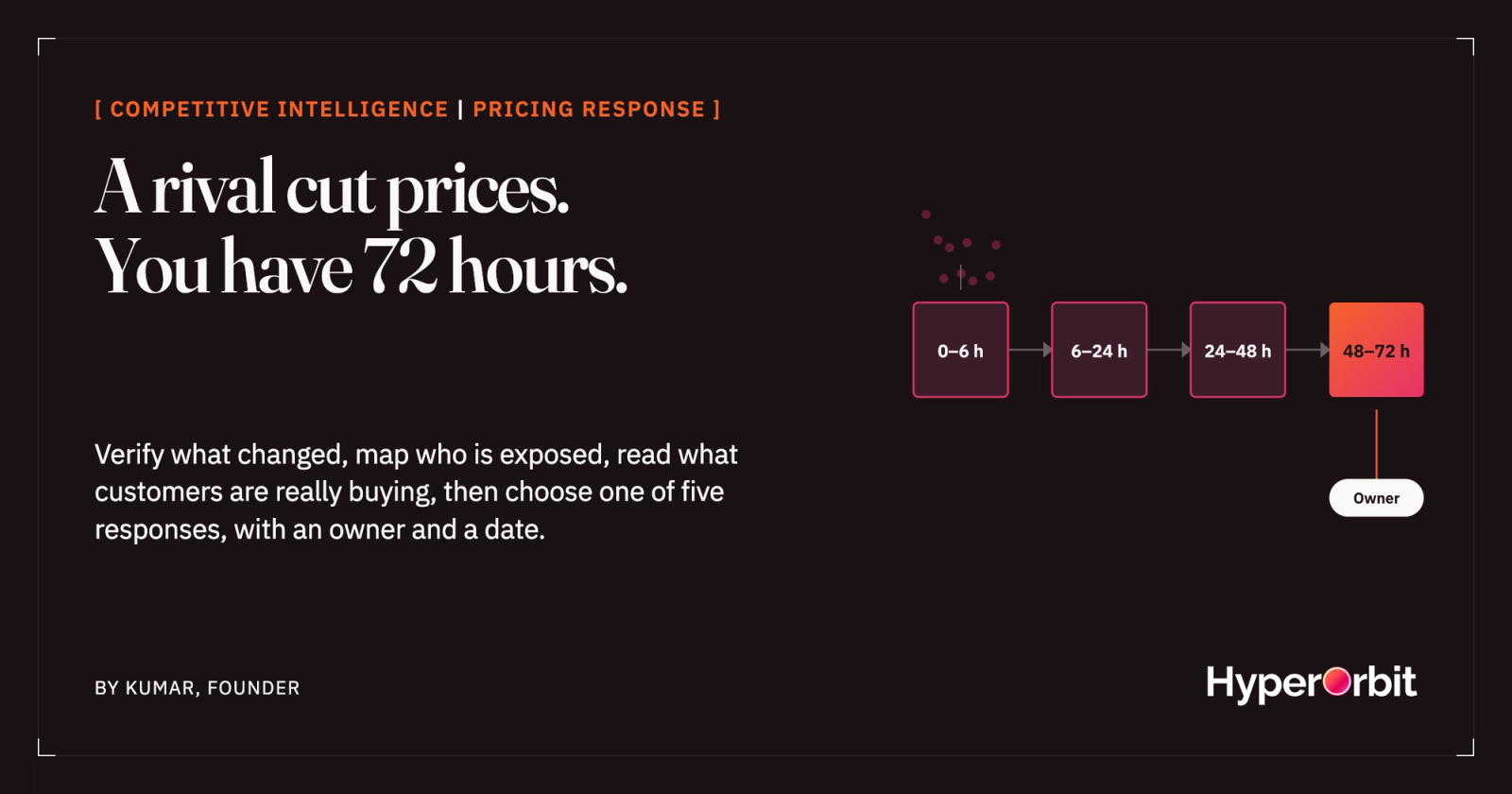
- 0 to 6 hours. Verify the pricing change. Output: the competitor-change brief.
- 6 to 24 hours. Map affected customers and deals. Output: the exposure matrix.
- 24 to 48 hours. Analyse customer reaction. Output: the customer impact assessment.
- 48 to 72 hours. Decide the response. Output: an action plan with owners.
Every decision should record:
- What changed.
- What evidence supports that assessment.
- Which customers or prospects are affected.
- What the commercial implications are.
- What we are doing.
- When we will look at the decision again.
The bigger problem: competitive intelligence is usually disconnected
Most organisations keep competitor information in one place, customer feedback in another and sales intelligence in the CRM.
That creates a gap.
A competitor announces a price cut. The product marketing team sees it. Sales takes the objection on a prospect call. Customer success picks up the renewal concern. Product carries on with its own roadmap.
Nobody necessarily links those signals.
The real benefit is not just knowing what competitors are doing. It is understanding how competitive changes affect customer perception, buying decisions, account risk and product priorities.
This is the kind of connected intelligence HyperOrbit is built to deliver: competitive signals and customer context in one place, so teams can see the change, assess the business impact and make a better decision.
Final thought
A rival's price cut can be a source of pressure. It can also expose weaknesses in your positioning, your packaging or your understanding of the customer.
The wrong move is to quote a new price before you understand the problem.
The better response is to establish the facts, assess the customer impact and make a deliberate decision.
72 hours is enough to move from market reaction to an evidence-backed response.
Frequently asked questions
Should we match a competitor’s price cut straight away?
Rarely. First establish what actually changed, which of your segments it touches and whether customers are re-evaluating you on price at all. A cut aimed at a different segment, or one that strips out capabilities, often needs no pricing response.
Why 72 hours?
It is long enough to verify the change, check pipeline and renewal exposure and read recent customer conversations, and short enough that sales is not left improvising for a fortnight. Each pass has a deliverable, so the team can show its work.
What goes in the exposure matrix?
One row per segment, such as new prospects, existing customers, enterprise and smaller accounts. For each, rate the potential exposure high, medium or low and name the evidence to examine: pricing objections, renewal conversations, competitor mentions, contract terms.
What are the five possible responses?
Do nothing; strengthen sales enablement with evidence; introduce targeted commercial flexibility for the exposed segment; revisit packaging and positioning; or reconsider the roadmap if feedback points to a real capability gap. Whichever you choose, record the owner and a date to reassess.