Customers will almost never decide to leave overnight.
The decision may come to light in the course of a renewal conversation, but the indicators are often there much earlier: declining product usage, a steady stream of support tickets, stakeholders becoming disengaged or increasing frustration with a particular workflow.
The problem is that these signals don’t tend to be in one place.
Product teams see usage patterns. Customer Success teams hear complaints. Support teams track unresolved issues. Sales teams manage renewal conversations. Each team has a piece of the picture, but nobody necessarily sees the full story.
Consider an illustrative scenario.
A B2B SaaS company has an enterprise customer at renewal. The account is still active, invoices are being paid, and there has been no sign at all from the customer that they are going to walk.
On the surface, it’s a very stable account.
But several signals are beginning to tell a different story.
This is an anonymised worked example, not a documented HyperOrbit customer case study. The company, events and figures are illustrative.
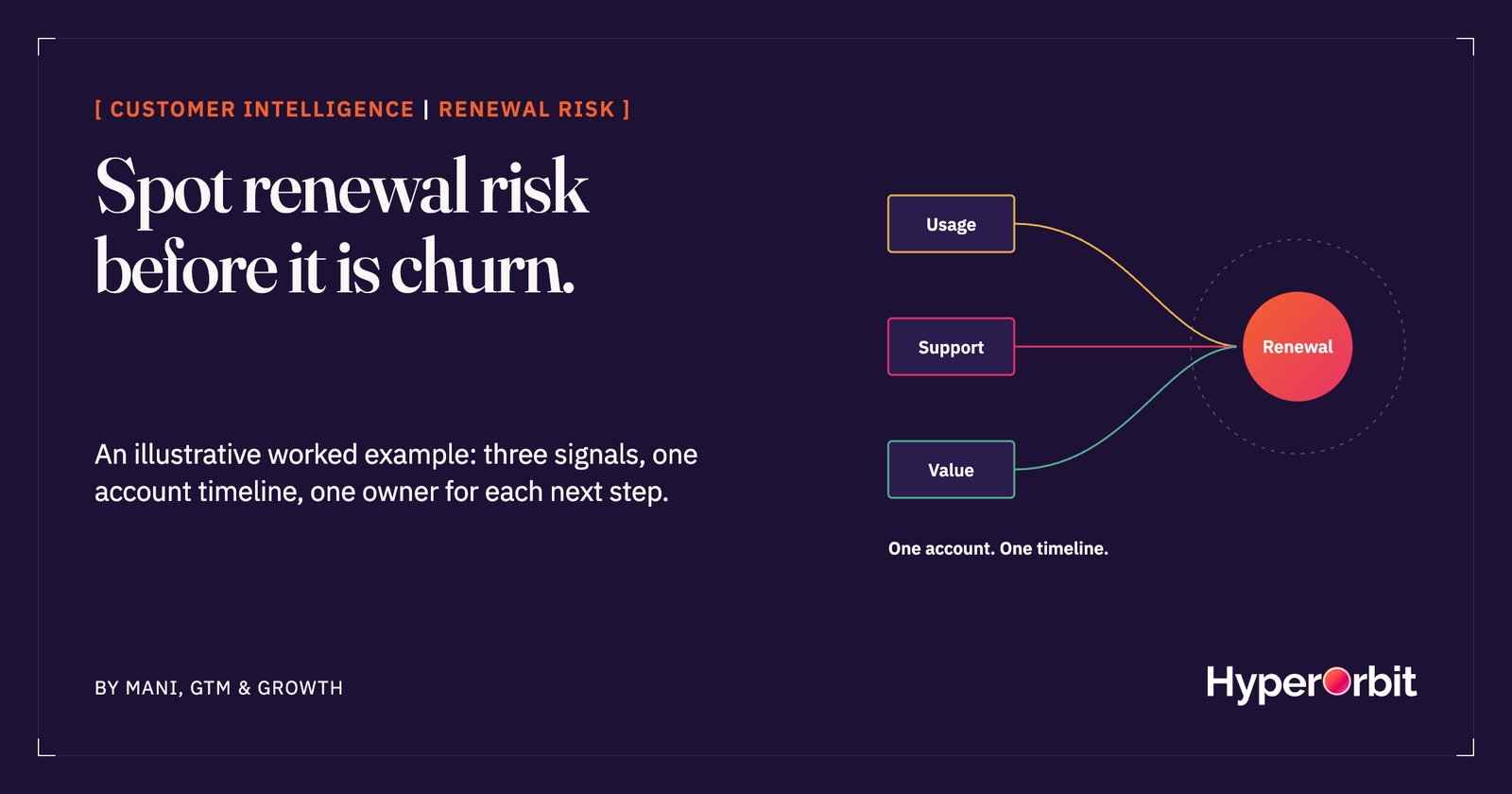
The first signal: product usage starts changing
The customer had been using the platform regularly across multiple teams.
Over time, the product team notices that active usage is declining. A few important workflows are being used less frequently, and one department has almost stopped engaging.
Individually, this could have several explanations: seasonality, a change in internal priorities, or a temporary operational issue.
It is a signal worth investigating, not proof that the customer will churn.
The problem is that this change is not immediately visible to the account owner, who is still working from the last quarterly business review.
The second signal: the same issue keeps appearing in support
Around the same period, support tickets reveal recurring friction around a particular workflow.
The customer has reported the issue more than once. Some tickets have been resolved individually, but the underlying problem remains.
Support sees a recurring technical or usability issue. Product sees separate tickets. Customer Success sees an account that has become less engaged.
Nobody has connected these observations yet.
This is where isolated feedback becomes more useful when it is connected to account context.
The third signal: the customer starts questioning value
During a customer conversation, the account team hears that the customer is reviewing how much value it is getting from the platform.
The conversation includes questions about adoption, usage, and whether the current contract still makes sense.
A competitor is also mentioned.
This changes the context of the earlier signals.
Declining usage is no longer just a product adoption question. Repeated support friction is no longer just a service issue. Together with a value concern and competitor evaluation, they suggest a potential renewal risk that needs attention.
Reconstructing the customer story
When you bring the signals together, the sequence becomes clearer.
- Early: usage declines in important workflows. It could indicate that adoption or value perception is changing.
- Next: similar support issues recur. It could indicate that underlying friction remains unresolved.
- Later: stakeholder engagement decreases. It could indicate that the account relationship is weakening.
- Renewal discussion: the customer questions value and mentions alternatives. It could indicate that commercial risk is becoming explicit.
The important insight is not any one event.
It is the relationship between them.
A usage decline, a support issue and a competitor mention may each have different explanations. When they appear in the same account over time, they provide a stronger reason to investigate the renewal.
What the team does next
Identifying a risk is only useful if it leads to a better response.
In this illustrative scenario, the team takes five steps:
1. Bring the evidence together
The account owner reviews usage trends, support history and recent customer conversations in one account-level timeline.
2. Confirm the underlying problem
Rather than assuming the customer is unhappy with the entire product, the team identifies the specific workflow causing friction.
3. Assign clear ownership
Customer Success coordinates the response, Product investigates the recurring issue, and Support confirms the resolution.
4. Reconnect the product to customer value
The team works with the customer to understand which outcomes matter, which teams need to adopt the platform, and what is preventing them from getting value.
5. Track whether the situation actually improves
The team monitors usage, issue recurrence, stakeholder engagement and the customer’s feedback. Risk status changes only when evidence supports the change.
The objective is not to persuade the customer to renew at any cost. It is to understand the problem, address what can be addressed, and make the relationship’s value visible.
The lesson: renewal risk is a connected signal problem
Many organisations have the data needed to identify customer risk.
The challenge is that the data is fragmented across product analytics, support systems, CRM records, customer conversations and feedback platforms.
A CRM can tell you when a renewal is due. A support platform can tell you what issues have been reported. Product analytics can show how usage is changing.
But a team still needs to connect those signals to understand what is happening inside the account.
This is where customer intelligence becomes operational.
HyperOrbit connects customer signals and account context, helping teams identify patterns, understand their implications, and determine what needs attention.
Instead of waiting for a renewal conversation to reveal a problem, teams can investigate meaningful changes while they still have time to respond.
The question to ask before your next renewal review
Don’t just ask whether the customer is likely to renew.
Ask:
- Has product usage changed?
- Are the same issues appearing repeatedly?
- Has engagement from important stakeholders changed?
- Has the customer questioned the value they are receiving?
- Are competitors entering the conversation?
- Can we connect these signals to a clear next action?
A renewal forecast tells you what the team currently expects.
Connected customer intelligence helps explain why that expectation may need to change.
The goal isn’t to predict every cancellation. It’s to make sure your team doesn’t miss the evidence that a customer relationship is changing.
Frequently asked questions
Can renewal risk be spotted before a renewal conversation?
Often, yes. Declining usage, recurring support issues and weaker stakeholder engagement usually appear well before the customer says anything about renewing, if the signals are connected to the account.
Is a single signal proof that a customer will churn?
No. A usage dip, a support ticket or a competitor mention can each have other explanations. Several signals on the same account over time are a stronger reason to investigate.
Who should own the response to a renewal risk?
One team should coordinate. In the worked example, Customer Success coordinates, Product investigates the recurring issue and Support confirms the resolution.
Is the scenario in this post a real customer case?
No. It is an anonymised, illustrative worked example, not a documented HyperOrbit customer case study, and the company, events and figures are illustrative.