Black Friday is one of the biggest tests of a retailer's customer experience. Promotions bring the shopper in, and the range of products shapes what they buy. The experience is judged on something far simpler: could the customer find what they were looking for, complete the purchase and get what they were promised?
For retailers, the answers often sit in a place that gets far less executive attention than the sales dashboard: public app reviews.
Reviews do not tell the full story. They are self-selected, often negative, and do not reflect the whole customer base. They can still show recurring friction, unexpected product issues and unmet expectations, and all three are worth looking at.
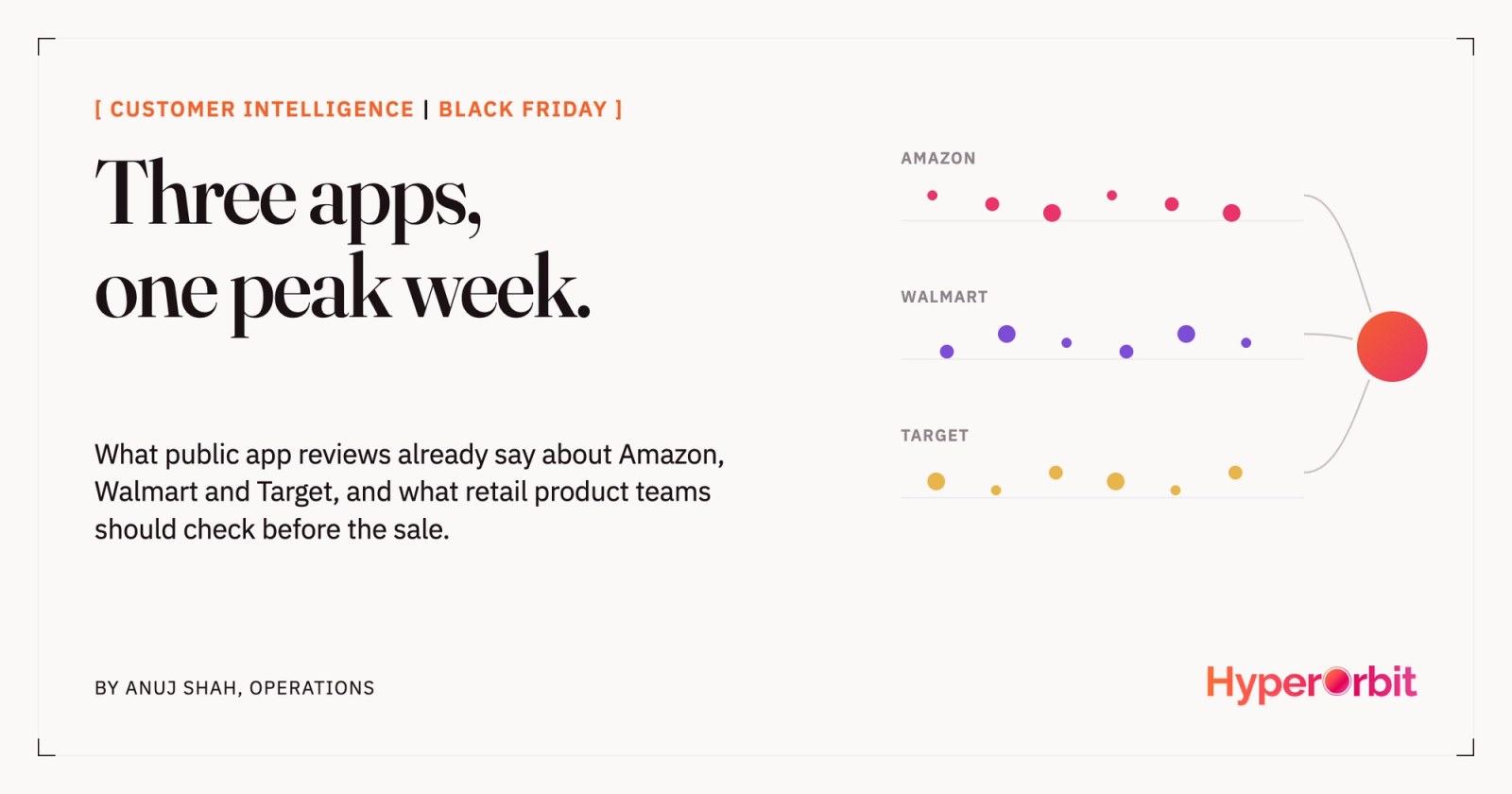
Just ahead of Black Friday 2026, we looked at publicly available review analysis and recent shopper feedback for three major retail apps: Amazon, Walmart and Target. The goal is not to rank the retailers. It is to understand what shoppers are already telling them, and what product and customer experience teams should review before real traffic and order volumes ramp up.
1. Amazon: the experience does not end at checkout
Amazon has built its shopping experience around selection, convenience and delivery. Public reviews suggest the experience after checkout remains a major source of frustration.
OneStar's public analysis covered 2,927 Amazon Shopping reviews posted between 29 October 2025 and 29 October 2026 on Google Play and the App Store in five countries. It identified three leading complaint themes:
- Service behind the app: 29% of complaints
- Crashes and bugs: 12%
- Charges and refunds: 8%
Within the service-related complaints, common themes were late delivery after the promised date, changing delivery estimates, cancelled orders and difficulty getting support.
The distinction matters. A customer can have a smooth experience browsing and checking out, and a late parcel or a difficult refund can spoil all of it.
What this tells product teams
Retailers often have a well-built digital journey up to the point of purchase. The customer's view of the product carries on through fulfilment, delivery, returns and support. Ahead of a high-volume period, product teams should check:
- Are delivery estimates still accurate as capacity changes?
- Do customers get timely updates when an order is delayed?
- Can a customer resolve a failed or cancelled order without re-telling the same story?
- Are refunds and membership fees clearly explained?
- Can customer support see the full order history and context?
A useful metric is not only checkout conversion. It is the percentage of orders that deliver on the promise made at checkout.
The signal: a retailer can win the transaction and still lose the customer's trust.
2. Walmart: when an app update disrupts an in-store habit
Walmart's app brings online shopping into the physical store through options such as in-store pickup and Scan & Go. That makes reliability critical. The customer is not at home with time to debug a process. They may be in the aisle or standing in a pickup area.
A September 2026 Unstar review investigation looked at 21,000 recent US Google Play reviews from 28 May to 29 September. It found a cluster of 60 reports after version 26.36 appeared on 17 September:
- 31 reviewers said Scan & Go had disappeared or would not load.
- 29 reviewers reported problems checking in for pickup.
- 15 of the pickup complaints described a store mode banner or button covering the check-in control.
The issues appeared alongside the version change. That does not prove each one was caused by it, but the timing makes the pattern worth investigating.
This is a different customer problem from a late delivery. The retailer has a digital function designed to make the in-store trip easier, and when it fails the customer is back to doing everything by hand.
What this tells product teams
The most important app features are not necessarily the ones with the most screens or the most engagement. Some earn criticism because customers depend on them at one particular moment. Before a major retail event, pay particular attention to:
- Store-mode and location-dependent features.
- Pickup check-in flows, and whether the key controls stay visible.
- Regression testing after app releases.
- Feature availability across stores and devices.
- The ability to detect sharp spikes in issue-specific reviews.
A useful question for product leaders: which features would cause the most customer disruption if they failed for a single day?
The signal: a small interface or release issue can become a high-friction operational problem when it hits a real-world shopping journey.
3. Target: promotions and convenience need to stay simple
Target's app covers product discovery, promotions, loyalty offers, store inventory, pickup and delivery. That breadth is useful, and it creates a design challenge: the shopper has to understand what they are getting, what they are paying and how to complete the order in as few steps as possible.
AppInsider's analysis of recent US App Store reviews points to price and subscription issues, crashes and bugs, and login problems. Other recent public reviews praise the pickup experience, and also flag longer-than-expected waits on some orders and concerns about the quality of the produce chosen.
The mix is telling. Customers can value the convenience of an app and still be frustrated by parts of it.
Promotional complexity is especially common during Black Friday. Shoppers compare discounts, eligibility, membership benefits, coupons and delivery options. If the saving is not clear or easy to apply, the promotion loses perceived value.
What this tells product teams
Promotions should reduce purchase friction, not add to it. Product and experience teams should examine:
- How many steps does it take to find and apply an eligible offer?
- Are membership requirements and exclusions visible before checkout?
- Can the shopper work out the final price without moving through several screens?
- Are pickup and delivery estimates realistic?
- Does the experience clearly show substitutions or stock changes?
The signal: a good promotion is a discount the customer can understand and actually get.
What links the three retailers?
The review themes differ, and they point to the same set of customer expectations:
- Keep the promise. What goes wrong: late delivery, cancellations, inaccurate estimates. What to monitor: promise accuracy and fulfilment exceptions.
- Make the experience reliable. What goes wrong: crashes, broken features, failed check-in. What to monitor: release-related issues and critical-flow failures.
- Make savings understandable. What goes wrong: confusing offers, fees and membership conditions. What to monitor: offer discovery, eligibility and checkout friction.
- Resolve problems quickly. What goes wrong: repeated support contacts and unclear refunds. What to monitor: resolution time and repeat-contact patterns.
- Preserve convenience. What goes wrong: pickup delays, stock changes and extra steps. What to monitor: pickup readiness, inventory accuracy and task completion.
The bigger point is that customer experience is not owned by one team or one channel. A complaint that looks like an app issue may be a fulfilment issue. A delivery complaint may start with an incorrect promise. A promotion complaint may come from a product design choice. Looked at in isolation, the links are very hard to see.
Five questions retail product leaders should ask before Black Friday
The review evidence points to five practical questions to ask before the peak shopping period.
1. Which customer promises are most likely to break under pressure?
Review delivery estimates, inventory accuracy, pickup capacity and the communication around order status.
2. Which critical workflows have changed recently?
Look at app releases, checkout, payment, store mode, pickup check-in and loyalty, and check whether new issues have appeared since each update.
3. What do customers keep struggling to understand?
Watch for confusion around discounts, fees, subscriptions, the refund policy, product availability and delivery terms.
4. Are different teams seeing the same problem?
Link app reviews to support tickets, customer service calls, operational data and product analytics. If the same issue keeps appearing across sources, it needs closer attention.
5. Who owns the response when a customer signal becomes important?
An insight with no accountable owner is another report. Agree the escalation paths before the shopping period begins.
Why app reviews should be treated as customer intelligence
Public reviews are easy to dismiss. They are often read one at a time, answered by support, or looked at only when the app rating moves. The value is in the patterns. Is a problem new or recurring? Did it appear after a release? Is it limited to one feature, device, market or customer segment? Does it also show up in support conversations? Could it affect purchase completion, fulfilment or retention?
That is where review analysis becomes more than sentiment reporting. Read alongside other customer and business signals, reviews show what customers are saying and what may be changing in their experience.
What changes after Black Friday?
This is the first half of the teardown. Before Black Friday, public reviews show existing customer friction and the workflows that need review. Afterwards, a different set of questions matters:
- Which problems became more visible?
- Did new complaints appear around delivery, stock, checkout or returns?
- Did existing problems become more frequent?
- Which customer expectations were not met?
- What should product and operations teams do differently before the next peak period?
We will return to the public review signals after the sale to see what changed.
The bottom line: Black Friday tests your promotional strategy, and it also tests the promises you make to customers and whether you can keep them across the whole experience.
Try it on your own app reviews
If you want to find recurring complaints, feature requests and emerging issues in public app reviews, the free App Review Analyzer turns a pile of unstructured reviews into signals your product team can investigate.
Sources
- OneStar, “Amazon Shopping: What people complain about and love in 2026”
- Unstar, “Walmart Scan & Go Not Showing? What 60 Reviews Say”
- AppInsider, “Target: Shop. Style. Save.”
- Zing, “Target App Store reviews”
Editorial note: figures are quoted from the sources above as they report them. Public reviews are self-selected and do not represent every customer.
Frequently asked questions
Why analyse public app reviews before Black Friday?
Public reviews show recurring friction in delivery, reliability, promotions and support before peak traffic arrives, so product and operations teams can check the workflows most likely to fail under load.
Are app reviews a reliable view of the customer experience?
Not on their own. Reviews are self-selected and skew negative. They are most useful for spotting patterns, such as a cluster of complaints after a release, and for checking against support tickets and operational data.
What did Amazon, Walmart and Target app reviews have in common?
Customers expect a kept promise, a reliable app, savings they can understand, quick resolution of problems and convenience that stays simple. Complaints in each app map to one of those.
Who should own the response to an emerging review signal?
One accountable owner per signal, with escalation paths agreed before the peak period. An insight with no owner is another report.