Ask an analyst firm how to buy competitive intelligence and the answer is a stack: a monitoring layer, a social listening layer, a knowledge management layer, a financial research layer, an AI research assistant, an enablement platform to push it all to sales, and a BI tool to draw the charts. Fourteen categories on the last list we saw, with the reassurance that no single tool covers everything and the real work is making them talk to each other.
For a global enterprise with an intelligence team of five supporting five hundred users, that may be the honest answer. For a SaaS company with a product marketer and a revenue leader who need to know what to do about a competitor's move before Thursday, it is a procurement plan for a problem they do not have. This post is the stack rebuilt around what the tool has to know, not how many categories it spans.
Why the stack keeps growing
Each layer in the standard stack exists because the layer below it produces something nobody can use directly. Monitoring produces alerts, so you need a knowledge layer to store them. The knowledge layer produces a library, so you need an AI assistant to search it. The assistant produces summaries, so you need an enablement platform to push them to reps. The enablement platform produces battlecards, so you need adoption metrics to see whether anyone read them. Every layer is a fix for the previous layer stopping short of a decision.
The stack is not wrong. It is a description of what it takes to turn collection into action when collection is the starting point. Start somewhere else and most of it collapses.
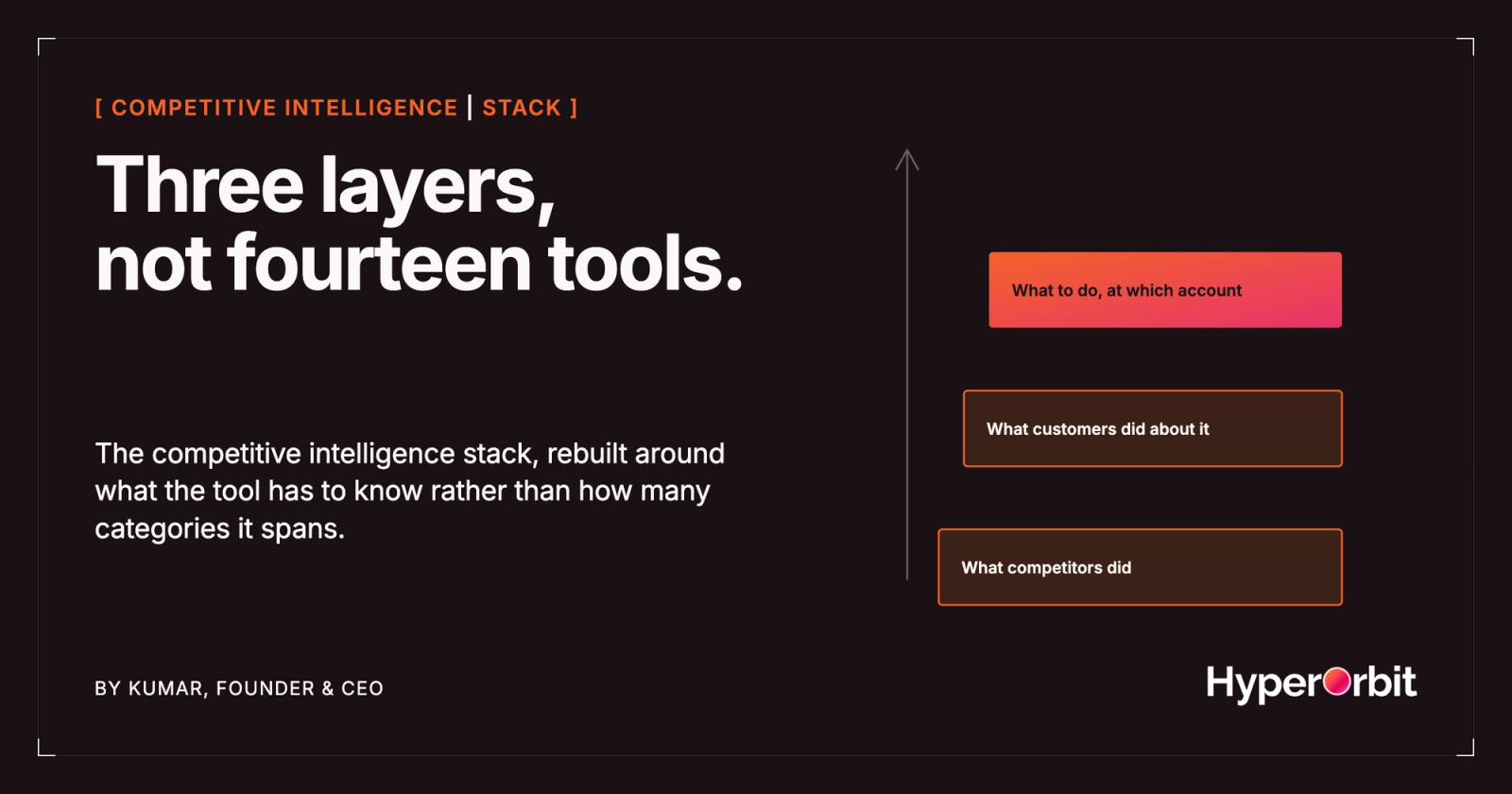
Three layers, by what the tool has to know
We wrote this split up in build or buy competitive intelligence and it applies to the stack question just as well.
Layer one: what competitors did. Pricing pages, changelogs, releases, funding, positioning, reviews. This is the layer every category on the fourteen-tool list serves in some form, and it is now a commodity. A monitoring tool, a scraper, an alert service or an agent all get it; the differences are coverage and upkeep.
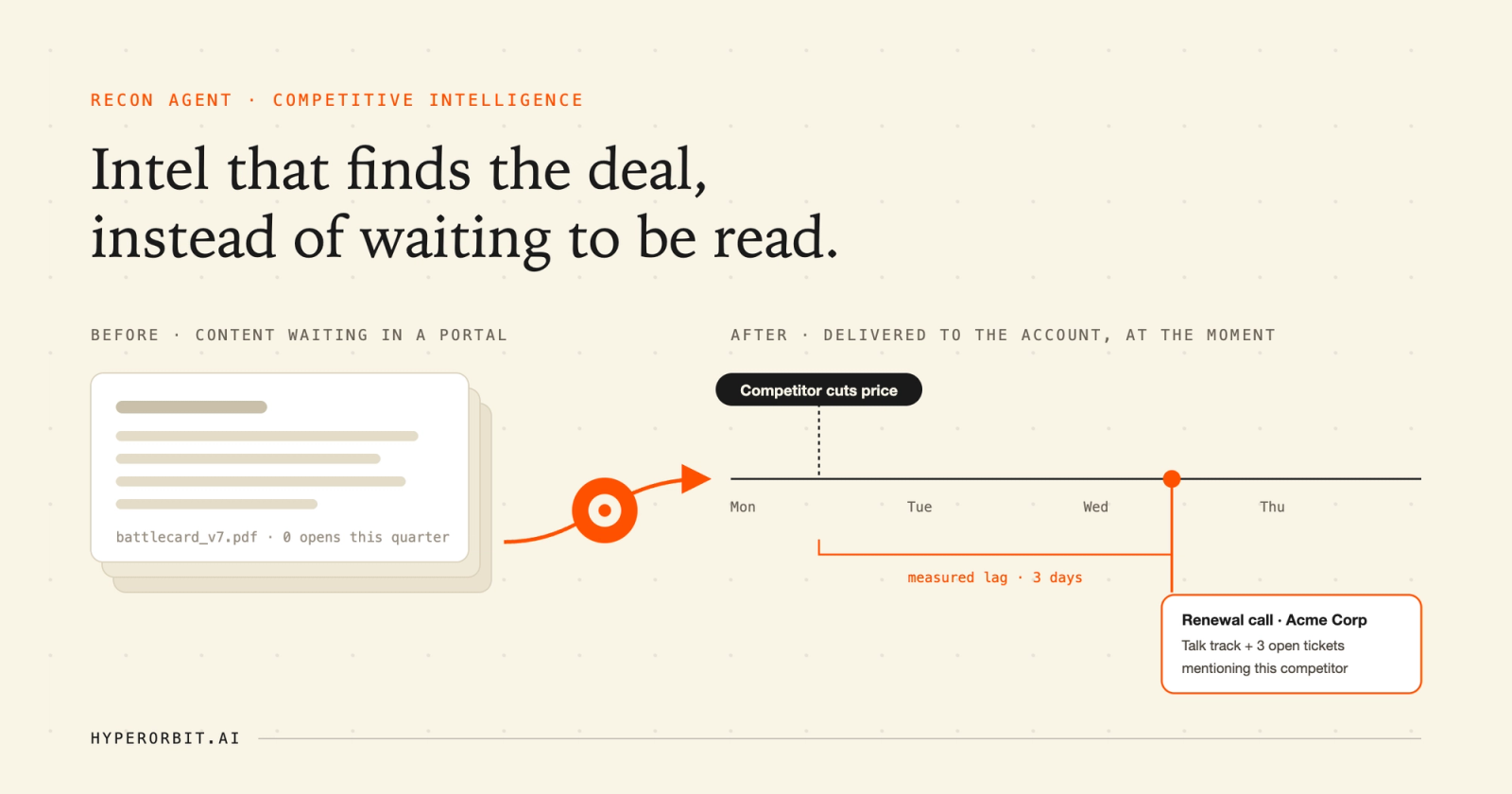
Layer two: what your customers did about it. The tickets, calls and reviews that mention the competitor, the lag between the move and the reaction, and the ARR of the accounts reacting. This layer is missing from the standard stack entirely, because the standard stack reads the competitor's footprint, not your own signal. Our worked example: a free tier launched on 22 May, and eight days later pricing complaints were up by 31 mentions across accounts worth $214K of ARR. No monitoring layer produces that line.
Layer three: what to do, at which account. The counter drafted for the affected account, routed to its owner before the next touchpoint, the battlecard updated as a by-product. This is what the enablement layer is trying to be, without the information layer two would give it.
Count the layers in your stack that read your own customer signal. If the answer is zero, adding tools will make the stack wider, not smarter.
What each standard category actually gives you
- DIY: alerts and a spreadsheet. Layer one, cheaply, until the person maintaining it changes jobs.
- Monitoring and social listening. Layer one with better coverage and a noise problem the next layer has to solve.
- Knowledge management. A library for layer-one output. Useful once, searched rarely.
- Financial and research platforms. Layer one for markets rather than competitors. Valuable for strategy, silent on your accounts.
- AI research assistants. A faster way to read layer one. Ask them which of your accounts a move touched and they cannot know.
- Enablement platforms. Layer three's delivery mechanism, fed by layer one. This is why adoption is their metric: reps are asked to read content that does not know their accounts.
- BI dashboards. Charts of whatever the layers above produced.
The convergence argument, and where it goes
The stack vendors are right that categories are converging under generative AI: monitoring tools now summarise, knowledge tools now answer questions, enablement tools now draft. But they are converging on layer one. A tool that summarises competitor news faster is still a tool that does not read your tickets. Convergence that matters is between competitor signal and customer signal, on one timeline, resolved to one account record.
That is what Recon is built as. It sweeps competitor sites, changelogs, pricing pages and reviews daily, scores each move by the pressure it puts on you, and drafts the counter with a confidence score, held for review. It shares one signal layer with Chorus, which reads your customer feedback, and Atlas, which watches accounts, so every move arrives with the reaction and the ARR attached. Cause and Effect puts the two on one clock, and the Signal Desk is where a question can draw on all three at once.
A stack for a SaaS team
- One agent reading competitors and one reading customers, on the same signal layer. That is layers one and two.
- Your CRM joined, so every move carries the accounts and ARR it touches.
- Delivery into the tools where the work happens: Slack, Jira, HubSpot, Intercom or Zendesk. That is layer three, without a separate enablement platform.
- A research assistant of your choice for the strategic reading, and a spreadsheet for whatever the read cannot yet answer.
Four items, one of which you already own. If you are choosing among tracking platforms for layer one, our ranked list compares six on the same dimensions, and the Klue and Crayon comparisons go dimension by dimension. If you want to see layers two and three on your own signal first, Starter runs Recon on one competitor source and Chorus on one feedback source at no cost.
Frequently asked questions
What is a competitive intelligence stack?
The set of tools a company uses to collect, store, analyse and distribute intelligence about competitors and markets. Analyst lists describe a dozen or more categories; the useful split is by what the tools have to know: competitor moves, your customers' reactions, and the action per account.
Do we need a separate enablement platform?
Only if the layer feeding it does not know your accounts. When competitor moves arrive with the affected accounts, the ARR and a drafted counter, delivery into Slack, Jira or the CRM is the enablement layer.
What is missing from most competitive intelligence stacks?
The layer that reads your own customer signal: which accounts mentioned a competitor after a move, how long the reaction took and what revenue is behind it. Monitoring, knowledge and research tools all read the competitor's footprint instead.
What should a SaaS company's competitive intelligence stack look like?
An agent reading competitors and one reading customers on the same signal layer, the CRM joined for accounts and ARR, delivery into the tools where the work happens, and a research assistant for strategic reading.