- 01What is voice of the customer?3 min
- 02What is competitive intelligence?3 min
- 03What is customer success?3 min
- 04What is account management?4 min
- 05AI agents in voice of the customer
- 06AI agents for competitive intelligence
- 07AI agents for churn prediction3 min
- 08AI agents for customer success
- 09AI agents for account management
AI agents for churn prediction
Churn prediction has a data problem and a timing problem. The signals that predict churn are spread across product usage, support, sales notes, billing and whatever a competitor did last month. And by the time a person assembles them, the account has usually already decided.
In episode seven of Customer Intelligence, Explained, we cover how an AI agent approaches churn prediction differently: watching the signals continuously rather than at review time, connecting cause to effect so the team knows what pushed an account into risk, forecasting renewal risk over the next 30 days rather than scoring today's health, and attaching revenue exposure so the forecast gets a meeting instead of a glance. We also cover what an agent cannot know about a relationship and why the CSM's read still matters.
Goes with this lessonSolutionChurn and renewal watch ›
What is said in this lesson
The spoken text from the video's captions, split into paragraphs. Read it in two minutes or search it for the part you need; the captions are automatic, so a word may be off here and there.
Show the transcript
Most customers who leave decide long before they tell you. The signs are there. A ticket with a sharper tone. A question about exporting data. A meeting that keeps getting moved. Each one looks small. Together they are a warning. Today, how an AI agent reads those signs and why a person still makes the call. So, what is an AI agent? A dashboard shows you data and waits for you to look. A chatbot answers when you ask. An agent does not wait. It watches your sources all the time, decides what matters, drafts an action, and hands it to a person to approve.
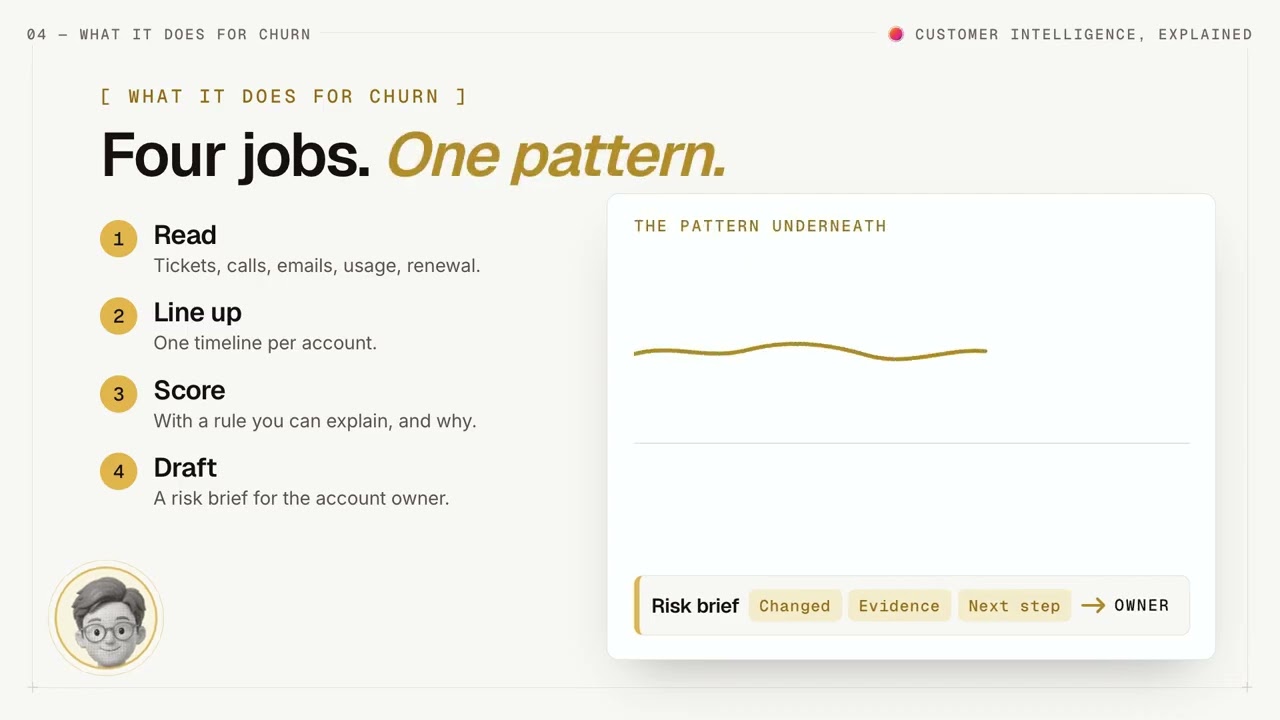
Watch, decide, draft, hand over. For churn, that difference matters because the dashboard is usually opened after the customer has decided. For churn, an agent does four jobs. One, it reads every signal about an account, tickets, calls, emails, usage, and the renewal date. Two, it puts them on one timeline per account. So a support problem and a quiet champion are seen as one story. Three, it scores the risk with a rule you can explain and it always says why. Four, it drafts a risk brief for the account owner.
What changed, the evidence, and a suggested next step. Here is the pattern underneath. The agent compares each account with its own normal, not with everyone else. A change matters more than a level. And words usually change before behavior because people say what they are about to do before they do it. Take a customer of an analytics tool. Usage looks healthy, but in one month the agent sees three things. Two tickets ask how to export all their reports. On a call, the customer's lead asks whether the contract can move to monthly billing, and a new finance contact has been added to the account.
Alone, each is nothing. Together, they look like a customer preparing to leave. The agent drafts a brief and suggests a value review with the new finance contact. The customer success manager reads it, adds context the agent could not know, and books the meeting herself. A risk score is a probability, not a verdict. The agent flags and explains. The person decides whether the risk is real and what to do about it. An agent never emails a customer to say it thinks they might leave and never offers a discount on its own.
The relationship belongs to people. Two mistakes to avoid. First, trusting a confident score with no evidence. A number with no reasons behind it cannot be checked or acted on. Second, automating a broken process. If your team has no agreed way to respond to risk, more alerts just mean more noise. Agree the playbook first. This week, take three customers who left last year. Rebuild the three months before they left. From tickets, calls, and usage. For each one, write down the first sign you could have seen and where it was.
That list is your first set of warning signals. Customer intelligence explained is presented by Hyperorbit, Agentic customer intelligence. Its account agent, Atlas, is in beta on the enterprise plan. Read the free churn prediction method at hyperorbit.i.
Every signal, on one orbit
Connect your first source in an afternoon. The first pass lands before your next standup.
Book a demo