
8 Minutes
Voice of Customer as a discipline has existed for decades. The tools have gotten better — NLP, sentiment scoring, multi-source aggregation. But the fundamental model hasn't changed: collect feedback, theme it, display it on a dashboard, hope someone acts on it.
That model has a hard ceiling. And for growth-stage SaaS companies managing hundreds of accounts across complex product surfaces, most teams are hitting that ceiling right now — even if they can't yet name it.
Here's what the ceiling looks like, why dashboards can't break through it, and what actually works in 2025.
The dashboard model assumes humans will act — they won't, consistently
Every VoC dashboard is built on an implicit assumption: that someone will review the data, draw the right conclusions, prioritise the right signals, and route them to the right people — consistently, week after week, without signal fatigue, without cognitive bias, and without the competing priorities that define every product, CS, and GTM leader's calendar.
That assumption is wrong. Not because people don't care — they do. It's wrong because it places the entire last mile of customer intelligence on the most variable, overloaded part of the system: human attention.
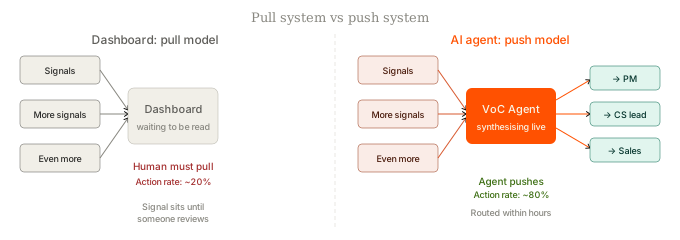
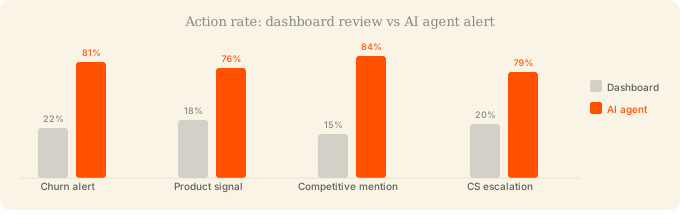
Research on decision-making in operational roles consistently shows that when insight delivery depends on a person pulling a report rather than the system pushing an alert, action rates drop by 60–80%. Dashboards are pull systems. Customers don't wait for you to pull.
What AI agents do differently: push, not pull
The architectural difference between a VoC dashboard and a VoC AI agent is not complexity or feature depth. It's the direction of information flow.
A dashboard waits for you to come to it. An agent comes to you — with a specific, contextualised recommendation, routed to the right stakeholder, at the moment it's most actionable. The same customer signal that would sit in a theme cluster on a dashboard until Tuesday's product review gets synthesised, contextualised against that account's health history and competitive exposure, and delivered as a CS alert within hours of appearing.
This isn't a productivity gain. It's a structural change in how customer intelligence reaches decisions. The same signal, delivered at the right time to the right person, has a fundamentally different impact on retention outcomes than the same signal sitting in a dashboard review queue.
The three jobs a VoC agent does that a dashboard cannot
Job 1 — Continuous synthesis across every channel: A VoC agent doesn't wait for weekly exports. It ingests support tickets, sales call transcripts, review site mentions, NPS verbatims, and product usage signals in real time — surfacing themes as they emerge rather than after they've been sitting in a queue for five business days.
Job 2 — Account-level health scoring without manual work: Instead of showing you aggregate sentiment, a VoC agent scores every individual account against a multi-signal health model — flagging the specific accounts that need CS attention this week, not just the themes that are trending this month.
Job 3 — Routing intelligence to the person who can act: A product signal goes to the PM. A churn risk goes to the CS lead. A competitive mention goes to sales enablement. The routing is automatic, context-aware, and immediate — not dependent on someone reading a dashboard and deciding who should know.
What a real VoC strategy looks like in 2025
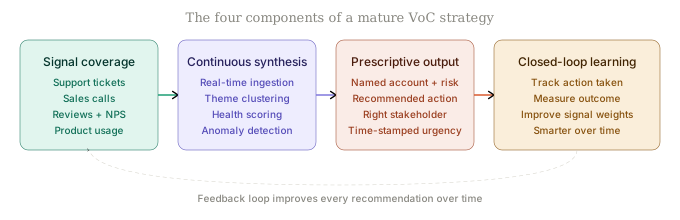
A VoC strategy is not a tool configuration. It's an operational architecture that connects customer signals to business decisions at the speed of the market. The components of a mature VoC strategy in 2025 look like this:
Signal coverage: Every customer touchpoint — support, sales, product, community, review sites — feeds into a unified ingestion layer. No signal is siloed by department or tool boundary.
Continuous synthesis: An autonomous agent processes the signal stream in real time, clustering themes, scoring account health, flagging anomalies, and identifying convergence patterns — without human intervention in the synthesis step.
Prescriptive output: The system doesn't produce a dashboard. It produces a recommendation — specific, contextualised, and time-stamped. "Account X shows three churn signals. Recommended action: CS outreach by Thursday. Context: champion changed roles 18 days ago, support tickets spiked last week, NPS dropped from 9 to 6."
Closed-loop measurement: Every recommendation is tracked to an outcome. Did the CS outreach happen? Did the account renew? This feedback loop makes the system smarter over time — improving signal weighting and recommendation quality based on what actually worked.
How to transition from dashboard to agent: a practical starting point
You don't need to rip out your current tooling to start this transition. Most teams begin with two parallel moves:
Move 1 — Identify your three most critical decision moments: Which decisions, if made two weeks earlier, would have the biggest impact on retention or revenue? These are the use cases your agent should be optimised for first. Churn prediction and competitive win/loss are the two highest-value starting points for most mid-market SaaS teams.
Move 2 — Replace one dashboard review with one agent alert: Pick your highest-stakes weekly dashboard review and replace it with a proactive agent alert to the same stakeholders. Measure the difference in response time and action rate over 60 days. The data will make the case for broader adoption more effectively than any business case document.
Conclusion
A dashboard tells you what happened. A strategy prevents what shouldn't.
The companies winning on customer retention in 2025 aren't winning because they have better dashboards. They're winning because they've stopped treating VoC as a reporting function and started treating it as an operational system — one that actively moves intelligence to decisions, automatically, at the speed the market demands.
A dashboard is a tool. A VoC strategy built on autonomous agents is infrastructure — the kind that compounds in value as your account base grows, your product surface expands, and your competitive environment intensifies. Every signal it processes makes the next recommendation sharper. Every closed loop makes the system more accurate.
The shift from pull to push, from descriptive to prescriptive, from analyst-dependent to agent-driven — this is not a future state. The teams building the deepest customer intelligence moats in 2025 are making this shift now. The question is whether you're one of them.