
12 Minutes
There is a moment every product manager knows. You are in sprint planning. Someone raises a feature request. Someone else says they have heard the same request. A third person says it came up in a renewal call three months ago. You spend fifteen minutes trying to reconstruct how many customers have asked for it, from how many channels, with what urgency, and what it would mean for revenue.
You finish the sprint planning without a definitive answer. The feature goes on the backlog. Three months later, a customer churns citing the missing capability.
This is the product-customer gap. It is not a failure of intent. Every team on that call cared about getting it right. It is a failure of architecture — a system that has no reliable, fast pathway from customer signal to structured product decision.
Nearly every SaaS organization recognizes the value of listening to customers, yet there is a wide gap between collecting feedback and turning it into meaningful, timely action. Asknicely
Closing that gap is the most operational problem in product management. AI agents are the first technology that actually addresses it architecturally rather than cosmetically.
The Four Stages Where the Gap Opens
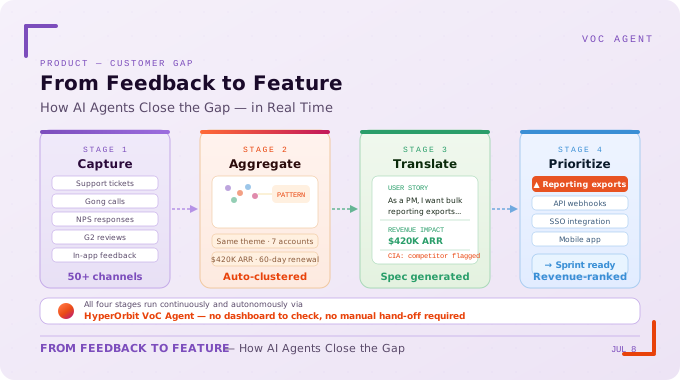
The journey from customer signal to shipped feature has four stages. Each one is a potential point of failure.
Stage 1: Capture. The customer says something. It might be in a support ticket, an NPS comment, a renewal call, a G2 review, or an offhand Gong call remark during a QBR. Most organizations capture some of these channels deliberately. None capture all of them systematically. Email surveys remain the most common feedback collection method, used by 87% of SaaS companies — but relying on a single channel risks missing critical touchpoints where friction can erode satisfaction and loyalty. Asknicely
The signal that most predicts churn is rarely the NPS survey. It is the support ticket that describes a workaround the customer has been using for six months because the product does not do what they need it to do. That ticket is in the support system. The product team is not in the support system.
Stage 2: Aggregation. Even when signals are captured across channels, they are rarely connected. The support ticket from TechCorp in March, the feature request from TechCorp's power user in April, and the "we're evaluating alternatives" comment from TechCorp's CSM in May are three separate data points in three separate systems. No human with a full workload reliably makes that cross-channel connection. The pattern is invisible.
Stage 3: Translation. Even when a pattern is recognized — someone notices that seven customers have mentioned the same capability gap in the last quarter — the work of converting that observation into a structured product requirement is manual and slow. What exactly do customers want? What are the underlying jobs they are trying to do? What would a user story look like? What is the revenue impact? This translation step is where most feedback dies: it sits in a Slack message, a Notion doc, or a Confluence page, never formatted into something engineering can act on.
Stage 4: Prioritization. Even when a requirement is written, it enters a backlog with fifty other items. Without revenue weighting — without knowing that this specific request comes from accounts representing $400K in ARR with an average renewal date of 90 days — it competes on equal footing with features that matter less to revenue. AI agents can analyze customer feedback, market trends, and competitive features to automatically generate potential requirements and feature suggestions, ensuring product roadmaps are data-driven and customer-centric. Getmonetizely
Each stage is a place where the signal degrades. Most teams manage stage one tolerably. Stages two through four are where the gap lives.
What AI Agents Do at Each Stage
The structural contribution of AI agents is not to make any one stage faster. It is to automate the hand-offs between stages — the transitions where signals are currently lost, delayed, or stripped of context.
At capture: The VoC Agent monitors all active feedback channels continuously — 50+ sources including support tickets, Gong calls, NPS responses, G2 reviews, Intercom conversations, in-app feedback, and renewal call notes. It does not wait for a weekly review or a quarterly survey cycle. It processes in real time, every day, every hour.
At aggregation: The agent automatically cross-references signals across channels and accounts. When TechCorp's support ticket, power user request, and CSM note all contain the same theme — even if the language is different — the agent clusters them as a single pattern. The three separate data points become one coherent signal: "TechCorp, $85K ARR, renewal in 60 days, has requested expanded reporting capability across three touchpoints in the last 90 days."
At translation: This is where the agent's output moves from intelligence to action. Rather than surfacing a theme and stopping — which is what most analytics tools do — the VoC Agent generates a structured product requirement directly from the clustered feedback. User story. Acceptance criteria. Revenue impact. Number of accounts affected. Competitive context from the CIA Agent if any competitor mentions are present. The output lands in the PM's backlog in a format engineering can immediately work with — no interpretation required, no requirement-gathering meeting needed.
AI clusters open-ended feedback, support queries, and behavioral trends into product insights automatically — closing the gap between user behavior and product decisions in real time. It can summarize key pain points, suggest UI fixes, or tag ideas for the product roadmap. Procreator
At prioritization: The requirement enters the backlog already weighted by revenue impact. The agent does not ask PMs to manually score requests by business value — it calculates the ARR at stake, the account renewal timing, the churn risk associated with the gap remaining unaddressed, and the competitive threat level. The PM's judgment call is no longer "which of these fifty requests is most important" — it is "given these three high-priority revenue-weighted requirements the agent has surfaced, which do we build first."
The Loop That Makes It Compound
The single-pass version of this — feedback captured, aggregated, translated, prioritized — is valuable on its own. But the more important property of an agent-based system is that it runs continuously and learns from its own outputs.
A feedback loop is the full cycle of asking users for input, acting on what they say, and then showing them that their voice made a difference. Most teams get stuck after step one. But when you complete the loop, you build trust, get more useful feedback, and your product keeps improving in the right direction. Qualaroo
When a feature is shipped in response to a cluster of signals, the agent tracks whether those accounts' sentiment improves, whether the feedback about that capability decreases, whether the accounts at risk renewed. That outcome data feeds back into the agent's prioritization model — it learns which types of signals most reliably predict churn risk, which feature gaps have the highest resolution impact, which customer segments produce the most accurate early warning signals.
Over time, the gap between customer signal and shipped feature does not just close. It stays closed — because the agent is continuously monitoring for the next opening, not waiting to be queried.
Why the Architecture Matters More Than the Tool
The future of product management isn't about writing requirements that age faster than milk — it's about shaping systems that learn, adapt, and respond in real time. This is a shift from designing workflows to designing behaviors. Corlytics
This framing matters because most product teams still approach the feedback-to-feature problem by adding tools to their existing workflow rather than changing the workflow architecture. They add a feedback aggregation tool. They add an NPS platform. They add a product analytics layer. Each addition improves one stage. None of them change the fundamental architecture — a human still has to sit at the centre of the system, pulling data from each tool and manually constructing the picture.
Most SaaS dashboards are basically historical records. They tell you last month's churn rate. They don't flag the accounts most likely to churn next month. AI closes that gap. Predictive features change the relationship users have with your product — they stop using it to review the past and start relying on it to navigate what's next. Danetsoft
The architecture change is this: the agent sits at the centre instead of the human. The human's job shifts from collecting and translating signals to making decisions about what to build and validating that the right signals are being tracked. That shift is not incremental. It is the difference between a product team that spends 60% of its time on intelligence-gathering and one that spends 60% of its time on building.
SaaS companies winning the retention war are the ones that know how to turn customer feedback into product success — not eventually, but systematically and without excuses. 88% of customers now expect companies to accelerate improvements based on their feedback. BlueSuite
The expectation is already set. Customers believe their feedback should produce faster, more responsive product evolution. The teams that meet that expectation are the ones with an architecture that does not require a quarterly review cycle to produce an action.
What This Looks Like in Practice
A mid-market SaaS company at $30M ARR running HyperOrbit's VoC Agent typically sees the following in the first 30 days:
The first week surfaces a feedback cluster that the product team knew existed abstractly but had never quantified — a workflow gap mentioned by 14 accounts representing $620K in ARR, with an average renewal date of 80 days. The agent produces a structured requirement and flags the cluster as high-priority. The PM takes the requirement directly into the next sprint planning.
By week three, the CIA Agent has cross-referenced two of those 14 accounts as having also mentioned a competitor in their feedback — elevating the urgency from a roadmap priority to a retention risk. Sales gets a battlecard. CS gets an alert. Product gets a commitment to accelerate the feature.
By day 45, the feature ships. The agent tracks the accounts' sentiment trajectory post-release. Twelve of the 14 show improving sentiment. Two do not — and the agent flags them for follow-up because the specific concern they raised was a variant of the original request, not the core issue.
This is the product-customer gap closing in real time. Not in a quarterly planning cycle. Not in a post-mortem after three churns. While the customer is still there.
Conclusion
The Gap Is a Systems Problem. The Agent Is a Systems Answer.
The product-customer gap has always been a systems problem. Customers send signals. The signals arrive in the wrong format, in the wrong place, at the wrong time for the people who could act on them. By the time the signal reaches the PM, it has been filtered, delayed, decontextualized, and separated from the other signals that would have made it urgent.
AI agents do not make product managers smarter or faster. They change the system so that the signal arrives in the right format, in the right place, at the right time — and already connected to the other signals that give it meaning.
That is the product-customer gap, closed.
HyperOrbit is live today. If you want to see what the VoC Agent finds in your customer feedback in the first session — and what it turns into — book a demo or start free.