
Competitor Comparisons
Unwrap vs HyperOrbit - Proactive Trends vs Autonomous Agents
Unwrap surfaces proactive trends from feedback. HyperOrbit goes further — predicting churn 60–90 days out and routing competitive alerts before you think to ask.
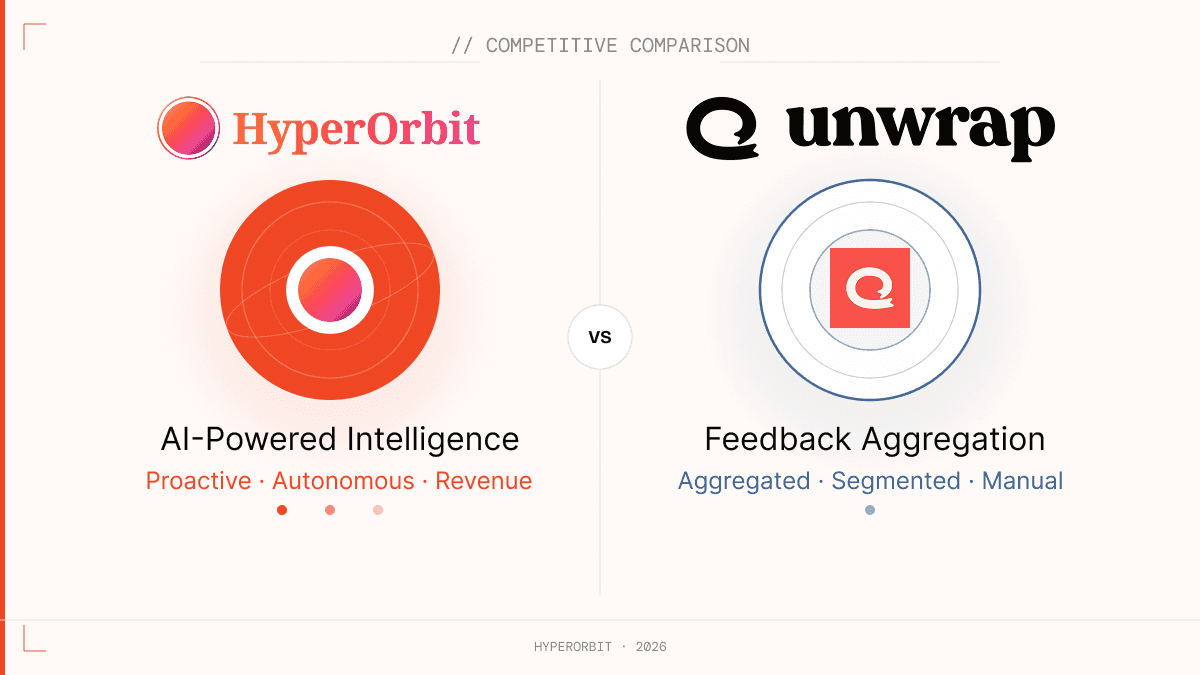
If you've been evaluating tools for understanding your customers better, you may have looked at both HyperOrbit and Unwrap. They both deal with customer intelligence in some form — but they're built for very different use cases and very different teams.
This post breaks down what each tool actually does, where they differ, and how to figure out which one fits — whether you're in CS, Product, or Product Marketing.
What is Unwrap?
Unwrap is designed to help product teams cut through the noise in customer feedback. It ingests data from tools like Intercom, Zendesk, and app store reviews, then uses AI to surface recurring themes and feature requests.
The platform is focused primarily on the product team use case: giving PMs a faster way to understand what customers want so they can prioritise the roadmap more confidently.
Unwrap is built around product feedback intelligence. It's strong at identifying feature requests and pain points from existing feedback channels — with the product roadmap as the primary output. |
What is HyperOrbit?
HyperOrbit is a customer intelligence platform that uses AI agents to continuously monitor signals across your customer data — support tickets, sales calls, product usage, reviews, and more — and surface actionable insights automatically.
Where Unwrap is focused on a specific workflow, HyperOrbit is built to serve CS teams preventing churn, Product teams deciding what to build or stop building, and Product Marketing teams tracking competitive positioning and message resonance — all from the same platform.
HyperOrbit is built around proactive, automated intelligence — not just for protecting revenue, but for making better product and go-to-market decisions. It monitors signals continuously so the right teams can act before it's too late. |
Side-by-side
Here's how the two products compare across the dimensions that matter most for B2B teams.
DIMENSION | HYPERORBIT | UNWRAP |
|---|---|---|
Primary use case | Customer intelligence for CS, Product & PMM | Product feedback & feature request analysis |
How insights surface | AI agents, automated & continuous | AI on connected feedback sources |
Primary users | CS, Product, Product Marketing, RevOps | Product Managers, Product teams |
Product decision support | What to build / stop building ✓ | Feature prioritisation from feedback |
Churn prevention | Native ✓ | Not a core feature |
Competitive intelligence | Built-in CI Agent | Not available |
Real-time alerts | Yes | Limited |
Revenue signal tracking | Integrated with CRM & CS tools | Not available |
Where they overlap
Both platforms try to make sense of customer signals automatically, rather than requiring manual tagging. If your main goal is to understand which product areas customers complain about most, there's real overlap.
But HyperOrbit is designed to serve more than the product team. CS teams use it to catch churn signals before they become lost accounts. Product Marketing uses it to track competitive mentions and positioning shifts. Unwrap stays focused on the product roadmap question.
Who each tool is for
HYPERORBIT IS FOR | UNWRAP IS FOR |
|---|---|
|
|
Can you use both?
Potentially, if your needs span both product prioritisation and revenue intelligence. Unwrap helps PMs move faster on the roadmap. HyperOrbit tells your CS and PMM teams what's happening across all customer-facing signals right now.
If protecting revenue and tracking competitive dynamics matter as much as feature prioritisation, HyperOrbit covers all three. Unwrap is narrower by design.
Unwrap is a focused product feedback tool for PMs who need faster insight-to-roadmap workflows. HyperOrbit is built for CS, Product, and Product Marketing teams who need continuous, automated intelligence — to protect revenue, make faster product decisions, and stay ahead of competitors. Different scopes. Different teams. |
What is Unwrap?
What is HyperOrbit?
Side-by-side
Where they overlap
Who each tool is for
Can you use both?
Book a quick demo and see how the CIA Agent and VoC Agent work together.