
Competitor Comparisons
Dovetail vs HyperOrbit - Research Repo vs Autonomous Agents
Dovetail is a research repository your team queries manually. HyperOrbit monitors continuously and routes revenue-weighted alerts to product, CS, and sales automatically.
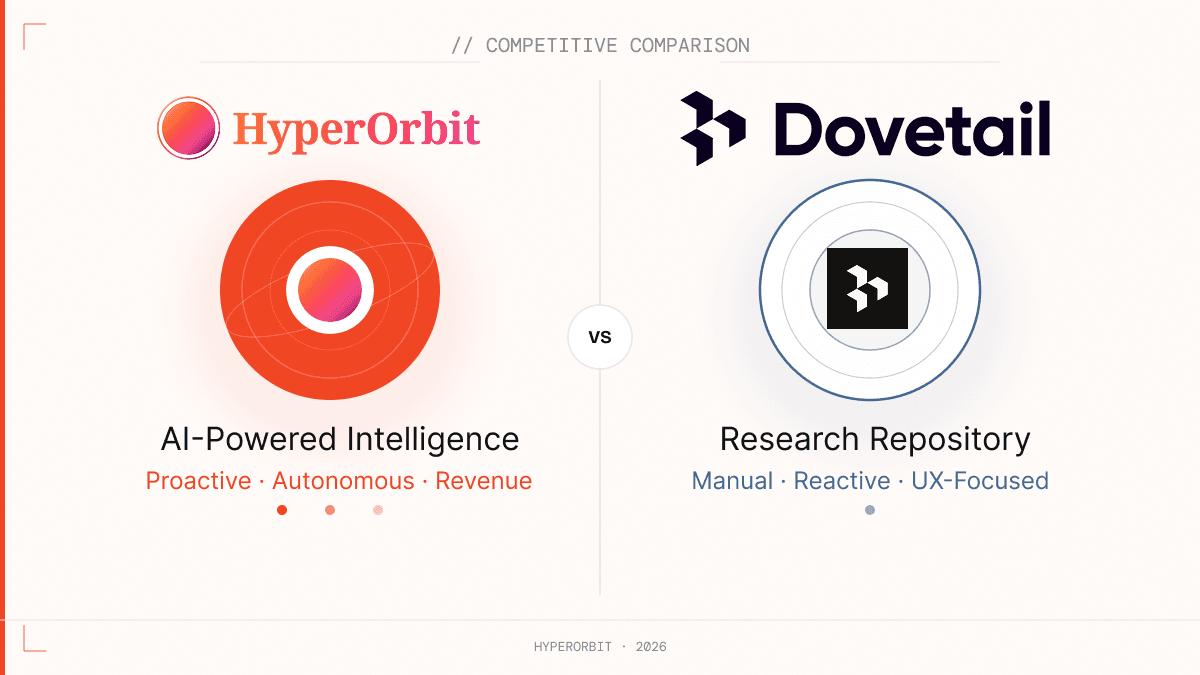
If you've been evaluating tools for understanding your customers better, you've probably come across both HyperOrbit and Dovetail. They both deal with customer intelligence in some form — but they're built for very different use cases and very different teams.
This post breaks down what each tool actually does, where they differ, and how to figure out which one fits — whether you're in CS, Product, or Product Marketing.
What is Dovetail?
Dovetail is a research repository and qualitative analysis platform. It's designed for UX researchers and product teams to store, tag, and surface insights from customer interviews, survey responses, and usability test recordings.
The core workflow is largely manual: you upload recordings or transcripts, apply tags and themes, and build a searchable archive over time. Dovetail is strong at helping research-heavy teams stay organised and share findings across the company.
Dovetail is built around organizing and structuring research. Its value compounds with what your team puts in — and the analysis remains researcher-driven. |
What is HyperOrbit?
HyperOrbit is a customer intelligence platform that uses AI agents to continuously monitor signals across your customer data — support tickets, sales calls, product usage, reviews, and more — and surface actionable insights automatically.
Where Dovetail asks you to bring the data and run the analysis, HyperOrbit is built to do that proactively. It's used by CS teams to prevent churn, by Product teams to understand what customers actually need so they can decide what to build (or stop building), and by Product Marketing to track competitive positioning and message resonance in real time.
HyperOrbit is built around proactive, automated intelligence — not just for protecting revenue, but for making better product and go-to-market decisions. It monitors signals continuously so the right teams can act before it's too late. |
Side-by-side
Here's how the two products compare across the dimensions that matter most for B2B teams.
DIMENSION | HYPERORBIT | DOVETAIL |
|---|---|---|
Primary use case | Customer intelligence for CS, Product & PMM | UX research repository & analysis |
How insights surface | AI agents, automated & continuous | Manual tagging, researcher-led |
Primary users | CS, Product, Product Marketing, RevOps | UX Researchers, Product teams |
Data sources | Support, CRM, calls, reviews, usage | Interviews, surveys, recordings (uploaded) |
Product decision support | What to build / stop building ✓ | Not designed for this |
Churn prevention | Native ✓ | Not built for this |
Competitive intelligence | Built-in CI Agent | Not available |
Real-time alerts | Yes | No |
CRM / Slack integrations | Zendesk, Salesforce, Gong, Slack + more | Limited; focused on research tooling |
Where they overlap
Both tools are trying to help teams understand customers. If your Dovetail research surfaces feature requests or competitive mentions, there's a surface-level overlap in the kinds of questions they help answer.
But the workflows — and the outputs — diverge significantly. Dovetail is a place to store and structure research after it's collected. HyperOrbit monitors and surfaces signals as they happen, and connects them to decisions: should we fix this? build this? kill this feature? how are competitors positioning against us?
Who each tool is for
HYPERORBIT IS FOR | DOVETAIL IS FOR |
|---|---|
|
|
Can you use both?
Yes — and some teams do. If you have a UX research function running structured interviews and a product team that also needs to know what customers are complaining about in support, or what's driving competitive churn, these are different problems that different tools solve.
Dovetail is where you store and analyse the research you deliberately run. HyperOrbit is what tells your CS, Product, and PMM teams what's happening right now — and what to do about it.
Dovetail is a strong research repository for teams with a structured UX research practice. HyperOrbit is built for CS, Product, and Product Marketing teams who need continuous, automated customer intelligence — to protect revenue, make faster product decisions, and stay ahead of competitors. Different tools. Different jobs. |
What is Dovetail?
What is HyperOrb
Side-by-side
Where they overlap
Who each tool is for
Can you use both?
Book a quick demo and see how the CIA Agent and VoC Agent work together.