
8 Minutes
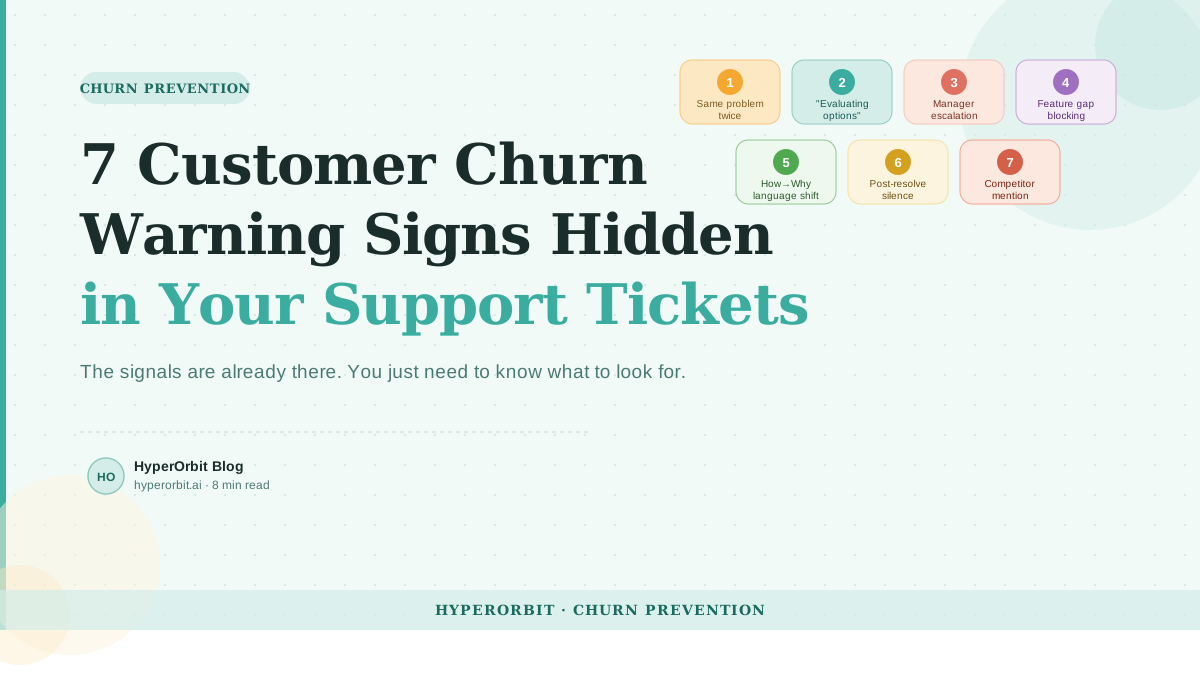
Churn doesn't start when a customer submits a cancellation request. It starts weeks — sometimes months — earlier, in the quiet accumulation of support tickets nobody had time to read closely enough.
The language is there. The frustration is there. The warning is there.
Most customer success teams miss it because they're reading tickets one at a time, resolving them in isolation, and moving on. They're not looking for patterns. They're not connecting a frustrated ticket in February to a renewal at risk in April.
That's the gap. And it costs mid-market SaaS teams an average of $450,000 per year in preventable churn.
Here are the seven warning signs hiding in your support queue right now.
Signs 1 and 2 — The Earliest Indicators
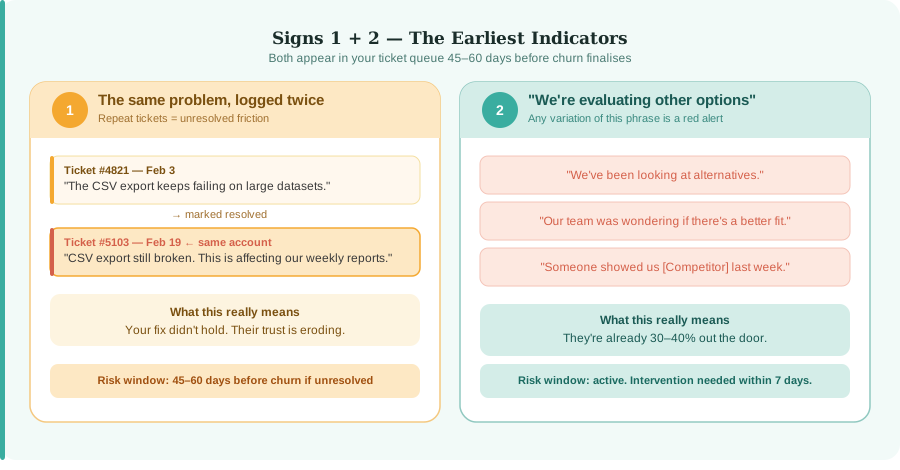
Sign 1: The same problem, logged twice
A customer submits a ticket. You resolve it. Three weeks later, the same customer submits the same ticket again.
This is the most underrated churn signal in your queue. A repeat ticket doesn't mean the customer is persistent — it means your fix didn't hold, and their trust in your support process is eroding. When this happens within a 30-day window, you're looking at a 45–60 day churn timeline if the underlying issue remains unresolved.
The pattern to watch: same account, same category, same week of the month. That rhythm means the problem is structural, not incidental.
Sign 2: Any variation of "we're evaluating other options"
This one is blunt. When a customer mentions alternatives — however casually — in a support ticket, the evaluation has already started. They're not window-shopping. They've been burned enough to start looking.
The phrases that matter: "We've been looking at alternatives," "Someone showed us [Competitor] last week," "Our team was wondering if there's a better fit."
Any one of these appearing in a support ticket should trigger a CS call within seven days. Not a reply ticket — a call.
Signs 3 and 4 — Escalation and Feature Gaps
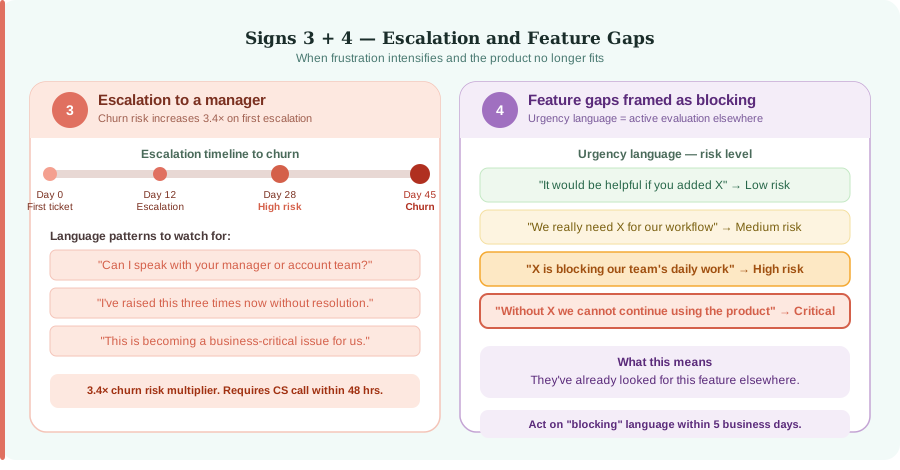
Sign 3: Escalation to a manager within 30 days of renewal
When a customer asks to speak with a manager, their churn risk increases 3.4 times — immediately. This is true regardless of whether the underlying issue gets resolved. The act of escalation signals that the customer has lost confidence in the standard support process.
When escalation happens within 30 days of renewal, the risk compounds. The customer is already in renewal evaluation mode, and now they have a fresh grievance on top of it.
The intervention protocol here is executive-level. A support response is not enough. The account needs a QBR, an executive call, or a direct outreach from the CS lead — within 48 hours.
Sign 4: Feature gaps framed as blocking issues
Every product gets feature requests. Most are benign. But there's a specific language pattern that separates a wishlist item from a genuine churn signal: urgency framing.
Low risk: "It would be helpful if you added X." — noting a gap. Medium risk: "We really need X for our workflow." — expressing dependency. High risk: "X is blocking our team's daily work." — operational friction. Critical: "Without X we cannot continue using the product." — active evaluation elsewhere.
The critical signal isn't the request itself — it's the implication that they've already looked for this feature elsewhere and found it. Act on blocking language within five business days.
Signs 5, 6 and 7 — The Subtle but Lethal Signals
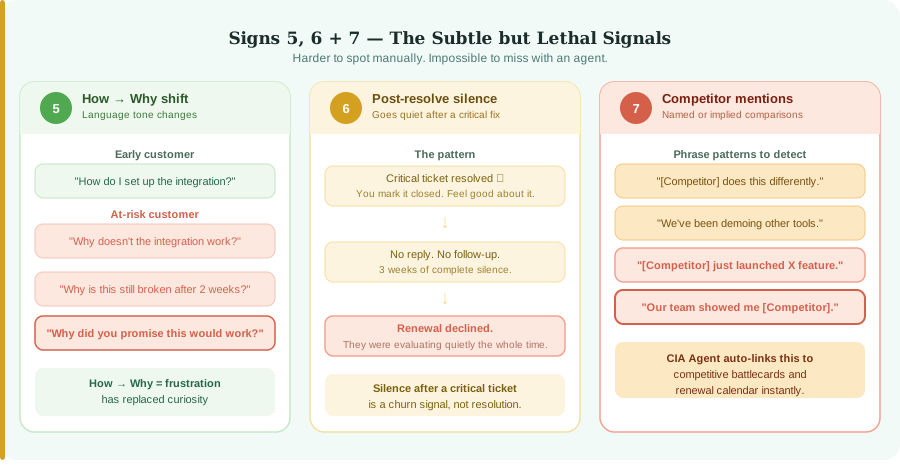
Sign 5: The shift from "how" questions to "why" questions
Early-stage customers ask how questions. They're learning, exploring, building. "How do I set up the integration?" and "How do I export a report?" are healthy curiosity signals.
At-risk customers ask why questions. "Why doesn't this integration work?" and "Why is this still broken after two weeks?"signal that curiosity has been replaced by frustration. When why questions start accumulating in a single account's ticket history, you're watching trust deteriorate in real time.
The shift usually happens gradually — two or three tickets, across four to six weeks. No individual ticket looks alarming. The pattern does.
Sign 6: Silence after a critical ticket is resolved
This is the most counterintuitive signal on this list. A customer submits an urgent, escalated ticket. You resolve it fast. They go quiet.
You feel good about this. You shouldn't.
In a healthy customer relationship, resolution is followed by acknowledgment — a thank-you, a follow-up question, continued engagement. When a customer goes completely silent after a critical issue is resolved, it often means one of two things: they're evaluating alternatives quietly, or the resolution didn't actually satisfy them and they've stopped expecting it to.
Either way, silence after resolution is a signal worth investigating — not celebrating.
Sign 7: Competitor mentions in any form
The most direct signal on this list. When a customer mentions a competitor — by name, by implication, or by feature comparison — in a support ticket, the competitive evaluation is already in progress.
These mentions are rarely aggressive. They appear as casual observations: "[Competitor] does this differently," or "Our team showed me [Competitor] last week." The casualness is deceptive. By the time a customer mentions a competitor in a support context, they've almost certainly had at least one demo.
This signal needs to do two things simultaneously: trigger a CS intervention on the account and feed into your competitive intelligence pipeline so your team understands which features are driving the evaluation.
Conclusion
The Problem Isn't the Signals — It's the Scale
Every one of these seven signs is visible in your support queue today. The challenge isn't recognising them in isolation — an experienced CS manager reading a single ticket would spot most of them. The challenge is catching them consistently, across every account, in real time, before they accumulate into a churn decision.
At 50 accounts, manual review is possible. At 200 accounts, it's expensive. At 500 accounts, it's impossible.
That's the scale problem. And it's exactly the problem HyperOrbit's VoC Agent was built to solve.
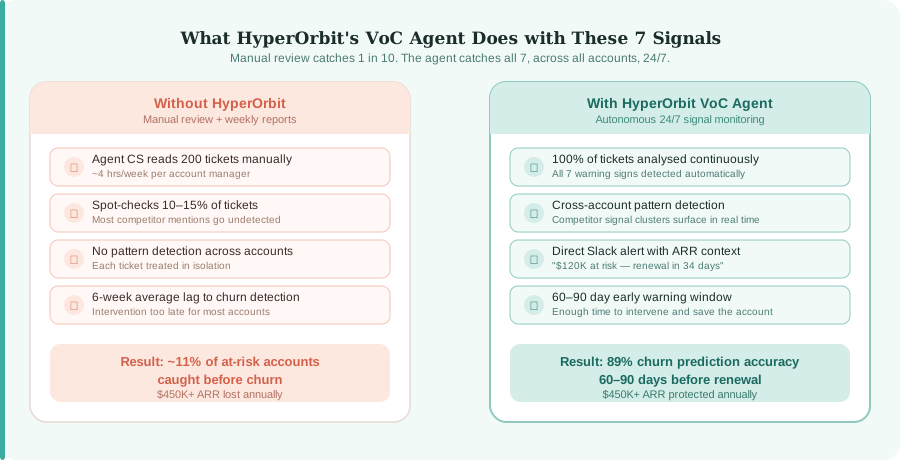
The agent monitors every support ticket, Gong call, survey response, and Slack message across all your accounts continuously. It doesn't spot-check. It doesn't miss the week you're at a conference. It detects all seven of these signals — and correlates them with renewal dates, ARR, and account health scores — to surface prioritised churn risk alerts directly to your CS team.
The result is an 89% churn prediction accuracy window of 60–90 days — enough lead time to actually intervene, not just observe.
Your support tickets are the most honest customer feedback you receive. They're not survey responses shaped by politeness. They're your customers telling you exactly what's wrong, in the language of genuine frustration. The only question is whether you're reading them before it's too late.
If you're relying on manual review to catch these signals, you're catching maybe one in ten. The other nine are churning quietly, one unread ticket at a time.
→ Related reading: How to Predict Customer Churn 60–90 Days Before It Happens
→ See it in action: Voice of Customer Agent
→ For competitor signals: Competitive Intelligence Agent