
18 Minutes
Every product team thinks they know their customers. Most are working with a fraction of the picture.
They have the NPS score from last quarter. A handful of support tickets that made it into the weekly digest. The three quotes from customer interviews that got included in the last roadmap presentation. And somewhere in a spreadsheet nobody opens anymore, 400 survey responses from a campaign that ran six months ago.
This isn't customer knowledge. It's customer archaeology — sifting through fragments of what customers said, at a point in time, through channels they happened to use, hoping the picture that emerges reflects something real about what they need today.
Voice of Customer analytics was supposed to fix this. In practice, most implementations have made the problem more sophisticated without actually solving it.
What Voice of Customer Analytics Actually Means
Voice of Customer — VoC — is the practice of systematically capturing, analyzing, and acting on what customers say about their experience with your product. In theory, it's straightforward: listen to customers, understand what they need, build accordingly.
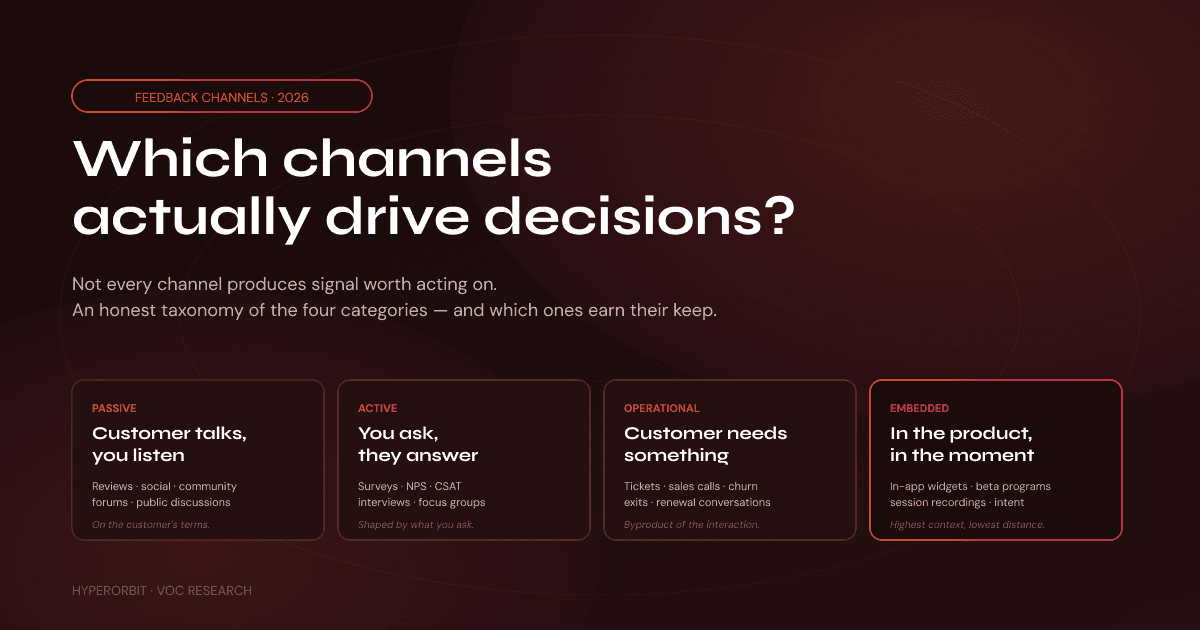
In practice, the gap between "listening" and "understanding" has always been wide. Customer feedback arrives in dozens of formats across dozens of channels simultaneously. A product team might be pulling signal from support tickets, in-app surveys, NPS campaigns, G2 reviews, Gartner peer insights, sales call recordings, customer success check-ins, community forums, and social mentions — all at the same time, all unsorted, all in different formats, all potentially contradicting each other.
Traditional VoC programs responded to this complexity with periodic analysis. Quarterly reviews. Monthly sentiment reports. Bi-weekly digest emails. The implicit assumption was that analyzing feedback regularly was good enough — that the patterns would hold long enough for a human team to catch them, interpret them, and act on them before they became problems.
That assumption no longer holds. Products ship weekly. Customer expectations evolve daily. A sentiment shift that starts in support tickets this Tuesday can translate to churn by the end of the month if nobody catches it in time.
The Three Gaps Every VoC Program Hits
The volume gap. The average mid-market SaaS company receives thousands of customer feedback signals every month across all channels. A human team can realistically read and tag a fraction of that. The rest gets sampled, summarized, or ignored — which means decisions get made on partial data while full-picture insights go unnoticed.
The context gap. Raw feedback without context is noise. Knowing that 200 customers mentioned "slow performance" this month tells you something. Knowing that 160 of those customers represent $4.2M in ARR, 40 of them are up for renewal in the next 90 days, and the accounts with the worst sentiment scores have already reduced their usage by 30% — that tells you everything. Most VoC tools capture the signal. Very few connect it to the business reality behind it.
The speed gap. By the time a quarterly VoC review surfaces a pattern, the customers driving that pattern have already formed a conclusion about your product. They've either adapted, downgraded, or started evaluating alternatives. The insight arrives after the window for action has closed.
These three gaps — volume, context, speed — are why so many product teams feel like they're listening to their customers while still being surprised by churn. They're not missing the signal. They're missing the infrastructure to process it fast enough, completely enough, and with enough business context to act on it before it's too late.
What Modern VoC Analytics Looks Like
The shift that's happened in VoC analytics over the past two years isn't primarily about AI — it's about architecture. The question is no longer "how do we analyze feedback?" but "how do we build a system that's always analyzing feedback, connecting every signal to business context, and surfacing the right insight to the right person at the right time?"
This means moving from periodic to continuous. Rather than exporting feedback monthly and running it through an analysis process, effective VoC systems monitor all channels in real time, maintaining a constantly updated picture of customer sentiment, emerging themes, and account-level risk.
It means moving from volume to weight. Not all feedback is equal. A feature request from a free-tier user and a feature request from a $200K ARR enterprise account should not receive the same priority score. Revenue-weighted signal tells a fundamentally different story than raw volume.
And it means moving from insight to action. The final output of a VoC system shouldn't be a report. It should be a decision: this account needs a call, this feature needs to move up the roadmap, this pattern in the data predicts a churn wave in six weeks.
The Five Core Capabilities of Effective VoC Analytics
Omnichannel signal capture. Customers don't express dissatisfaction through a single designated channel. They complain in support tickets, warn in NPS responses, vent in community forums, and signal in usage patterns simultaneously. An effective VoC system captures all of it — not as separate data sources requiring separate tools, but as a unified stream of customer intelligence.
Semantic classification beyond keywords. Keyword matching is how VoC programs worked in 2015. Customer language is far too nuanced for it. "Just here to watch the dumpster fire" contains no negative keywords. "I guess it works if you don't care about speed" reads as neutral by word count. Effective VoC analytics uses trained semantic models to understand intent, emotion, and urgency — not just the words on the surface.
Account-level intelligence. Every piece of feedback should be traceable to the customer and account behind it: their ARR, their contract tier, their renewal date, their support history, their usage trend over the past 90 days. Without this layer, VoC is demographics. With it, VoC is intelligence.
Predictive churn signals. The most valuable thing a VoC system can do is tell you about a problem before the customer decides to leave. Churn doesn't happen suddenly — it's preceded by a sequence of signals: declining engagement, increasing support friction, negative sentiment on specific features, competitive mentions in feedback. A well-built VoC system learns to recognize this sequence and flags at-risk accounts while there's still time to intervene.
Closed-loop action triggers. Insight without action is expensive data storage. The output of VoC analytics should connect directly to the workflows where decisions happen — Slack alerts for at-risk accounts, Jira tickets for recurring feature requests, automated CSM notifications when a high-value account's sentiment score drops below threshold. The loop isn't closed until someone does something differently because of what the data surfaced.
How HyperOrbit Approaches VoC
HyperOrbit's VoC Agent was built around a single conviction: the gap between what customers are experiencing and what product teams know about it should be measured in hours, not weeks.
The agent runs continuously across every connected feedback channel — support platforms, NPS tools, review sites, community forums, customer success notes, sales call transcripts. Every signal is classified by theme, sentiment, urgency, and intent using models trained on the nuances of customer language, not keyword frequency. Every classified insight is immediately connected to the account behind it: the ARR at stake, the renewal timeline, the usage trend, the CSM owner.
The result isn't a dashboard. It's a live picture of your customer base — which accounts are healthy, which are at risk, which are silently evaluating alternatives, and which patterns in the feedback are predicting trouble six to twelve weeks out.
When the VoC Agent detects an at-risk account, it doesn't wait for someone to log in and discover it. It surfaces the alert to the right person — the CSM, the product lead, the account executive — with the context they need to act: what the customer has been saying, across which channels, over what timeframe, and what similar patterns have indicated in the past.
HyperOrbit's VoC Agent also works in conjunction with the Competitive Intelligence Agent. When a customer's negative sentiment correlates with competitive mentions in their feedback, both signals are treated as a compound risk — not separate data points in separate tools. This cross-agent intelligence is what separates a VoC program that tells you what happened from one that tells you what's about to happen.
What Good VoC Analytics Changes
Product teams with mature VoC programs don't just make better decisions — they make decisions faster, with more confidence, and with less internal debate about what customers actually want.
Roadmap prioritization stops being a negotiation between whoever has the most compelling anecdote and becomes a data-driven process: these features, weighted by the ARR of the customers requesting them, represent the highest-impact work for next quarter. The conversation changes from "I think customers want X" to "customers representing $3.8M in ARR have flagged X as a blocker in the last 60 days."
Churn prevention shifts from reactive to predictive. Instead of discovering a customer is unhappy when they submit a cancellation request, the team knows 60 to 90 days in advance — in time to intervene, address the underlying issue, and convert a potential loss into a renewal.
Competitive positioning becomes grounded in reality. Instead of relying on win/loss reports that arrive quarterly, product teams know in real time which competitor features are showing up in customer feedback, which deals are being influenced by competitive gaps, and which improvements would have the most direct impact on win rates.
And customer relationships deepen — not because the team has more conversations, but because the conversations they do have are more informed. When a CSM reaches out to a customer proactively, with specific knowledge of what that customer has been experiencing, the dynamic shifts from account management to genuine partnership.
Conclusion
Conclusion
Voice of Customer analytics has always promised to put customers at the center of product decisions. For most teams, the promise has outrun the reality — not because the intention was wrong, but because the infrastructure wasn't built to deliver it.
The gap isn't in listening. Product teams are surrounded by customer signal. The gap is in the distance between that signal and the decision it should inform — the weeks it takes to surface a pattern, the context that gets lost when feedback is separated from the account behind it, the speed at which an unaddressed problem becomes a churned customer.
Closing that gap is what HyperOrbit was built to do. Not as another dashboard to check when you remember to, but as an always-on intelligence layer that connects every customer signal to the business context behind it and surfaces the right insight before the window for action closes.
The customers who will define your product's next chapter are already talking. The question is whether your VoC system is built to hear them — and act — fast enough to matter.