
18 Minutes
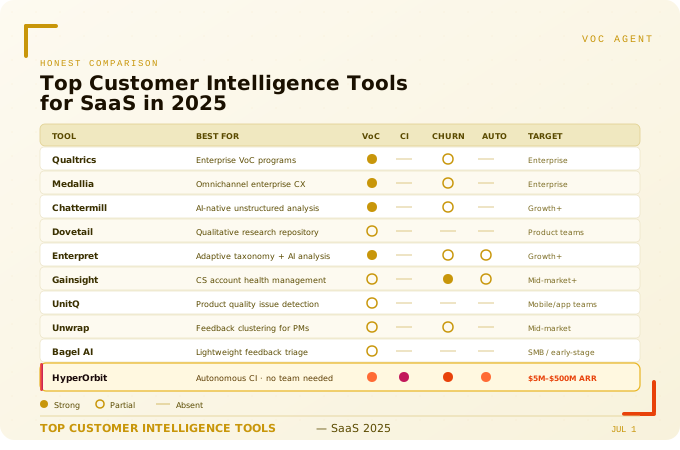
The customer intelligence tools market has expanded faster than most SaaS buying teams can track. Every platform claims to turn customer feedback into actionable intelligence. Very few of them do it in the same way, for the same buyer, at the same scale.
This is not a sponsored list. Each tool below has a genuine use case where it is the right answer. The goal is to help you identify which one matches your actual situation — your team size, your primary problem, your organizational maturity — rather than which one has the best demo.
Ten tools. Honest strengths. Honest limits. A clear profile for each.
1. Qualtrics XM
Best for: Large enterprises running structured VoC programs at scale.
Qualtrics XM focuses on enterprise customer research and Voice of Customer programs, recognized as a Leader in Gartner's 2025 Magic Quadrant for Voice of Customer platforms. Its strength lies in solicited feedback at scale, making it better suited for periodic customer experience measurement than for surfacing buyer sentiment during active deal cycles. Outreach
Qualtrics is the platform organizations deploy when they need a formal, governed, multi-department VoC program with survey methodology at its core. It handles NPS at scale, tracks longitudinal CX trends, and gives executives boardroom-ready reporting that justifies CX investment.
Honest limit: Qualtrics is built for structured, solicited feedback. It is not designed to continuously monitor unstructured signals — support ticket language, competitive mentions in renewal calls, declining engagement patterns. It captures what you ask for, when you ask for it. For mid-market SaaS teams that need continuous unsolicited signal monitoring, it is more infrastructure than intelligence.
Profile fit: 1,000+ employee organizations with dedicated CX research functions, compliance requirements, and the budget and patience for an enterprise implementation.
2. Medallia
Best for: Enterprise organizations with complex omnichannel feedback environments.
Medallia has distinguished itself in the VoC space by adding 100+ AI-powered features since 2024, turning omnichannel data into real-time, actionable insights. Strategic acquisitions and a strong focus on unstructured data position Medallia as a system of record for customer signals, acting almost like a CRM or CDP platform. CX Today
Medallia is the platform enterprises deploy when feedback comes from everywhere — in-store, digital, support, social, contact center — and they need a single system to aggregate and analyze it all. The breadth of its integration surface and the depth of its analytics are genuinely impressive at enterprise scale.
Honest limit: Medallia's power comes with significant implementation overhead. Enterprise platforms like Chattermill and Medallia typically require 6–12 weeks to implement with professional services. Chattermill For mid-market SaaS teams that need to be operational in days rather than months, Medallia is architecturally mismatched. Pricing is firmly enterprise.
Profile fit: $100M+ ARR organizations, multi-channel consumer businesses, and enterprise SaaS companies with dedicated CX infrastructure teams.
3. Chattermill
Best for: Fast-moving SaaS and consumer companies that need AI-native feedback analysis.
Chattermill is a customer experience intelligence platform that analyzes large volumes of unstructured feedback from surveys, support tickets, reviews, and social channels. It uses AI to identify themes, patterns, and sentiment trends across all incoming data. Chattermill Its proprietary Lyra AI goes beyond sentiment classification to surface specific pain points, churn risks, and recurring issues in real time.
Chattermill is consistently highlighted as the most capable pure-play feedback analytics platform for product and CX teams dealing with high volumes of unstructured text. Companies like Uber, Booking.com, and E.ON use it because the AI is more accurate than most competitors on nuanced, multi-topic feedback.
Honest limit: Chattermill works best in organizations with cross-functional buy-in where multiple teams actively use the platform. It is an analysis platform — it does not autonomously route alerts, trigger workflows, or offer competitive intelligence. It is also positioned for teams solving a CX insight problem, not a competitive intelligence or churn prediction problem specifically.
Profile fit: Growth-stage to enterprise SaaS and consumer companies with significant feedback volume, product-led or CX-led culture, and the organizational maturity to act on sophisticated analysis.
4. Dovetail
Best for: Product and research teams centralizing qualitative feedback and user research.
Dovetail collects feedback from user feedback, service tickets, and sales calls, funneling everything into a customer insights hub. The solution makes all insight searchable so critical stakeholders can unlock new knowledge via prompts. It can also help create action plans based on stored insights and generate VoC reports with one click. CX Today
Dovetail's Fall 2025 platform launch introduced agents, automation, and integrations with Salesforce, Linear, and Gong, turning customer signals into real-time intelligence and action. Business Wire
Dovetail's particular strength is qualitative research centralization. If your team runs user interviews, usability studies, and collects rich qualitative feedback alongside structured data, Dovetail gives you the repository, AI analysis layer, and cross-functional visibility that keeps research from becoming tribal knowledge.
Honest limit: Dovetail is fundamentally a research and insights repository. Its automation and agent capabilities are newer and still maturing. For teams that need proactive churn risk detection, competitive intelligence, or autonomous signal routing, Dovetail is more of a library than an intelligence system.
Profile fit: Product teams and UX researchers at companies with formal discovery practices, qualitative research programs, and stakeholders who need searchable, shareable insight repositories.
5. Enterpret
Best for: Product-led companies that need deep, customizable feedback taxonomy at scale.
Enterpret is a customer intelligence platform built specifically for product and CX teams that need to make sense of large volumes of unstructured feedback. The platform connects to 50+ feedback sources and applies custom AI models to categorize, cluster, and surface themes without manual tagging. The standout feature is Enterpret's Adaptive Taxonomy — a five-level classification system that learns your business language and evolves as new signals emerge. Zonka Feedback
Enterpret is the right tool when your feedback volume is high enough that generic sentiment analysis misses the nuances specific to your product domain — and you need the AI to learn your customers' exact vocabulary. Teams at companies like Notion, Canva, and Strava use it to connect customer pain points directly to roadmap decisions.
Honest limit: Enterpret is an analysis platform — it requires human decision-making to act on its outputs and does not have native competitive intelligence. Its Adaptive Taxonomy is powerful but requires meaningful setup investment to calibrate correctly. Pricing is custom and skews toward growth-stage and enterprise buyers.
Profile fit: Product-led growth companies with significant feedback volume, dedicated product analytics functions, and the organizational maturity to operationalize sophisticated taxonomic analysis across teams.
6. Gainsight
Best for: B2B SaaS customer success teams managing account health at scale.
Gainsight helps customer success teams monitor health scores, track lifecycles, and intervene proactively to reduce churn. Customer health scoring and lifecycle awareness allows tracking of customer engagement, product usage, and sentiment to produce a dynamic health score across the customer journey. Risk detection identifies churn risks through behavior patterns and triggers alerts so teams can proactively address issues before they escalate. Capacity
Gainsight is the dominant platform in customer success operations — the tool CSMs live in. Its health score architecture, lifecycle management, and playbook automation are mature and deeply integrated with the CS workflow.
Honest limit: Gainsight's intelligence is primarily behavioral — login frequency, feature adoption, product usage. It does not natively analyze the content of customer feedback at scale, detect competitive mentions in support tickets, or generate product requirements from sentiment patterns. It tells you what customers are doing, not what they are saying or why they are about to leave. Implementation is complex and the learning curve steep.
Profile fit: Mid-market to enterprise B2B SaaS companies with dedicated CS teams of 5+ people and high-value accounts requiring active lifecycle management.
7. UnitQ
Best for: Product and engineering teams tracking quality issues from user feedback.
UnitQ monitors product quality by analyzing customer feedback for bugs, issues, and quality signals. The platform quickly surfaces product issues by detecting patterns in user-reported issues across support tickets, app reviews, and social mentions. Chattermill
UnitQ has a specific, valuable use case: connecting customer-reported quality signals directly to product and engineering. If you have a mobile app or a product with high interaction volume and you need to know when users are hitting bugs, crashes, or UX friction — at scale, in real time — UnitQ is purpose-built for that problem.
Honest limit: UnitQ's strength is product quality monitoring, not broader customer intelligence. It does not address churn prediction from sentiment trajectories, competitive signal detection, or roadmap prioritization from revenue-weighted feedback. It is a specialized tool for a specific engineering and quality use case.
Profile fit: Mobile-first product companies, high-interaction SaaS products with significant app store presence, engineering teams that need a direct feedback-to-bug pipeline.
8. Unwrap
Best for: Mid-market product teams that need structured feedback clustering without enterprise complexity.
Unwrap sits in the practical middle of the market — more capable than basic survey tools, more accessible than enterprise platforms like Medallia or Qualtrics. It connects to common feedback sources, applies AI clustering to group similar requests, and surfaces themes for product managers in a clean interface that does not require a data team to operate.
For product managers drowning in unread feedback across multiple channels, Unwrap provides a meaningful first step toward systematic intelligence without the implementation overhead or cost of more complex platforms.
Honest limit: Unwrap is primarily a clustering and organization tool. It does not offer continuous autonomous monitoring, competitive signal detection, churn prediction, or cross-channel correlation at the depth that more specialized platforms provide. It is the right answer for teams moving from spreadsheets toward structured intelligence — not for teams that need operational, autonomous action-triggering.
Profile fit: Mid-market SaaS product teams at Series A–C stage that need organized, AI-clustered feedback without enterprise tooling costs or dedicated analytics headcount.
9. Bagel AI
Best for: Early-stage SaaS teams that need lightweight, fast feedback triage.
Bagel AI is built for the early end of the market — companies where feedback volume is still manageable but growing fast enough that manual reading is becoming a bottleneck. It applies AI to surface themes and patterns quickly without requiring significant setup, integration work, or budget.
For product teams at companies below $5M ARR who need to move from entirely manual feedback processing to something more systematic, Bagel AI offers an accessible starting point with a low barrier to entry.
Honest limit: Bagel AI is designed for early-stage use cases at modest scale. It does not offer the depth of analysis, breadth of integration, autonomous routing, or competitive intelligence that mid-market and enterprise teams require as they grow. Teams that graduate past early-stage will outgrow it.
Profile fit: Pre-Series B SaaS companies with limited feedback volume, small product teams, and budget constraints that make enterprise tooling inaccessible.
10. HyperOrbit
Best for: Mid-market SaaS teams that need autonomous customer intelligence without building a CI team.
HyperOrbit is built for a specific buyer profile — the CPO, VP of Product, or Head of CS at a $5M–$500M ARR SaaS company who needs customer intelligence that works continuously without requiring a dedicated research or CI function to operate it.
The VoC Agent aggregates feedback across 50+ channels, detects churn signals 60–90 days in advance using a three-component model (Sentiment Health, Engagement Health, Competitive Threat), generates revenue-weighted product requirements, and routes alerts autonomously. The CIA Agent monitors customer feedback specifically for competitive signals — competitor mentions, feature gaps, pricing pressure — and auto-generates battlecards for sales and CS teams.
The structural differentiator is the cross-agent intelligence loop: competitive signals from the CIA Agent cross-referenced against account health signals from the VoC Agent, producing a combined competitive churn risk signal that neither standalone tool generates.
Honest limit: HyperOrbit is not the right tool for teams that need enterprise-level survey methodology, longitudinal CX research programs, or the organizational governance features that Qualtrics or Medallia provide. It is also not a qualitative research repository like Dovetail. It is built for operational, autonomous, action-triggering intelligence — not exploratory research.
Profile fit: Mid-market SaaS companies ($1M–$500M ARR) that need proactive churn prevention, competitive intelligence from customer feedback, and cross-functional signal routing without dedicated CI headcount.
The Decision Framework
The tools above solve different problems for different organizational profiles. Here is the simplest version of the selection logic:
Structured enterprise VoC at scale → Qualtrics or Medallia.
AI-native unstructured feedback analysis → Chattermill or Enterpret.
Qualitative research centralization → Dovetail.
CS account health management → Gainsight.
Product quality issue detection → UnitQ.
Mid-market feedback clustering → Unwrap.
Early-stage lightweight feedback triage → Bagel AI.
Autonomous churn prevention and competitive intelligence without a CI team → HyperOrbit.
The most common mistake mid-market SaaS teams make is buying an enterprise tool they do not have the organizational maturity to use fully — or a research tool when they actually need operational intelligence. The second most common mistake is buying a single-signal tool (VoC only, or CI only) and missing the cross-reference that produces the most actionable insights.
The platforms in this guide fall into two categories: tools that surface insights and tools that help teams act. Customer data platforms unify data but require separate systems to activate it. The platforms that win are those that process customer intelligence and execute on it within the same system teams use daily. Outreach
Conclusion
Match the Tool to the Problem, Not the Demo
Every tool on this list has a conference room where it looks like the best customer intelligence platform ever built. Every tool also has a profile of buyer for whom it will underdeliver — not because the product is bad, but because the problem it was designed to solve is different from the problem that buyer actually has.
The best customer intelligence tool is the one that closes the gap between customer signal and business action for your specific team size, use case, and organizational structure — and keeps closing it without requiring someone to check a dashboard every Friday.
Book a HyperOrbit demo to see whether the autonomous agent model fits your profile — and if a different tool on this list would serve you better, we will tell you that too.