
12 Minutes

Your engineers use Cursor to ship code. Your sales team uses Gong to summarize calls. Your support team handles tickets in Zendesk with AI. Every part of your organization now relies on AI, but none of these tools really know what your customers want or what your competitors are doing to win them over.
An autonomous product decision layer is designed to close that gap.
What it actually is
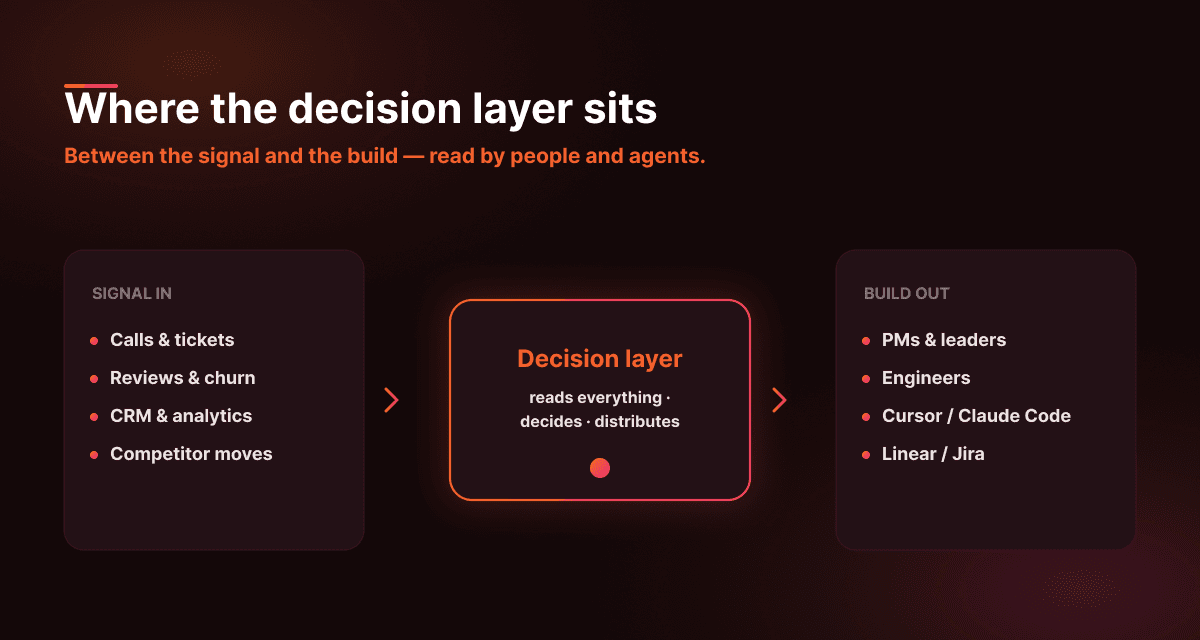
An autonomous product decision layer is a system that runs continuously underneath your product org. It takes the customer and market signals scattered across your stack and turns it into scoped product decisions — delivered to the people and the AI agents who do the building.
Three jobs, really. It reads signals from everywhere customers and competitors show up: sales calls, support tickets, reviews, churn notes, CRM, product analytics. It decides — surfacing the next moves worth making, ranked by impact, with the evidence attached. And it distributes those decisions to whoever needs them, human or machine.
The important part is the architectural slot it sits in. It’s not a feedback inbox. It’s not a roadmap board. It lives between the tools where customer conversations happen and the tools where work gets shipped — the decision-making layer in the middle that everything else reads from.
Why is this becoming a thing now
Every era of software grows a new layer when the old setup buckles. CRMs appeared when reps outgrew spreadsheets. Data warehouses appeared when analytics queries started crashing the production database. The product decision layer is appearing now because the old way of making product decisions quietly broke the moment every team started running on AI.
The old way worked like this: a PM read the tickets, sat in on the calls, talked to support and sales, held it all in their head, and made the call. When you shipped a few things a quarter, one human’s bandwidth was enough.
It isn’t anymore. Now every function ships more, faster — and none of the AI doing that work shares any context about the customer. Engineering ships quickly with Cursor, but the evidence behind a ticket lives in someone else’s tool. Sales spots a product gap on a call, and it dies in a CRM note nobody opens. Support sees the same complaint forty times, and it never reaches the roadmap. The PM writes a crisp PRD grounded in… whatever they happened to read that morning.
The result is an org producing enormous output and almost no decisions. More tokens, not more shipped value. The fix isn’t another AI tool — it’s a shared source of truth about the customer that all the other tools can read from.
What it isn’t (feedback, roadmaps, and VoC)
The category is new enough that the words are still slippery. The fastest way to understand it is by contrast.
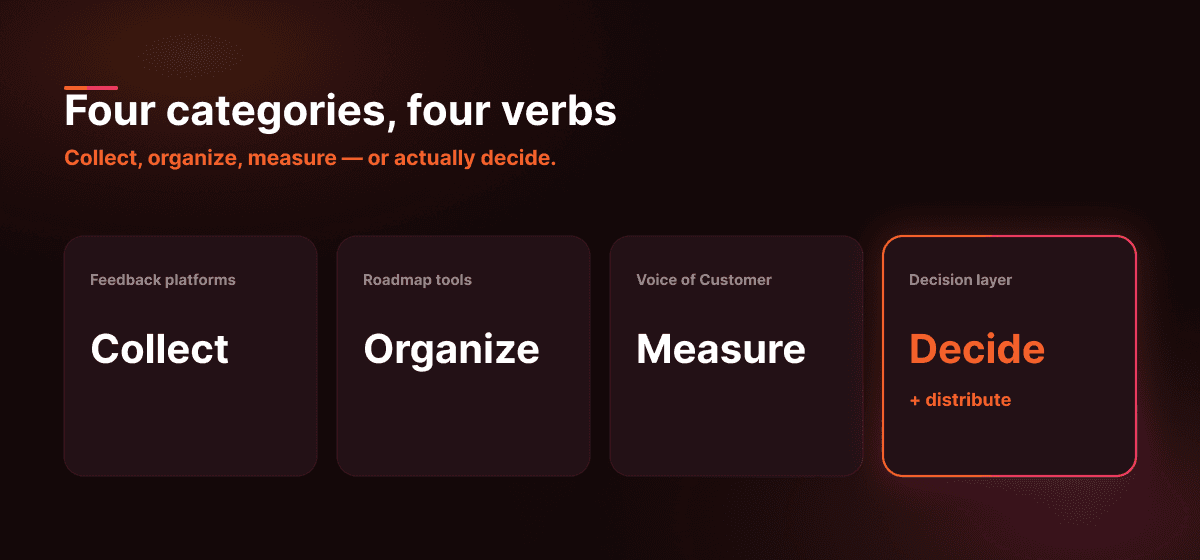
Feedback platforms collect and tag. They pull in the signal, classify it, and hand you a tidy, tagged inbox or dashboard. Useful — but the decision still happens later, in a meeting, by a human. The platform is an input to that meeting, not the meeting.
Roadmap tools organize. They’re great at structuring what you’ve already decided to build and showing it to stakeholders. They don’t help you decide; the evidence and the revenue context get pasted in after the fact to justify a call that’s already been made.
Voice of Customer platforms measure. They’re tuned for survey-driven research at scale — satisfaction across a big base, reports for leadership. Not built to drive what gets built on Tuesday.
A decision layer decides and distributes. The output isn’t a tagged inbox, a voting board, or a CSAT chart. It’s a scoped product call, with the evidence and the dollar exposure attached, ready for a human or an agent to act on. Collect, organize, measure — those are the old verbs. Decide is the new one.
The blind spot most decision layers share
Here’s where most of the conversation about decision layers goes wrong, and it’s the part worth slowing down on.
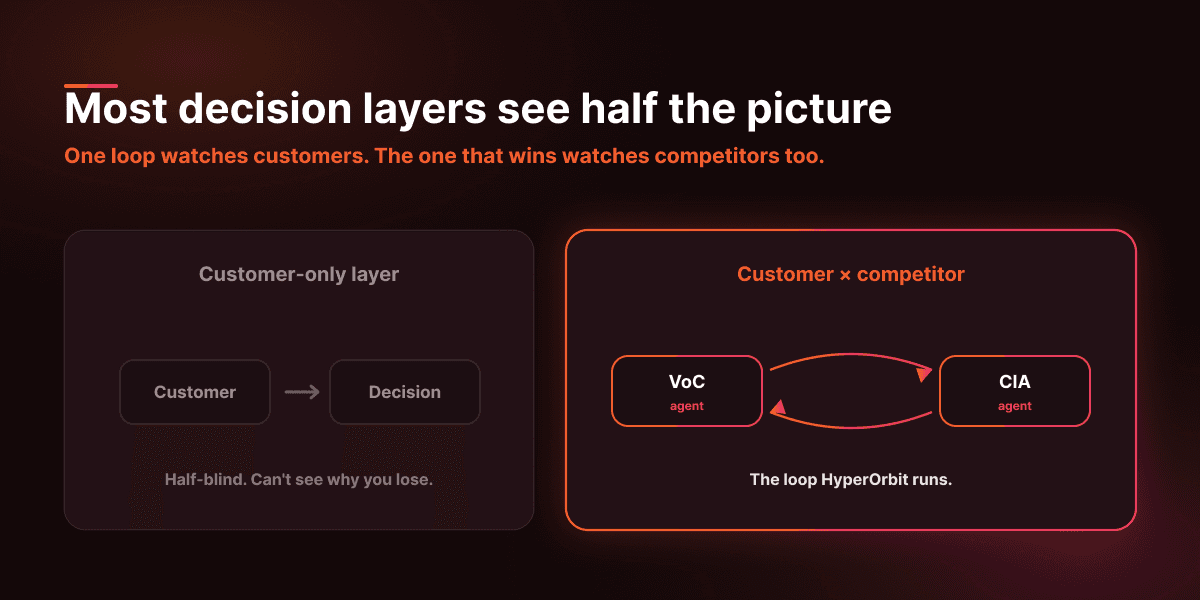
Nearly every version of this idea is built on customer signal alone. Tickets, calls, reviews, churn notes — all of it is about what your customers are saying. That’s necessary. It’s also half the picture.
Because the question that actually decides your roadmap is rarely “what do customers want?” in isolation. It’s “why are we losing deals we should win, and what’s the competitor doing that we’re not?” A customer-only decision layer can tell you a feature is being requested. It can’t tell you that the requests spiked the week a competitor shipped it, or that three of your last five losses named the same rival in the churn call. It’s flying with one eye closed.
This is the part of the architecture we think about most at HyperOrbit, and it’s why we run two agents instead of one. A Voice of Customer agent reads what customers say, continuously, and ranks the patterns by impact. A Competitive Intelligence agent watches the market. The thing that makes it a real loop rather than two dashboards is that they share signals: when a competitor’s name turns up inside a churn call or a lost deal, both agents see it. Customer pain informs your competitive positioning; competitor moves explain your churn. A dashboard makes you go find that connection. The loop hands it to you.
You can run a decision layer without that second loop. You’ll just keep being surprised by losses you could have seen coming.
What a good one actually does
Strip away the marketing, and the category comes down to a few capabilities running as one continuous loop:
Continuous ingestion from every customer- and market-facing tool, automatically, with no taxonomy to hand-maintain.
Entity resolution — the same customer shows up in five systems under three names and two account IDs, and the layer stitches them into one record at ingestion. This is the unglamorous part that most internal builds fail at by month three.
Decisions ranked by impact — not a list of feature requests, but scoped calls weighed against your existing roadmap by dollar exposure and customer count, with the evidence attached.
A closed outcome loop — every shipped bet tracked against the prediction it was built on, so the roadmap becomes a record you can audit instead of a pile of opinions.
Distribution to humans and agents — the same decision readable by a PM in a planning doc and by a coding agent pulling context before it writes code. The open Model Context Protocol that Anthropic introduced has made this kind of agent-readable distribution the direction the whole category is heading.
Signal in, decisions out, outcomes measured, loop closed. It doesn’t sleep, and you don’t have to prompt it.
“Can’t we just build this ourselves?”
Honestly? You can build a v1 in a weekend with Claude Code. Plenty of teams have. A lot of those experiments are still running six months later — technically alive, trusted by nobody. Four things tend to break between month two and month six:
Model drift. The classifier that nailed it in month one decays as your product and your market vocabulary move. By month three, accuracy drops below the line where anyone believes the output. Keeping a model adapting to your data is an ML-ops problem, not a prompting one.
Multi-source reconciliation. Pulling from one tool is easy. Pulling from five and resolving the same customer and the same request across five different schemas is a distributed-systems problem that costs about as much to do well as buying something purpose-built.
Security and compliance. SOC 2, PII handling, tenant isolation, audit logs, access control. Two engineers, a quarter to do it badly, a year to do it well. Most internal builds die at their first procurement review.
Trust. When the AI gets it wrong, who owns it? If nobody can explain how a decision was generated, the CRO won’t rely on it, finance won’t fund it, and the CPO won’t defend it in a board meeting. The build version is great on demo day. The bought version is the one your CISO signs off on.
How to evaluate one
If you’re shortlisting, these are the questions that separate the real thing from a dashboard with an API bolted on:
Does it produce decisions, or just summaries? Ask to see the actual output, not a screenshot.
Does it resolve entities across sources natively, or is that manual?
Does it see competitors, not just customers — or is it half-blind by design?
Does it close the loop on outcomes, or leave you guessing whether the bet paid off?
Can your agents read from it, not just your people?
Is it secure and auditable enough to survive procurement?
Where HyperOrbit fits
We’re building toward this from the competitive-and-customer angle, and we’ll be straight about where we are: HyperOrbit is in private beta with design partners. We’re not a replacement for an enterprise survey suite, and we’re early. What we’re opinionated about is the architecture — that a decision layer worth trusting has to see both sides of the loop, customer and competitor, and surface the call rather than hand you another place to go look.
Serving those decisions to your agents over MCP — so Cursor, Claude Code, and the rest of your build stack can read from the same loop your team does — is on our roadmap. It’s not live yet, but it’s the direction we’re building, because a decision layer that only people can read leaves half its value on the table in an AI-native org.
Conclusion
The bottom line
AI-native product orgs don’t need more AI tools. They’re drowning in those. They need one shared truth about the customer and the market that every tool — and every agent — reads from. Get that layer right and the work your team does stops being synthesis and starts being judgment. Get it wrong, or build it half-blind, and you’ll keep shipping faster in roughly the wrong direction.
HyperOrbit is in private beta. If you want a decision layer that watches customers and competitors in one loop, come see what your stack is already telling you.