
12 Minutes

Almost every article about AI in product strategy this year says the same things: you can forecast faster, prioritize smarter, and price better. While these points are true, they miss the real risk. The real issue isn’t that your strategy is too slow. It’s that AI can make you confidently wrong, and it can happen very quickly.
What AI actually changes in Product Strategy
If you ignore the typical buzzwords used by the LinkedIn experts, AI’s real value in strategy work is clear and is very specific. It can use predictive models to turn historical data into pricing or demand forecasts within minutes, rather than weeks or months. It can use prioritization engines to score the backlog based on multiple variables simultaneously and run regression models to validate the backlog scoring. And it can use large language models to quickly summarize a market scan or draft a positioning document before you finish your coffee.
This is where AI is genuinely helpful. A roadmap prioritization meeting that once required an offsite and several spreadsheets can now begin with a model-generated score, line item by line item, that can be quickly vetted in minutes. A pricing test that used to take weeks to months can now be completed in hours, especially when using Synthetic respondents for a quick dipstick analysis of your pricing strategy. It’s clear that AI speeds up the practical and mathematical parts of strategy work.
The part that doesn’t get talked about
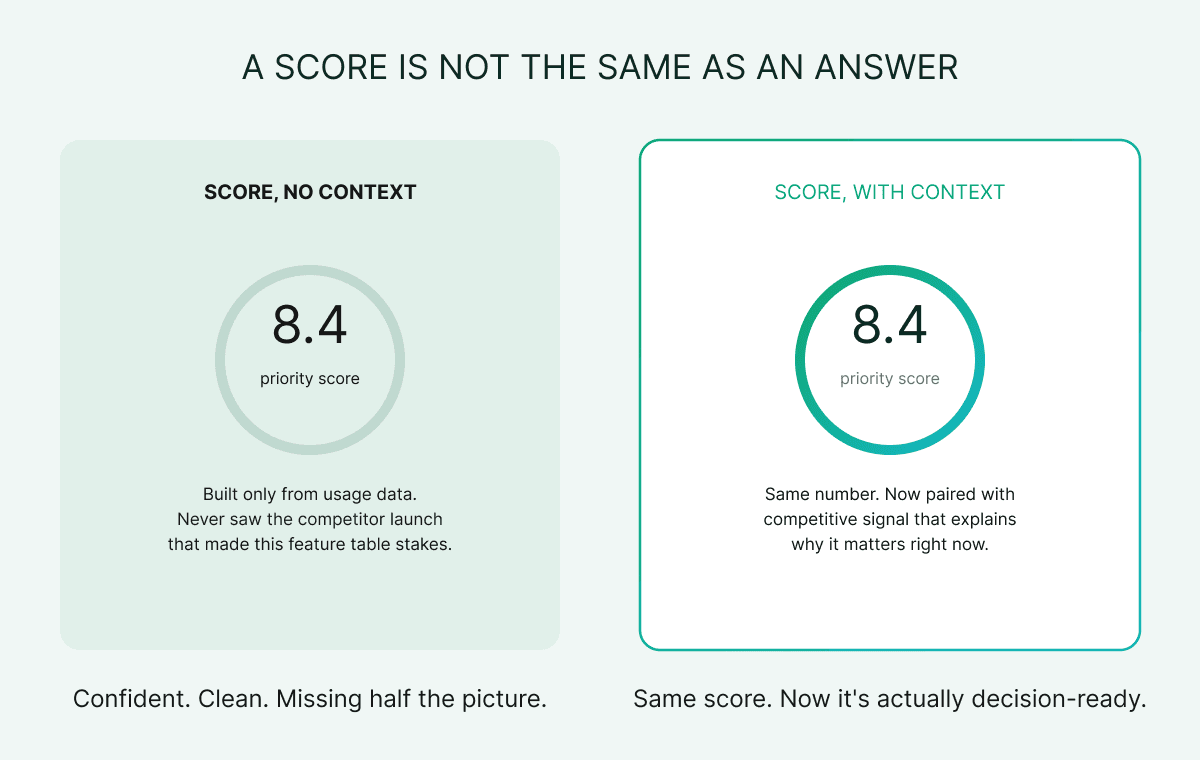
But here’s the problem: a prioritization score, a pricing recommendation, or a forecast is only as good as the information loaded into the AI models for inference. Most AI tools only see part of the picture, not because AI models are incorrect or incapable; they can only see what has been given to them.
For example, a feature-scoring model that uses only your usage data and support tickets measures only what your customers have already told you. It doesn’t know if a competitor just released the same feature and changed what your users expect. A pricing model based on your sales history is focused on the past. It can’t see if a competitor’s new pricing tier will suddenly make your ‘optimal’ price seem too high or outdated.
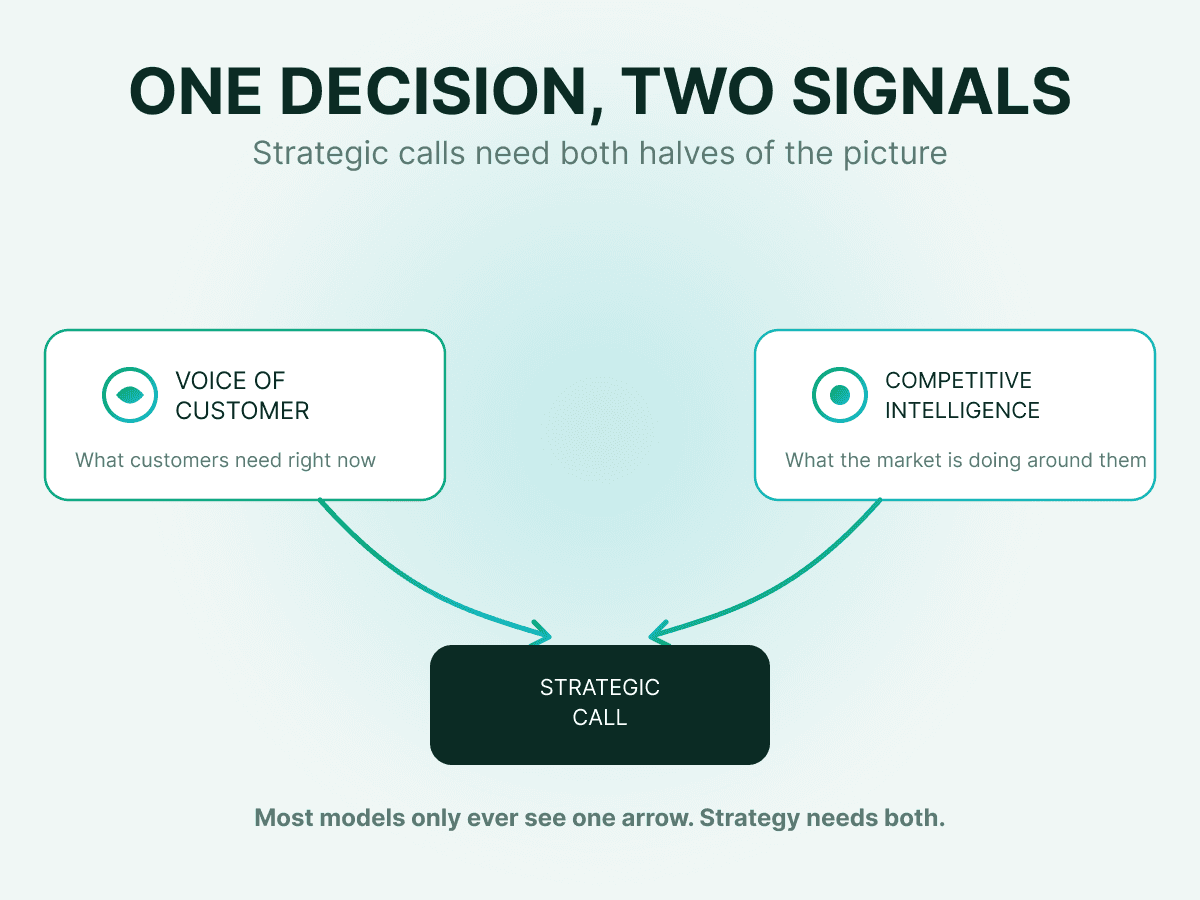
Strategy is supposed to bring together two signals: what your customers need and what’s happening in the market. Most tools ask a model to answer this question after seeing only one side. The result still looks like a confident, clear number. That’s the trap. A model doesn’t hold back just because it’s missing context. It gives you its best answer anyway, and a simple score is easy to mistake for the right one. This is the exact wall we ran into building HyperOrbit, and it’s the reason the product exists as two agents that talk to each other instead of one that tries to do everything: a Voice of Customer agent and a Competitive Intelligence agent, feeding each other in both directions, so a strategic call gets made with both halves of the picture instead of one. The bidirectional loop isn’t a feature bullet — it’s the actual argument for why a strategy decision needs more than one data source before it gets treated as settled.
Where it actually goes wrong
The ways this can go wrong are specific, and it’s important to name them clearly rather than just hint at them.
Accountability can become unclear very quickly. If a pricing model suggests a number that causes a renewal to fail or dissuades a prospect from signing off on a deal, who is responsible—the product manager who approved it or the model that created it? Teams that don’t discuss this before relying on AI for decisions often end up having the conversation only after something goes wrong.
Bias can be hidden in the score. If a prioritization model is trained primarily on your most vocal customer segment, it will prioritize features for that group and quietly push everything else aside. The confidence number attached can make this bias look like valuable insight.
Automation can also create its own momentum. Once a roadmap is scored and ranked, it’s easier to go along with the ranking than to challenge it, even if someone in the room has important context the model missed.
This isn’t an argument against using AI for strategy. It’s a reminder to treat AI’s output as just one input into a decision that a person is still responsible for—not the final decision itself.
How to actually start
Don’t begin by choosing a platform. Instead, identify one strategic decision you often struggle with—like feature prioritization that becomes a political debate, pricing decisions based on outdated data, or a roadmap that ignores recent competitor moves—and use AI to help with that specific decision first. Before you trust a score, make sure you know what information it uses and what it misses. A model that only looks at customer data won’t tell you about competitors, and a model that only tracks the market won’t show if customers care. If a decision involves both, your inputs should too.ell.
Also, keep the model’s output separate from the final decision. Confidence scores can be helpful, but they don’t replace accountability.

Conclusion
Where this is heading
The next step for AI in product strategy isn’t just faster forecasting—most teams already have that. It’s about using tools that stop treating customer and market signals as separate research areas with different owners, and instead combine them as a single input for the same decision.
Getting there isn’t really about which AI tool you buy. It’s about whether the systems generating your customer insight and your competitive insight are still sitting in separate tools, run by separate teams, feeding separate slides into the same planning meeting. Connect that, and the forecasts and scores you’re already generating become much more trustworthy.