
12 Minutes

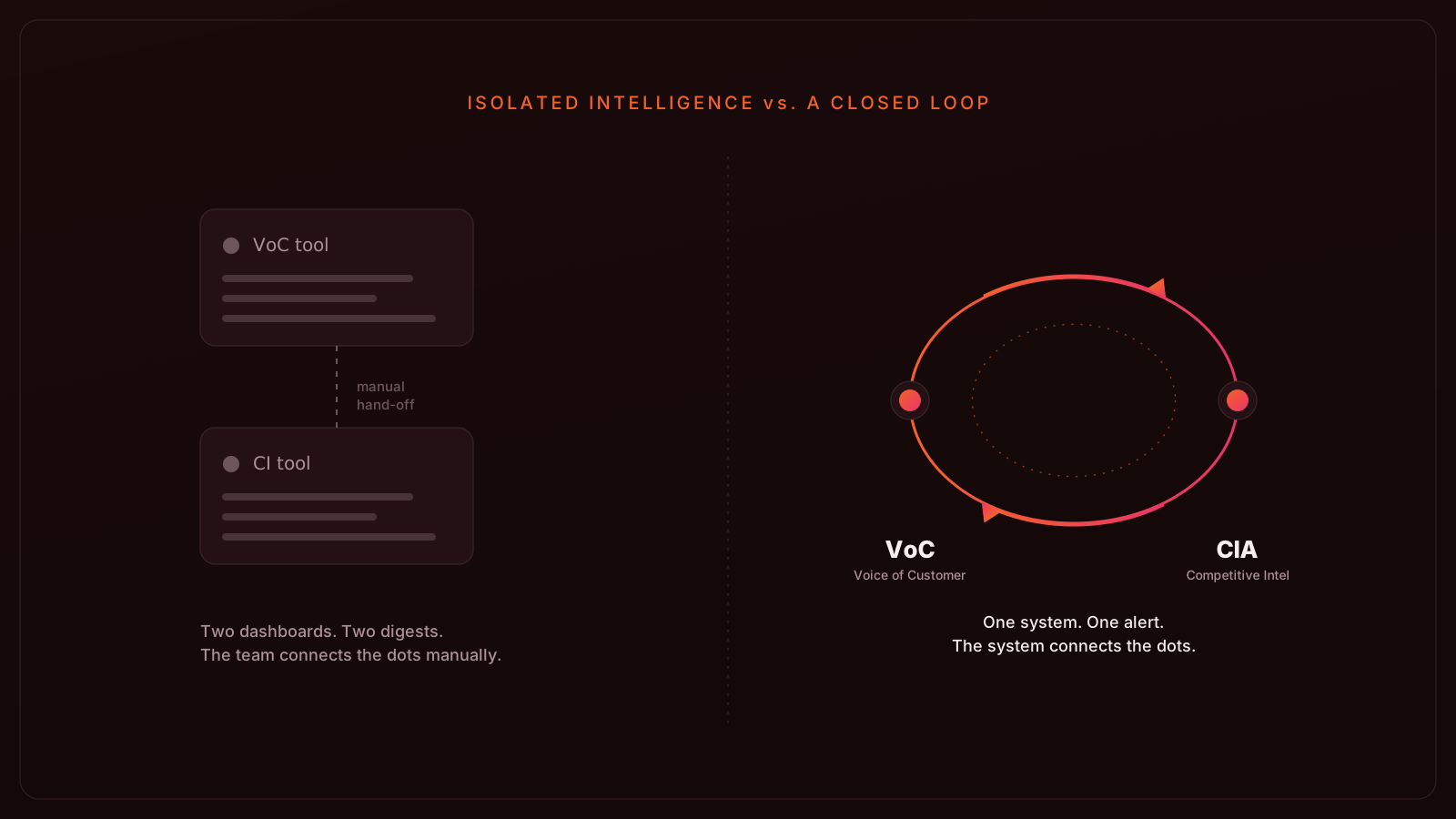
Most customer intelligence tools focus on a single task. Your VoC tool shows what customers are saying, while your competitive intelligence tool tracks what competitors are doing. This means you end up with two dashboards, two weekly digests, two sets of action items, and a team that has to connect the dots manually.
HyperOrbit was built on a different idea. These two intelligence streams are not separate problems—they are part of the same loop.
This post explains what the CIA × VoC loop is, how it works, and why the architecture itself—not just any single feature—is the real competitive advantage.
What Is the CIA × VoC Intelligence Loop?
The CIA × VoC intelligence loop is a cross-agent system where a Competitive Intelligence Agent (CIA) and a Voice of Customer Agent (VoC) share a continuous feedback cycle. Each agent’s output becomes the other’s context. This creates a system that links what customers are saying today with what competitors are doing tomorrow, and acts on both automatically.
In a single sentence: the VoC Agent detects churn signals in customer conversations; the CIA Agent tracks competitive threats in real time; both agents update each other so the system responds to both at once.
No single-agent tool can replicate this because replication requires two agents who share context. Most tools, even AI-powered ones, operate in isolation.
The Problem With Isolated Intelligence
To understand why the loop matters, it helps to see what you lose without it.
What an isolated VoC looks like
Your VoC tool is reading support tickets, survey responses, and call transcripts. It flags that four enterprise accounts have used the phrase "limited reporting" in the last 30 days. Your CS team gets the alert. They schedule calls. By the time the calls happen, two of those four accounts have already started evaluating a competitor.
The signal was real. The timing was too late.
What isolated CI looks like
Your CI tool flags that a competitor just launched a new reporting module. Marketing gets the battlecard update. The battlecard now notes "Competitor A: stronger reporting." But no one knows which of your current accounts specifically named reporting as a pain point — that information lives in a different system.
The competitive move was captured. The customers most at risk weren't connected to it.
What the loop fixes
When VoC and CI run as a closed system:
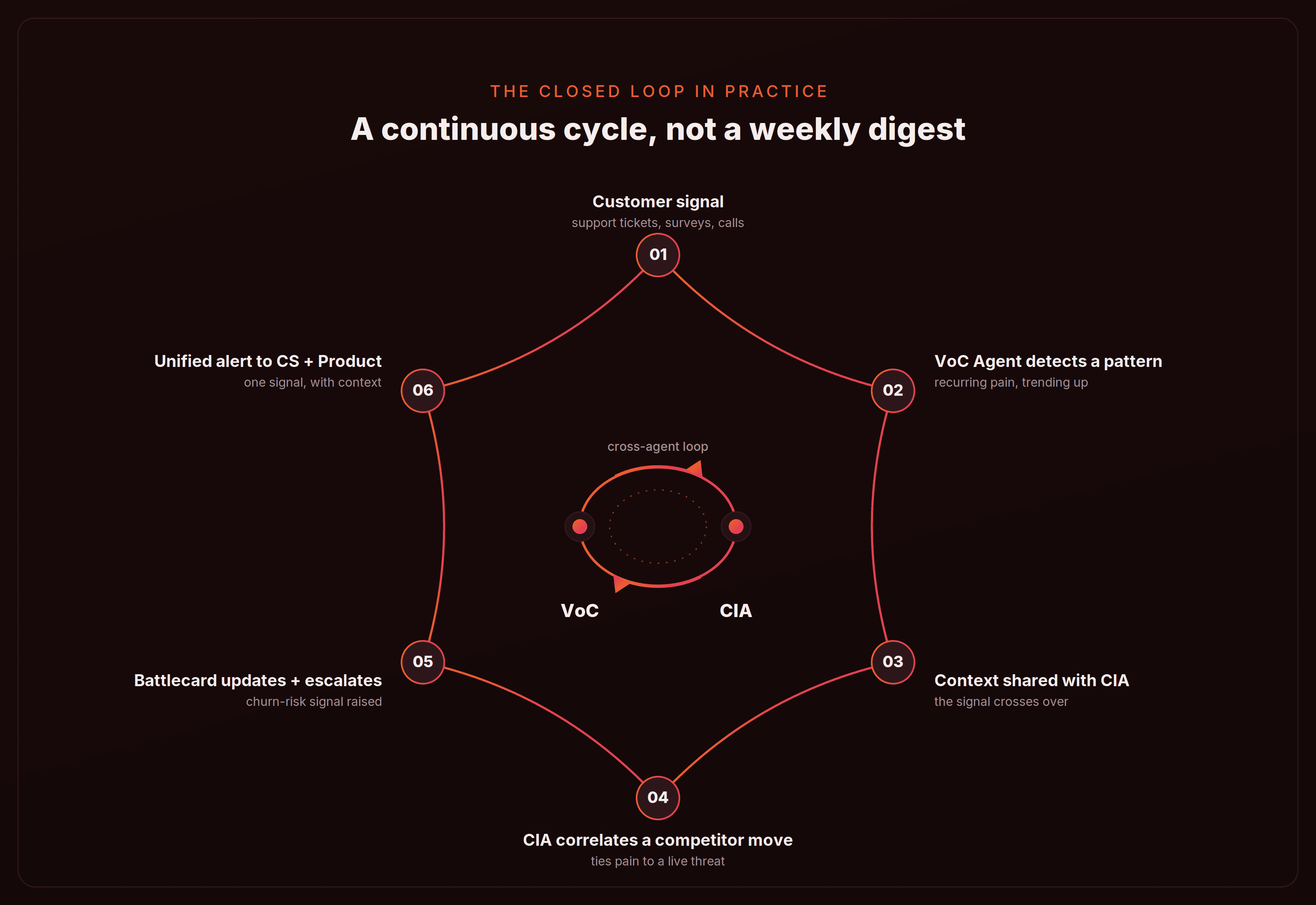
The VoC Agent detects a pattern — "limited reporting" in enterprise accounts, trending upward.
That signal automatically surfaces in the CIA Agent's context.
The CIA Agent correlates it with a competitor move: a reporting module launched 45 days ago.
Both agents update their outputs: the VoC Agent escalates the churn risk for affected accounts; the CIA Agent marks the competitor's reporting capability as an active threat tied to live revenue.
The CS team gets a unified alert: "4 enterprise accounts mention reporting limitations. Competitor A launched a relevant module 45 days ago. Accounts at risk: [list]. Battlecard updated."
The human gets one alert instead of two disconnected signals. The system connected the dots. No manual analysis required.
How Each Agent Works
The VoC Agent
The VoC Agent continuously monitors customer conversations across the channels that feed into it — support tickets, NPS surveys, sales call transcripts, success call notes, and product reviews.
It does three things continuously:
Pattern detection. Surfaces language patterns, recurring complaints, and topic clusters that individual conversations hide.
Churn signal scoring. It assigns churn risk scores to accounts based on signal strength, recency, and escalation patterns. In beta, HyperOrbit's VoC Agent predicts customer churn with 89% accuracy (early deployments, limited sample; accuracy improves as the model sees more signals), 60–90 days before it happens.
Loop contribution. Passes high-risk topics and account-level signals into a shared context that the CIA Agent can act on.
The VoC Agent is not just a dashboard that shows what customers said. It is an agent that acts on customer feedback and passes information to the CIA Agent when a competitive context is needed.
The CIA Agent
The CIA Agent monitors external competitive signals: competitor websites, pricing pages, product announcements, review sites, job postings, and public news.
It does three things continuously:
Change detection. It tracks meaningful changes, such as new features, pricing changes, and positioning shifts, across configured competitors.
Battlecard maintenance. It updates competitive battlecards automatically as new information arrives. There are no quarterly review cycles because battlecards stay current by default.
Loop contribution. When a competitive move overlaps with an active VoC signal, the CIA Agent escalates the issue by flagging that a competitor’s move directly relates to a pain pattern already seen in customer conversations.
The CIA Agent is not just a spreadsheet of competitor features. It is an agent that tracks competitive moves in context and passes information to the VoC Agent when customer signals are affected.
The Closed Loop in Practice
Here is the full cycle, step by step:
The loop runs continuously. It does not wait for a weekly digest, a quarterly review, or for someone to open the dashboard. When a competitor launches something that directly threatens accounts already showing churn signals, the system recognises it and alerts the relevant team, usually within hours of the competitive move and at the same time as the customer signal.
Why This Architecture Cannot Be Replicated by a Single Agent
A single agent working with both VoC and CI data simultaneously would need a context that keeps growing—every customer conversation, every competitive signal, for every account, all at once. This approach is computationally expensive, context-window-limited, and structurally inefficient. More importantly, it misses the benefit of coordination. The CIA × VoC loop is valuable because the two agents have different views on what is relevant. The VoC Agent knows which customers are at risk, while the CIA Agent knows which competitive moves matter. The loop acts as the layer that connects their different judgments.nts.
A single agent with two objectives loses the specialisation that makes each goal manageable. Two agents sharing context gain the coordination that makes both objectives more effective.
This is not just a difference in features. It is a difference in architecture. Adding a CI tab to a VoC tool does not create a CIA × VoC loop, and neither does adding a VoC tab to a CI tool. The loop requires real cross-agent context sharing, not just two products under one login.
What Customers Should Expect From the Loop
Earlier churn signals
The loop gives churn risk scores a competitive context. An account showing moderate churn signals on its own becomes a high priority when a competitor launches a feature that matches their pain point. Without the loop, the account stays in the medium-risk queue. With the loop, the account receives an immediate alert that includes the competitor context.
Battlecards that are actually current
Competitive battle cards are often out of date. Most teams only update them quarterly, if at all. The CIA Agent updates battlecards continuously, and the loop prioritises updates based on which competitive moves matter to accounts already at risk. The most important information appears first, automatically.
Fewer context switches for the CS team.
The biggest practical benefit is one that the dashboards hide: your CS team stops switching between tools. The loop surfaces a unified signal — customer risk + competitive context — in a single alert. The team spends less time assembling the picture and more time acting on it.
Frequently Asked Questions
What is the CIA × VoC loop?
The CIA × VoC loop is HyperOrbit's cross-agent architecture connecting a Voice of Customer Agent and a Competitive Intelligence Agent in a shared, continuous feedback cycle. The VoC Agent detects churn signals in customer conversations; the CIA Agent tracks competitive moves in real time; both agents share context so the system responds to both simultaneously and automatically.
How is this different from tools like Dovetail, Enterpret, or Gong?
Dovetail, Enterpret, and Gong are Gen 2 tools. They surface signals for humans to act on. HyperOrbit is Gen 3, using autonomous agents that act on those segments and automatically cross-reference VoC and competitors. The key architectural difference is cross-agent context sharing. The CIA Agent knows what the VoC Agent has flagged, and vice versa. Single-agent tools cannot replicate this by definition.
Can I use the CIA Agent or the VoC Agent independently?
Yes. Both agents work independently and provide value on their own. The VoC Agent focuses on detecting churn signals, while the CIA Agent handles competitive monitoring. The CIA × VoC loop is the extra capability that appears when both agents run together and share context.
How accurate is the churn prediction?
In beta deployments, HyperOrbit's VoC Agent predicts customer churn with 89% accuracy, 60–90 days before it happens. This is an early result with a limited sample size; accuracy improves as the system processes more signals across more accounts.
What does "Gen 3 customer intelligence" mean?
Gen 1 customer intelligence was static reporting, using spreadsheets and periodic surveys. Gen 2 brought real-time dashboards, such as Dovetail and Enterpret, that surface signals continuously but still require humans to interpret and act. Gen 3 uses autonomous agents—systems that interpret signals, act on them without waiting for human input, and coordinate across multiple intelligence streams at once. The CIA × VoC loop is a Gen 3 architecture.
How does the loop handle false positives — what if a VoC signal is noise?
The VoC Agent uses pattern detection across multiple signals and accounts, not just single-mention alerts. If a term appears only once in one conversation, it does not trigger an escalation. The agent checks for pattern strength, recency, and account-level context (such as renewal timing, account size, or prior escalation history) before marking a signal as actionable. The CIA Agent uses the same logic. A single competitor blog post does not trigger a battlecard update unless it shows a real capability change.
Is the CIA × VoC loop a patented architecture?
The loop is HyperOrbit's proprietary cross-agent architecture, implemented in the platform. It is not a standard feature offered by other customer intelligence platforms.
Who should use HyperOrbit?
HyperOrbit is designed for product and customer success teams at B2B SaaS companies that are actively managing churn risk and competitive positioning simultaneously. If your team is running both a VoC program and a CI program separately, and you are manually connecting the dots between them, the CIA × VoC loop closes that gap.

Conclusion
The Honest Limitation
The CIA × VoC loop is a powerful architecture, but it is still in beta. The accuracy figures and results described here are from early deployments with a limited sample size. We are open about this because AI systems perform differently at different scales, with different data inputs, and for different product categories.
The architecture is real. The early results are real. The claim that this works perfectly at every scale is not one we make.
If you want to test it with your actual data, your churn patterns, and your competitive set, that is what the pilot is for.
The Core Claim
Most customer intelligence platforms ask you to choose between VoC and CI. Some offer both, but as separate modules that don't share context.
HyperOrbit believes that having to choose is the problem. Customer signals and competitive signals belong in the same loop. A platform that keeps them separate will always be slower than one that treats them as a single, continuous system.
The CIA × VoC loop is not a feature roadmap item. It is the architecture that the product was built around from day one.
HyperOrbit is an agentic AI platform for B2B SaaS customer intelligence teams. The CIA Agent and the VoC Agent are now available. Learn more at hyperorbit.ai.