
14 Minutes

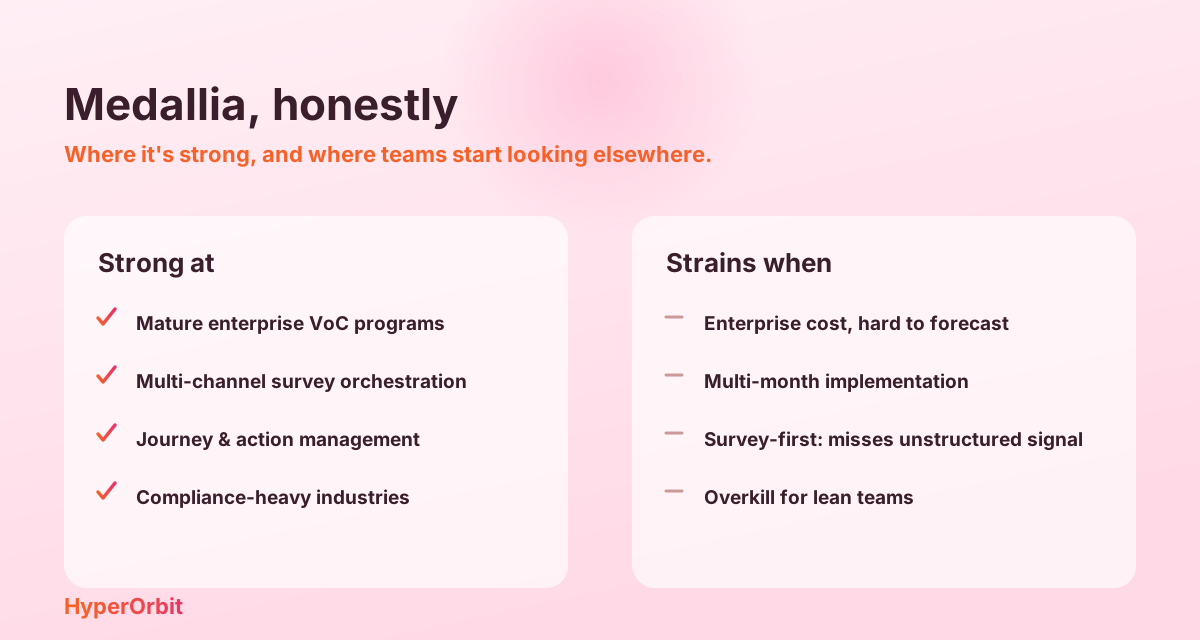
Medallia is a solid CX platform. Survey design, journey orchestration, action management, text analytics, feedback collection across dozens of touchpoints — if you’re a large enterprise running a mature voice-of-customer program with a large team to operate it, it earns its place.
The reason people go looking for alternatives is rarely that Medallia is bad at what it does. It’s that what it does comes with an enterprise price tag, a multi-month implementation, and a pricing model most teams find hard to forecast, complexity in the product due to feature overload. For a growing SaaS company or a B2C brand, a lean CX team, or a product org that just wants to know what customers are saying and what to do about it, that’s a lot of platform for the problem in front of them.
So before you start comparing options, do the unglamorous thing first: get your requirements lined up. The right alternative looks completely different depending on the answer, and the most expensive mistake in this whole category is switching to a tool that solves a problem you don’t have.
Here’s the honest version of the landscape, grouped by the problem each tool actually solves.
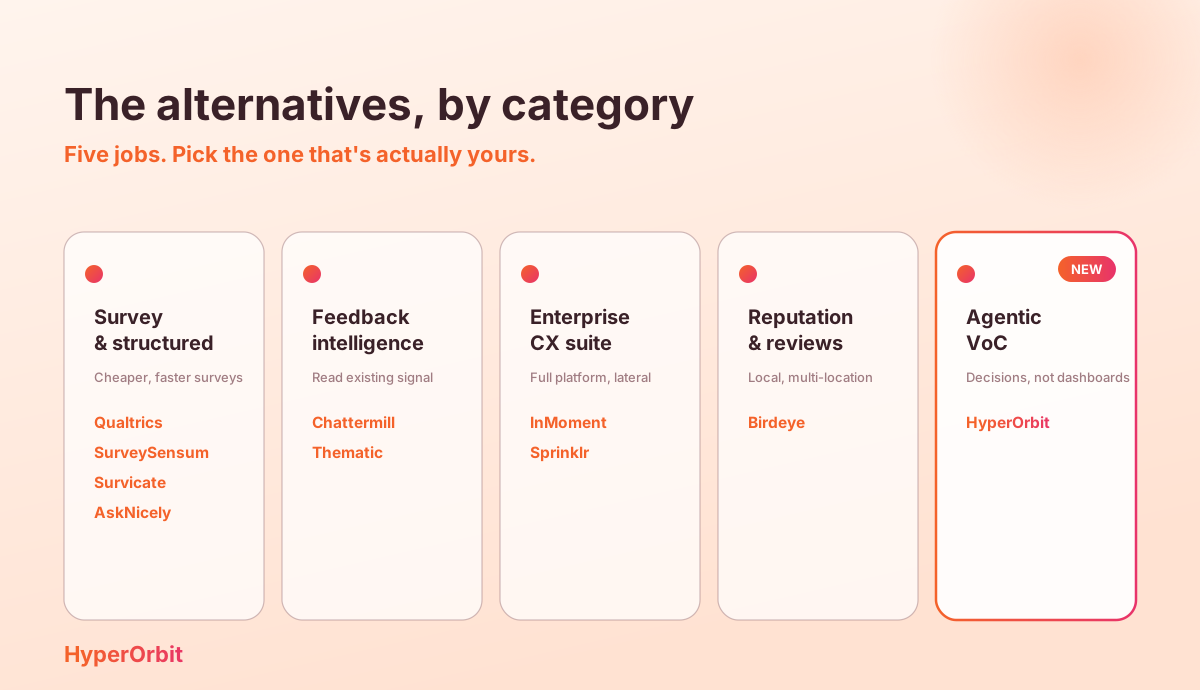
If the problem is cost, survey and structured feedback tools
A lot of teams shopping for Medallia alternatives are, when you get down to it, using Medallia to send NPS and CSAT surveys. If that’s you, you’re paying for a jet to cross the street.
Qualtrics is the closest like-for-like at the top of the market. Deep survey design, multi-channel distribution, text analytics, predictive modeling. If your program is genuinely built around structured surveys deployed across email, web, and in-app, it’s excellent — and priced and staffed accordingly. In practice, the Medallia-vs-Qualtrics decision usually comes down to which vendor you’re already in bed with and whether you need their research and employee-experience modules too. (Worth knowing: Qualtrics has been consolidating the category hard — more on that below.)
Alchemer covers NPS, CSAT, and CES with text analytics and templating at a fraction of enterprise pricing. It won’t touch Medallia’s journey orchestration, but if you weren’t using that anyway, you won’t miss it.
Survicate is the lightweight pick — embeddable surveys in your app, site, or email, live in hours, with clean routing into HubSpot, Intercom, and Slack. No orchestration, no cross-channel analytics. That’s the point.
AskNicely is narrower still: NPS tied to frontline-team performance, built for hospitality, healthcare, and home services where satisfaction maps to a specific person or location. It replaces one slice of Medallia, not the platform.
If the problem is an unstructured signal, feedback intelligence
This is the gap survey tools can't close, and it's the real reason a lot of teams leave. Medallia's architecture is survey-first — if an insight doesn't arrive through a survey it administers, it mostly doesn't show up. But your customers are talking everywhere else: support tickets, app reviews, chat logs, call transcripts, community threads. Switching to another survey tool won't capture any of that. You need a different kind of tool.
Chattermill sits more as an analytics layer on top of feedback you're already collecting — good when you have decent survey coverage but can't make sense of the open-text and support data next to it.
Thematic is focused on text analytics for open-ended survey responses: theme detection, sentiment over time, and the drivers behind an NPS move. Great if you already generate a lot of free text and need to read it properly.
HyperOrbit takes the same idea — making sense of the feedback you already have — and makes it agentic. Instead of a dashboard you go query, a Voice of Customer agent reads tickets, calls, reviews, and churn notes continuously and surfaces the patterns ranked by revenue impact rather than volume. The part that's different: a second Competitive Intelligence agent shares signals with it, so competitor mentions buried inside customer conversations connect back to your positioning automatically. It's early — private beta with design partners — and built for teams who want the decision surfaced, not another tool to staff.
The thing to notice: every tool in this group is built to read feedback that already exists. That's a fundamentally different job than collecting surveys — and a different job than the next group.
If you genuinely need a full suite: enterprise CX platforms
Sometimes the answer really is another heavyweight. If so, go in clear-eyed.
InMoment is the closest “lateral move” — survey collection, text analytics, case management, reporting, all in one. But here’s the part that changes the math in 2026: InMoment was acquired by Press Ganey Forsta in 2025, and Qualtrics then acquired Press Ganey Forsta in a $6.75B deal that closed in May 2026. InMoment now shares a parent with Qualtrics, and several industry analysts expect it to be gradually wound down. Migrating off Medallia onto a platform that may be sunset is a lot of disruption to end up somewhere unstable. Ask hard questions about the roadmap before you sign.
Sprinklr grew out of social media management into CX. If most of your signal comes from social, reviews, and community, its coverage there runs deeper than Medallia’s. If your signal comes from surveys and tickets, it’s solving a different problem than you have.
If the problem is reviews: reputation management
Birdeye is a different animal from everything above — built for multi-location businesses (restaurants, clinics, retail, home services) managing Google reviews, local reputation, and location-level feedback. If “Medallia alternative” for you really means review and local SEO management, this is purpose-built for it. If it doesn’t, skip it.
A newer category worth knowing: agentic VoC
There’s a category that didn’t exist the last time most people evaluated Medallia, and it’s where we (HyperOrbit) sit, so treat this as the section to read most skeptically.
The tools above mostly hand you a dashboard — they organize the signal and wait for you to come ask the right question. The agentic approach flips that: instead of a place to go analyze feedback, you get agents that read it continuously and bring you the decision.
In our case, that’s two agents that share what they find. A Voice of Customer agent reads customer conversations as they happen — tickets, calls, reviews, churn notes — and surfaces patterns ranked by impa
ct rather than volume. A Competitive Intelligence agent watches the market. The part that’s hard to replicate is that they talk to each other: when a competitor’s name turns up inside a churn call or a lost deal, both agents see it, so customer pain informs your competitive positioning and competitive moves help explain your churn. A dashboard makes you go find that connection yourself. The loop hands it to you.
To be straight about it: we’re early, in private beta with design partners, and we are not a like-for-like replacement for Medallia’s enterprise survey suite. If you need multi-channel survey orchestration and CMS-compliant healthcare workflows, we’re the wrong tool, and one of the platforms above is the right one. Where the agentic approach fits is the increasingly common case where the actual gap isn’t surveys at all — it’s that nobody can read the continuous, unstructured signal fast enough to act on it, and nobody’s connecting it to what competitors are doing.
How to think about the switch
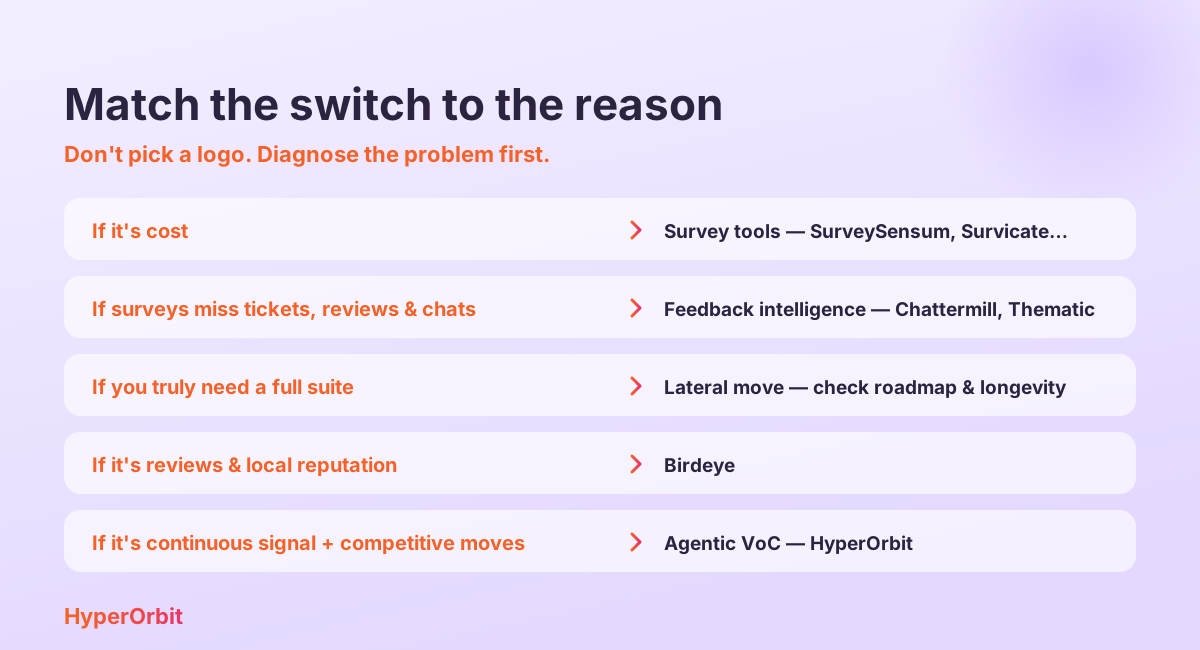
Strip away the logos, and it comes down to matching the move to the reason:
If it’s cost — most of the survey tools here (Alchemer, Survicate, AskNicely) are cheaper and live in days, not months.
If surveys are missing what customers say in tickets, reviews, and chats — that’s a gap in your stack, not a vendor problem, and another survey platform won’t fix it. Feedback intelligence (HyperOrbit, Chattermill, Thematic) does.
If you truly need a full suite — a Medallia-to-InMoment-or-Qualtrics migration is expensive and disruptive, the platforms are more alike than not, and the recent consolidation means you should be very clear on roadmap and longevity before committing.
If it’s reviews and local reputation — Birdeye- and you’re done.
If the gap is reading unstructured signal continuously and tying it to competitive moves — that’s the agentic category, and it’s worth understanding before you assume the answer is “a cheaper Medallia.”

Conclusion
The bottom line
The best Medallia alternative isn’t a product; it’s a clear answer to “what’s actually broken.” Get that right, and the shortlist picks itself. Get it wrong, and you’ll spend six months and a budget migrating into the same problem with a different login screen.
HyperOrbit is in private beta with design partners. If your gap is continuous customer and competitive signal rather than surveys, come see what your data is already telling you.