
15 Minutes
Your customer mentioned a competitor in a support ticket three weeks ago. Someone on the sales team heard the same name on a discovery call last week. A churned account cited them in the exit survey yesterday.
Nobody connected these signals. There is no system connecting them. The competitive intelligence your customers are volunteering — in real time, across channels — is sitting unread in three different tools while your product roadmap is built without it.
This is the state of competitive intelligence at most mid-market SaaS companies. Not negligence. Structural failure.
The Real Problem With How SaaS Teams Do CI Today
B2B SaaS sales teams spend 8–12 hours per month per rep researching competitors, while product marketing spends 30–40 hours per quarter updating battlecards that are outdated within 30 days. (ARISE GTM)
Think about that ratio. Thirty to forty hours of manual work, every quarter, producing a document that expires in a month. Before the next quarterly update cycle begins, the battlecard is already wrong. A competitor launched a new feature. They updated their pricing page. A major customer of theirs left and wrote a public review explaining why.
The annual cost for a 50-person sales organisation exceeds $400,000 in direct labour alone, before counting opportunity costs from lost deals. (ARISE GTM)
And this is the optimistic scenario — the one where somebody is actually maintaining the battlecards. At most companies, competitive intelligence is an afterthought. There is a shared Google Doc that was last edited eight months ago, a Notion page with broken links, and a Slack channel where salespeople occasionally paste screenshots of competitor pricing pages.
The competitive landscape moves daily. The intelligence systems built to track it move quarterly. That gap is where deals are lost, features get built that customers already moved past, and churn happens that a faster team could have prevented.
Where Your Best CI Is Already Coming From
Here is what most product and CI teams miss: the richest competitive intelligence you will ever access is already flowing into your product every day — through customer feedback.
Customers who are evaluating a competitor will mention it in a support ticket before they mention it anywhere else. They will ask your CS team about a specific feature gap that a competitor just closed. They will cite a competitor's pricing in their renewal negotiation. They will reference a competitor's user experience in an NPS comment.
Almost all customer interaction data disappears the moment a call ends. (Battlecard) But before it disappears, it contains a competitive signal that no external monitoring tool would catch — because it is not a competitor's website update or a press release. It is a real customer, in a real evaluation, telling you exactly how they are thinking about alternatives.
Social media monitoring, online reviews, and support interactions all extract signals from call transcripts, chat logs, and tickets to understand where the service is falling short — and where competitors are pulling ahead. (Clootrack)
The companies running the best competitive intelligence programs are not the ones with the largest CI budget or the most sophisticated external monitoring stack. They are the ones that have closed the loop between customer feedback and competitive knowledge.
The Four Competitive Signals Hiding in Your Feedback
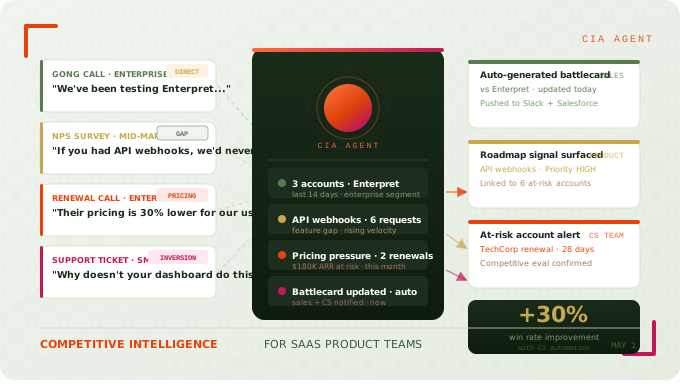
Not all competitive mentions are equal. The CIA Agent classifies them into four distinct signal types, each requiring a different response.
Signal 1: Direct competitor mentions
The most obvious signal, and still the most undertracked. A customer types the name of a competitor in a support ticket, a Gong call transcript, or an NPS comment. AI leverages Natural Language Processing to sift through unstructured sources like emails, call transcripts, and support tickets, identifying negative sentiment or mentions of competitors. (Lucid)
When this happens once, it is noise. When it happens three times in the same account across different channels in a two-week period, it is an active competitive evaluation. The signal is not the mention — it is the pattern.
Signal 2: Feature gap language
A customer asks whether your product can do something. You say it cannot. They say they understand and move on. Two weeks later they mention a competitor by name in their renewal call. The feature gap and the competitive evaluation are the same signal — they just appeared in different places at different times.
Feature gap language — phrases like "we need this to work with," "is there a way to," "we've been asking for this for months" — is one of the earliest indicators that a customer is actively comparing alternatives. When multiple accounts use similar feature gap language in the same month, it is a market signal, not just an account signal.
Signal 3: Pricing pressure language
When a customer starts negotiating renewal with specific competitor pricing figures, the evaluation is already in late stages. But earlier in the journey, pricing pressure shows up differently: "we're trying to reduce our tool spend," "we're evaluating whether this is the right investment," "leadership is asking us to justify our subscriptions." These phrases precede the explicit price comparison by weeks.
Signal 4: Sentiment inversion on competitive categories
A customer who used to praise your reporting is now asking why a specific report does not exist. The sentiment has not turned negative — it has inverted from praise to absence. This inversion often tracks exactly with a competitor feature launch that the customer has been shown in a sales demo. Traditional competitive intelligence relied heavily on manual research, quarterly reports, and static documentation — leaving sales teams with outdated battlecards while competitors launched new features and adjusted positioning in real time. (Unleash)
What Continuous CI Looks Like in Practice
Manual CI collection is built around a workflow: someone monitors competitor websites, updates battlecards on a schedule, and distributes findings in a weekly digest. Every step of this workflow introduces delay. A competitor price drop warrants an immediate battlecard update and a notification to active deal owners. A competitor blog post about a new feature might only need a monthly review summary. (Salesmotion) But that triage requires someone to have seen the signal, evaluated its urgency, and acted immediately. That is not how quarterly battlecard updates work.
Continuous CI replaces that workflow with a monitoring system that never stops. The CIA Agent runs 24/7 across every feedback channel — support tickets, call transcripts, NPS responses, sales call notes, review platforms, renewal conversations — and surfaces competitive signals as they appear, not on a schedule.
The output is not a quarterly report. It is a live competitive picture that updates every time a relevant signal arrives. When three enterprise accounts mention the same competitor feature in the same week, that surfaces immediately. When a competitor pricing change shows up in renewal conversations, product and sales know before the next call.
A leading SaaS company implementing AI-powered competitive intelligence saw a 65% reduction in time spent researching competitors. (Unleash) More importantly, the intelligence that used to arrive too late arrived in time to act on.
The Cross-Agent Advantage: Why CIA + VoC Changes the Equation
Standalone competitive intelligence tools track what competitors are doing publicly — website changes, job postings, press releases, review platforms. That information is real, but it is available to everyone. It tells you what your competitor shipped. It does not tell you whether your customers care.
The signal that matters is not whether a competitor launched a feature. It is whether your customers are reacting to it. A competitor pricing change is strategically significant only if your accounts are citing it in renewal conversations. A competitor's new integration announcement matters only if your customers have been asking for that integration.
The CIA Agent, working in combination with the VoC Agent, connects these two data streams. External competitor moves cross-referenced with internal customer feedback produces a signal that neither source generates alone: competitive threats that are specifically relevant to your customer base, ranked by which accounts are actually affected.
A product team acting on this combined signal is not building defensively against everything a competitor ships. They are building precisely against the moves that their own customers are responding to. The difference between winning and losing often comes down to who knows more, faster — and competitive intelligence helps teams learn about competitor moves before their prospects do. (Battlecard) When that intelligence comes from your own customer feedback, it is faster and more targeted than anything external monitoring can produce.
Building Your CI System: The Three Layers
Whether you are building competitive intelligence manually, with existing tools, or with an autonomous agent, the architecture is the same. Three layers, in sequence.
Layer 1: Signal capture — Every channel where competitive mentions can appear must be monitored. Support tickets, call transcripts, NPS open-text, renewal conversation notes, review platform responses, lost deal notes. If a channel is not in the system, signals disappear.
Layer 2: Pattern detection — Individual mentions are noise. Patterns across mentions are intelligence. A single competitor mention in one support ticket is not actionable. Twelve competitor mentions across six accounts in thirty days, concentrated in enterprise customers approaching renewal, is a strategic signal.
Layer 3: Routed action — Intelligence without routing is not intelligence. The product team needs to know about feature gaps. Sales needs updated battlecard language. CS needs to know which accounts are in active competitive evaluation. Each signal type routes to a different team with a different action trigger.
Organisations implementing competitive intelligence automation report 85–95% reduction in manual research time and 30–40% improvement in competitive win rates. (ARISE GTM) The manual process was not just slow — it was structurally preventing the routing that makes CI actionable.
Conclusion
The Intelligence Was Always There
Every company that has lost a deal to a competitor had the signals. A customer mentioned the competitor three months before the deal closed. A feature gap came up in support. A pricing conversation happened in a renewal call that someone made a note of, filed in Salesforce, and never cross-referenced with anything else.
The intelligence was there. The system to surface it, connect it, and route it to the right person at the right time was not.
The competitive landscape has never been more dynamic, and traditional approaches to competitive intelligence are failing to keep pace — sales teams drowning in outdated battlecards while competitors launch new features and shift positioning in real time. (Unleash)
The product teams winning on competitive intelligence today are not the ones with the biggest CI budget. They are the ones who stopped treating competitive intelligence as a quarterly research project and started treating it as a continuous signal — one their customers are already generating, in every support ticket, every call, every renewal conversation.
The CIA Agent surfaces that signal in real time. If you want to see what it finds in your own customer feedback, book a demo and we will show you the competitive signals your customers are already leaving.