
14 Minutes
Your team spent three weeks collecting customer feedback. A product manager synthesized it into a 40-slide deck. Leadership reviewed it in a quarterly meeting. Three months later, nothing shipped.
This is not a rare failure. It is the default outcome.
Research consistently shows that the vast majority of customer insights collected by companies never influence a single decision. Not because the data was bad. Not because people didn't care. But because the pipeline between insight and action is broken in ways most teams don't even see.
This post diagnoses exactly why that pipeline breaks — and what a different approach looks like.
The Insight Graveyard Is Real
Companies spend tens of billions of dollars annually collecting customer feedback. Surveys, NPS runs, support tickets, sales call notes, review sites, Slack threads, Gong calls — the channels multiply every year. The volume of feedback most mid-market SaaS companies receive today would have required an entire research team to process five years ago.
But volume has never been the problem.
38% of organizations identify fragmented customer data as a major obstacle to creating great customer experiences. (Wordnerds) The feedback exists. It is scattered, siloed, and stuck.
And even when it does get synthesized, the synthesis is always late. A product manager sitting down on Friday afternoon to read through the week's Intercom threads is working with signals that are already days old. By the time those signals reach a roadmap discussion, they are weeks old. By the time a decision is made, acted on, and shipped — the customers who raised those concerns may have already churned.
Only 1 out of 26 unhappy customers complain. The rest simply leave. (Fullview) The feedback you are manually reading represents a fraction of the actual signal. The customers who didn't bother writing in have already made their decision.
Three Reasons the Pipeline Breaks
The insight-to-action gap is not a motivation problem. Product managers want to act on customer feedback. Customer success teams want to flag churn signals early. Leadership wants to make data-driven decisions.
The gap is structural. Here is where it collapses.
Reason 1: Insights live in the wrong place
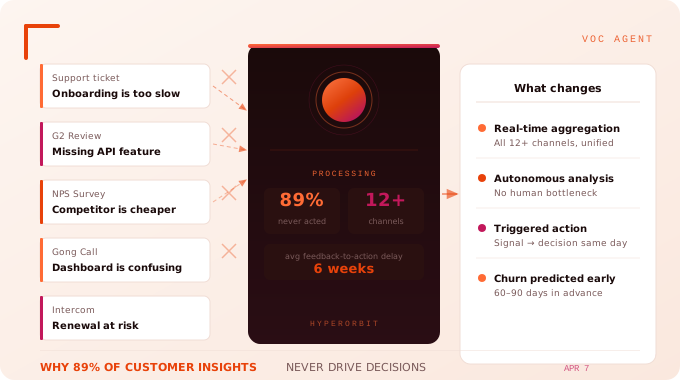
Feedback arrives in twelve or more places simultaneously — app store reviews, Zendesk tickets, Intercom conversations, Gong call transcripts, NPS surveys, G2 reviews, Slack messages from the sales team. Each channel has its own owner, its own cadence, its own format.
Nobody has a complete picture. The CS team knows what churned accounts complained about. The product team knows what power users request. Sales knows what's losing deals. Nobody puts it together.
The result is that every team is making decisions based on an incomplete slice of what customers are actually saying.
Reason 2: Analysis is slow and biased by who does it
When insights do get synthesized, a human is doing it. Humans are fast at pattern recognition when they expect to find something. They are slow at spotting anomalies, terrible at maintaining consistency across thousands of data points, and deeply susceptible to recency bias and confirmation bias.
The senior PM who is bearish on a pricing-related feature request will unconsciously deprioritize the six tickets that mention pricing friction. The customer success lead who just had a great call with a power user will feel better about retention than the data justifies.
Manual synthesis is not neutral. It is always shaped by who did it and when.
Reason 3: By the time insights reach a decision-maker, they are stale
Most companies operate on feedback cycles measured in weeks. NPS runs quarterly. Roadmap planning happens monthly. Sprint retros happen bi-weekly. None of these cycles are fast enough to catch a churn signal before it becomes a churned customer.
Customers want to be heard, and more importantly, they want to see action. If users give feedback but nothing changes, trust erodes. (Vitally) But trust erodes quietly. There is no notification when a customer stops believing their feedback is heard. They just start taking calls from your competitors.
What Happens When Insights Don't Drive Decisions
The consequences are not abstract.
A mid-market SaaS company with $10M ARR and a 12% annual churn rate is losing $1.2M every year. Industry data puts average B2B SaaS churn at 10–14% annually, with 60–70% of companies failing to hit the 5% benchmark considered healthy. That gap between actual and healthy churn is largely preventable — and most of it traces back to feedback signals that existed but were never acted on.
Feature failure is the other casualty. When roadmap decisions are made on incomplete, delayed, or biased insight synthesis, the wrong features get built. 30% of features in typical SaaS products see less than 10% adoption. That is not an engineering problem. It is a customer intelligence problem.
The teams building these features believed they were solving something customers cared about. They just did not have a reliable, complete, real-time picture of what customers actually cared about.
The Gap Is Not Solvable With More People
The reflex response is to throw more people at the problem. Hire a user researcher. Add a customer insights analyst. Build a feedback review process.
This works up to a point. At 50 customers, a dedicated person reading every piece of feedback is feasible. At 500, it becomes a full-time job to stay current. At 5,000, it is impossible.
Scale is not the only problem. Even at manageable customer counts, the human-in-the-loop model introduces all the delays and biases described above. More people doing the same slow, biased manual process does not close the insight-to-action gap. It just makes the gap more expensive.
The companies closing this gap are not doing it with headcount. They are doing it by changing the architecture of how feedback flows from customers to decisions.
What Closing the Gap Actually Looks Like
The insight-to-action gap closes when three things change simultaneously.
Aggregation becomes continuous, not periodic. Customer feedback stops living in twelve silos and starts flowing into a single system in real time. Every channel — support, sales, reviews, surveys, in-app feedback — is monitored continuously. No signal waits to be collected on a Friday afternoon.
Analysis becomes autonomous, not manual. Instead of a human reading tickets and writing summaries, an AI agent is analyzing thousands of data points simultaneously, identifying patterns, tracking sentiment shifts, and surfacing the signals that matter. It does not have recency bias. It does not have a prior hypothesis to confirm. It processes everything at once.
Action becomes triggered, not scheduled. When a churn signal emerges, the system flags it immediately — not at the next quarterly review. When a cluster of customers starts citing a competitor feature as a reason for frustration, that surfaces the same day, not three weeks later when someone gets around to reading the support tickets.
60% of CX leaders consider AI transformative in enabling actionable insights. (Wordnerds) The teams moving fastest on this are not replacing their product managers or customer success teams. They are removing the manual, slow, error-prone middle layer between customer voice and business decision.
The Competitive Reality
Here is what makes this urgent.
The insight-to-action gap is not evenly distributed. Some companies are already running on continuous, automated customer intelligence. They know when a customer segment starts expressing frustration before it shows up in churn data. They know which competitor features are being cited in support tickets this week, not this quarter. They build features customers actually want because they have a real-time, complete picture of what customers actually want.
Companies still running on manual feedback cycles are competing against this.
The gap between the fastest and slowest customer intelligence operations is widening. And because customer intelligence feeds directly into product decisions, retention strategies, and roadmap priorities, the compounding effect is significant.
The 89% of insights that never drive decisions? Every single one of them was a signal. Some were churn signals. Some were roadmap signals. Some were competitive signals. They just never made it from customer to decision-maker in time to matter.
That is the problem worth solving.
Where does your team sit on the customer intelligence maturity curve?
Take the Customer Intelligence Maturity Assessment — 15 questions, five minutes, and you will know exactly which part of the insight-to-action pipeline is breaking for your team.
Conclusion
The Fix Starts With Acknowledging the Architecture Problem
Most teams treating the insight-to-action gap as a process problem are solving the wrong thing. New templates, better meeting cadences, and stricter tagging taxonomies are all attempts to make a slow, manual, biased system slightly less slow, slightly less manual, and slightly less biased.
The gap does not narrow. It just gets more decorated.
The shift that actually closes it is architectural: moving from periodic, human-mediated feedback synthesis to continuous, autonomous customer intelligence. Not as a long-term aspiration — as a practical decision about how your team operates now.
The 89% of insights that never drive decisions are not a data problem. Your team is collecting more data than it has ever collected. They are not a priority problem. The signals are there; they are just arriving too slowly, in too many places, filtered through too many human assumptions before they reach anyone with the authority to act.
They are a pipeline problem. And pipelines can be rebuilt.
The companies that do this first do not just move faster. They compound. Every week of continuous intelligence builds a more accurate picture of what customers want, what risks are emerging, and where the competitive landscape is shifting. Every week of manual feedback synthesis falls further behind.
If you want to know exactly where your pipeline is breaking — which stage of the insight-to-action flow is costing you the most — the Customer Intelligence Maturity Assessment will tell you in five minutes. It diagnoses the specific gap, not the general problem.
Because closing the gap starts with knowing where it is.