
8 Minutes
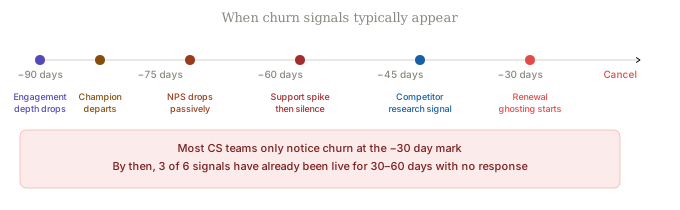
Most SaaS teams discover churn at renewal. The signals appeared 60–90 days earlier — they just weren't watching for them.
Churn is almost never a surprise to the customer. By the time they're sending the cancellation email, they've been mentally checked out for months. The decision was made during a frustrating support experience, or the week a competitor launched a feature they'd been requesting for a year, or the quarter their internal champion left and no one reached out.
The problem isn't that the signals don't exist. The problem is that most CS and product teams aren't instrumenting for them early enough — or with the right data sources.
Here are the six signals that consistently precede churn by 60–90 days — and what to do when you see them.
Signal 1: Declining product engagement depth
The most reliable early churn signal is not declining login frequency — it's declining depth of engagement. A customer may still log in weekly but be using only 20% of the features they used three months ago. They've stopped exploring. Breadth of feature use contracts before frequency does, and that contraction is the earlier signal.
Watch for: Drop in unique features accessed per session, reduction in workflow completions, decrease in data export or report generation volume — all without a corresponding drop in login count.
Signal 2: Spike in support ticket volume followed by silence
A short burst of high-friction support tickets followed by a sudden drop in contact is a two-part churn signal. The burst indicates a problem. The silence usually means the customer has stopped trying to fix it — they've decided to leave instead.
Watch for: Any account that opens 3+ tickets in a two-week window, then goes quiet for 30+ days. Cross-reference with product engagement data to confirm the disengagement pattern.
Signal 3: Champion departure or role change
Research consistently shows that champion departure is one of the highest-correlation churn predictors in B2B SaaS. When the internal advocate who drove adoption leaves or moves to a different role, there is typically a 90-day window before the account goes cold — unless a new relationship is established.
Watch for: LinkedIn job change alerts for key contacts, email bounce notifications from primary users, shift in who is submitting support tickets. Most CRMs don't track this automatically — you need a dedicated signal layer.
Signal 4: Passive NPS decline without complaint
Promoters who quietly slide to passives — without ever filing a ticket or raising a concern — are among the most dangerous churn signals because they generate no noise. They've stopped being disappointed. They've started being indifferent. Indifference, not frustration, is what actually precedes quiet churn in B2B accounts.
Watch for: Any account whose NPS response drops from 9–10 to 7–8 with no corresponding support activity, especially in accounts with low login frequency trends over the same period.
Signal 5: Competitor research signals
Customers who are considering switching don't stay silent — they go looking. Review site comparisons, G2 category page visits, competitor trial sign-ups, and even social media questions about alternatives all appear in the digital trail 45–60 days before a cancellation request. Most companies have no mechanism to detect this.
Watch for: Review site activity from your current customer segment, competitive comparison queries in community forums, and any CS conversation where a customer mentions a competitor by name — even casually. A competitive intelligence agent that monitors these surfaces cross-references them against your active customer list in real time.
Signal 6: Reduced stakeholder breadth
Healthy accounts grow their internal user base over time. Churning accounts shrink it. When an account that had 12 active users drops to 4, it's not a license management decision — it's a consolidation before exit. Reduced stakeholder breadth is the quiet internal signal that happens as teams wind down their commitment before formally cancelling.
Watch for: Drop in seat utilization rate, reduction in the number of unique users submitting requests or logging in, and team-level deactivations that happen outside the normal off-boarding cycle.
Why individual signals aren't enough — you need signal convergence
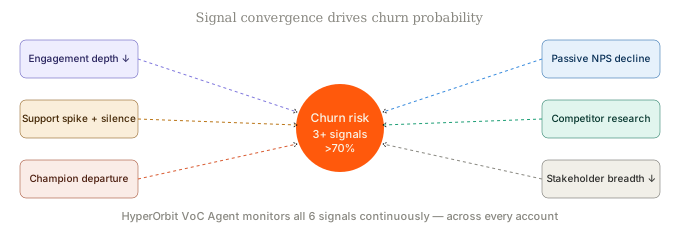
Any single signal can be a false positive. An account might have low logins because of a holiday period. A champion might change roles without the account being at risk. What actually predicts churn with high confidence is the convergence of multiple signals within a 30-day window. When three or more of these six indicators appear together, churn probability exceeds 70% in the following 90 days.
This is why manual health scoring is insufficient. A CS manager cannot simultaneously monitor engagement depth, support patterns, NPS trends, competitive research signals, and stakeholder breadth across 80 accounts. An AI agent can — continuously, across every account, and with no signal fatigue.
Conclusion
Churn is predictable — if you're watching the right signals
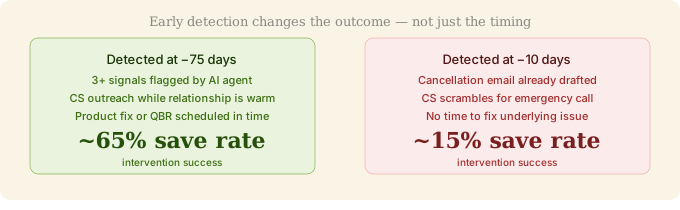
The companies that consistently beat their net revenue retention targets aren't reacting to churn faster. They're seeing it earlier — at the 60–90 day mark, when there's still enough relationship capital and time to intervene effectively. A well-timed outreach from CS, a proactive product fix, or a re-engagement campaign at the 75-day mark has a fundamentally different success rate than the same action at the 10-day mark.
The six signals above are all detectable with the right instrumentation. The obstacle for most teams isn't awareness of these signals — it's the operational capacity to monitor them continuously across a full customer base. That's the problem autonomous AI agents were built to solve.
Start by auditing which of these six signals your team currently monitors. Most teams discover they're actively watching two or three at best — and doing so manually. That's the gap between your current churn rate and what it could be.