
14 Minutes
Every product team doing customer intelligence believes they are doing it well. The Gen 1 teams believed their spreadsheets were rigorous. The Gen 2 teams believe their dashboards are sophisticated. Both are right — relative to what came before. Neither is right about what is actually possible.
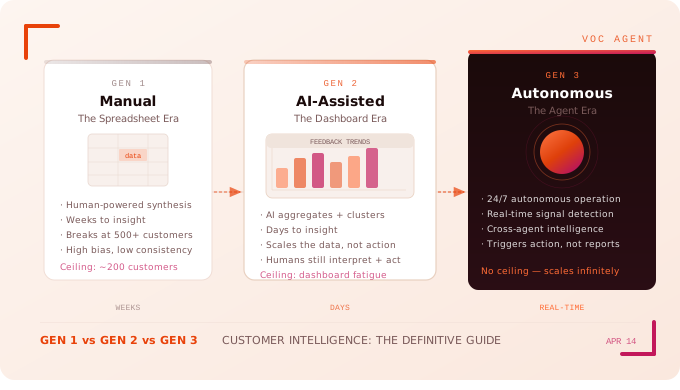
The generational framework for customer intelligence is not marketing language. It maps to a real architectural shift in how feedback flows from customers to decisions, how quickly that flow moves, and how much human effort sits in the middle of it. Each generation solved the problems of the one before it. Each one introduced new bottlenecks that the next generation had to fix.
This is the definitive guide to all three.
Gen 1: Manual Intelligence (The Spreadsheet Era)
Gen 1 is not ancient history. Most companies still run some version of it.
The hallmarks are recognizable: a customer success manager copy-pasting quotes from Zendesk into a Google Sheet. A product manager reading through last week's NPS comments every Friday. A quarterly business review slide built by someone who spent three days compiling feedback from six different sources into a single document.
Gen 1 intelligence is human-powered from start to finish. Collection is manual, analysis is manual, synthesis is manual, and reporting is manual. The only tool doing any work is the human doing the reading.
It has real virtues. Gen 1 produces nuanced qualitative understanding that algorithms still struggle to match. An experienced PM reading customer feedback will catch subtle implications, tonal shifts, and contextual signals that no automated system would flag. The analysis is shaped by someone who understands the product, the customer relationships, and the competitive context.
The problems are equally real. Gen 1 does not scale. It does not stay current. And it is not consistent.
A team of three can manually process customer feedback at 100 customers. At 500, the same process means somebody is always behind. At 5,000, it is mathematically impossible. The team that was rigorous at 100 customers is now making decisions based on a sample of the feedback they should be reading — not because they became less diligent, but because the volume outgrew the architecture.
The other problem is latency. Traditional business intelligence began with manual reporting — reports were slow to produce and out of date as soon as they were printed. (Domo) Customer feedback in a spreadsheet is the same problem. By the time it is synthesized and presented, the signals are weeks old. By the time a decision is made, the customer who raised the issue has already churned or moved on.
Gen 1 works. It just does not work at scale, at speed, or with consistency.
Gen 2: AI-Assisted Intelligence (The Dashboard Era)
Gen 2 emerged as the obvious fix for Gen 1's scale problem. If humans cannot read every ticket, let software aggregate the data and surface the patterns. If reporting is always late, build a live dashboard.
The tools of Gen 2 are everywhere: sentiment analysis layers on top of feedback collections, keyword clustering to group similar requests, NPS trend charts, customer health score dashboards, weekly summary emails generated by AI. Products like Dovetail, Enterpret, and Qualtrics operate primarily in this space — powerful aggregation and analysis tools that require human judgment to interpret and act on.
Gen 2 solved the scale problem. An AI-assisted platform can process thousands of feedback entries in seconds where a human would need weeks. It surfaces patterns the human eye would miss and maintains consistency that manual analysis cannot.
Most AI analytics platforms until now were glorified dashboarding tools with a sprinkle of automation. They still required manual exploration, technical know-how, and some degree of baked-in logic. AI was assistive, but had zero agency. (Tellius)
That is the precise limitation of Gen 2. The intelligence is there. The agency is not.
A Gen 2 dashboard tells you that 34% of this month's feedback mentions onboarding friction. It does not decide what that means for the roadmap. It does not flag that the same customers mentioning onboarding friction also have low product usage scores — meaning churn risk is elevated, not just satisfaction risk. It does not alert the customer success team that three of those accounts are up for renewal in six weeks.
The insight sits in the dashboard. The action requires a human to notice the dashboard, interpret what they see, connect it to other data sources, decide it is urgent enough to act on, and then do something about it.
Analytics tells you what changed. Intelligence tells you why it changed and what to do next. (CX Today)
Gen 2 is very good at the first part. It does almost nothing for the second.
The result is a subtler version of the Gen 1 problem. The data is no longer late — it is available in near real-time on a dashboard. But the human in the middle is still a bottleneck. The product manager checking the dashboard once a week is still creating a one-week lag between signal and response. The customer success lead who interprets the health score data through the lens of their current mental model is still introducing the biases that Gen 2 was supposed to eliminate.
Gen 2 made the data more available. It did not make the pipeline more autonomous.
Gen 3: Autonomous Intelligence (The Agent Era)
Gen 3 does not improve the dashboard. It removes the need for it.
Agentic analytics uses autonomous agents to detect patterns, generate insights, and sometimes act without requiring a human to initiate every step. Domo Applied to customer intelligence, this means feedback stops flowing into a system that waits to be queried. It starts flowing into a system that continuously monitors, connects, interprets, and acts — without someone pressing refresh.
The architectural difference is significant. Gen 2 is pull-based: a human decides to look at the dashboard, runs a query, reads the output, and decides what to do. Gen 3 is push-based: the system continuously monitors signals, identifies what matters, and surfaces the right information to the right person at the right time — or in some cases, triggers an action directly.
A churn-risk flag without a workflow is just anxiety. A churn-risk flag that triggers a tailored save play, escalates to a retention queue, and measures whether retention improved is operational intelligence. CX Today
That distinction — between a flag and a workflow — is the entire difference between Gen 2 and Gen 3.
What Gen 3 looks like in practice for a mid-market SaaS product team:
The Voice of Customer Agent is continuously aggregating feedback across every channel — support, sales calls, reviews, NPS, in-app, social — and detecting when sentiment in a specific customer segment shifts. It does not wait for Friday's manual review. It flags the shift the same day it happens.
The Competitive Intelligence Agent is monitoring feedback for competitive mentions. When three enterprise accounts in the same week mention a competitor feature in their support tickets, it surfaces that pattern immediately — not at next quarter's competitive review.
The two agents share signal. When the VoC Agent identifies a churn risk and the CIA Agent has logged that the same account recently mentioned a competitor, the combined picture — declining sentiment plus active competitive evaluation — produces a signal that neither agent would surface alone.
Agentic AI can execute multi-step tasks and collaborate across workflows — making decisions, designing workflows and interacting with various tools. IBM The cross-agent intelligence loop is Gen 3's most powerful property, and it is the one no single-agent competitor can replicate.
Why the Generation You Are In Determines the Competitive Gap
The companies running Gen 3 customer intelligence today are not just faster at processing feedback. They are operating with a fundamentally different information advantage.
A Gen 1 company learns what customers think in weeks. A Gen 2 company learns in days. A Gen 3 company learns continuously — and acts on what it learns before the competitor who relies on dashboards has opened their laptop.
Leading platforms already show this shift — predictive insights now sit alongside customer records, giving service teams actionable intelligence with AI instead of dashboards. Girikon
That gap compounds. Every week of Gen 3 operation builds a more accurate picture of customer behavior, refines the churn prediction models, and tightens the feedback loop between customer signal and product decision. Every week of Gen 2 operation produces another set of dashboard screenshots that someone may or may not act on.
Gartner predicts that by 2027, 50% of business decisions will be augmented or automated by AI agents for decision intelligence. Findanomaly That is not a distant forecast. It is a window that is closing.
How to Know Which Generation You Are In
Gen 1: Your team has regular rituals for manually reading and synthesizing customer feedback. Insights live in documents and decks. Acting on feedback requires a meeting.
Gen 2: You have tools that aggregate and visualize feedback. Someone checks the dashboard regularly. Insights are available but still require interpretation and a human decision to act on.
Gen 3: Customer feedback continuously informs your decisions without a human in the middle of every step. Churn signals trigger workflows. Competitive mentions surface automatically. The system acts, not just reports.
Most mid-market SaaS companies today sit somewhere between Gen 1 and Gen 2. Very few have made the shift to Gen 3.
The Transition Is Not As Difficult As It Looks
Moving from Gen 2 to Gen 3 does not require ripping out existing tools or re-architecting your data stack. It requires changing the direction of data flow — from a system you query to a system that continuously monitors and surfaces.
The hardest part is not technical. It is organizational. Gen 2 built habits around checking dashboards and running weekly reviews. Gen 3 makes those habits unnecessary — but breaking them requires trust that the autonomous system is actually catching what the human review used to catch.
It does. And it catches considerably more.
Conclusion
Generation Is a Choice
Every company decides which generation of customer intelligence to operate at. Gen 1 was the default for a long time because it was the only option. Gen 2 became the default as feedback volume scaled beyond human capacity. Gen 3 is available now — not as a future capability but as a present one.
The question is not whether Gen 3 intelligence is better. Agentic AI marks a pivotal leap — businesses get a living, breathing data ecosystem that anticipates change and drives swift, intelligent responses, rather than being tethered to static dashboards or belated post-campaign reports. (CMSWire)
The question is whether your team makes the shift before the competitor who sells to the same customers does.
The generational framework is not about technology preference. It is about competitive positioning. Companies that understand customers faster, more completely, and more continuously than their competitors have a structural advantage that compounds over time. The generation you operate at is the single largest determinant of how wide that advantage is — and which direction it runs.
If you are not sure which generation describes your current operation, the Customer Intelligence Maturity Assessment will tell you in five minutes, with specific recommendations for what to change first.