
8 Minutes
Ask any product leader whether competitive intelligence matters and you'll get an enthusiastic yes. Ask them to show you their current CI process and you'll usually find a Notion page last updated four months ago, a Slack channel where someone occasionally drops a competitor's pricing page link, and a quarterly slide deck that nobody reads between reviews.
The gap between the importance of competitive intelligence and the quality of most CI programs is one of the most consistent failure patterns in SaaS product management. The reason isn't lack of interest. It's that CI is treated as a project — a deliverable — rather than a continuous operational function wired into how the team already works.
Here's a practical framework for building a CI habit that survives beyond the initial enthusiasm.
Step 1: Define the three questions CI must answer for your team
The most common reason CI programs collapse is that they try to monitor everything and answer nothing specific. Before instrumenting a single signal source, align your product team on the three core questions your CI function must answer consistently:
Which competitor moves represent an immediate threat to our roadmap priorities?
Where are competitors winning deals we're losing — and why?
What are customers saying about competitors that we should be building toward?
Every signal source, cadence, and output you build should trace back to one of these three questions. If it doesn't, it's noise — and noise is what kills CI programs.
Step 2: Build your signal stack — not your report stack
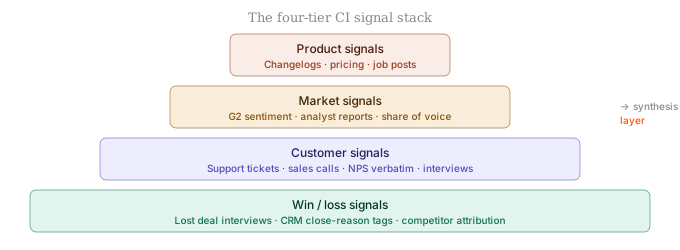
Most CI programs are built around reports. The right architecture is built around signals — real-time inputs that feed into a synthesis layer before becoming a report. Your signal stack for a SaaS product team should cover four tiers:
Product signals: Competitor changelog monitoring, feature release tracking, pricing page change detection, and job postings (which reveal what competitors are building next).
Market signals: Review site sentiment shifts on G2 and Capterra, analyst report updates, and category-level share-of-voice movement.
Customer signals: Mentions of competitors in support tickets, sales call transcripts, and NPS verbatim responses. These are the richest signals — and the most underused.
Win/loss signals: Structured data from lost deal interviews and CRM close-reason tagging, analysed for competitor-attributed patterns.
Step 3: Set a cadence — and protect it ruthlessly
CI without a cadence is a research project. CI with a cadence is an operational function. For most SaaS product teams, a three-tier cadence works well:
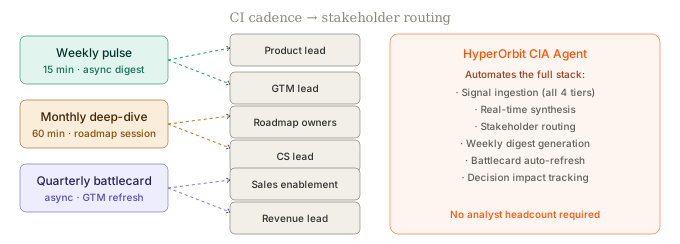
Weekly pulse (15 mins): A short async update — new competitor feature releases, notable review site shifts, any sales deal lost to a named competitor this week. Delivered as a digest to product and GTM leads. No meeting required.
Monthly deep-dive (60 mins): A structured review of competitive positioning across your top three competitors — feature gap analysis, messaging comparison, pricing movement, and win/loss patterns from the month. This is the session where roadmap implications are discussed.
Quarterly battlecard refresh (async): Update your sales battlecards with the latest product and positioning data so GTM teams are always working from current intelligence, not last quarter's snapshot.
Step 4: Route insights to the people who can act on them
This is where most CI programs break down even when the signals are good. A product insight about a competitor's new feature needs to reach the PM owning the relevant roadmap area — not land in a general Slack channel where it gets 3 emoji reactions and disappears.
Define a routing map upfront: which CI signal type goes to which role, through which channel, with what expected response. Competitor pricing change → Head of Revenue + Product Lead, same day. New competitor integration released → PM for integrations, within 48 hours. Win/loss pattern shift → CS lead + Sales enablement, weekly digest.
Without explicit routing, CI becomes everyone's responsibility and therefore no one's priority.
Step 5: Close the loop — measure CI impact on decisions
A CI program that cannot demonstrate its influence on decisions will always be the first thing cut when resources tighten. Track a simple metric: how many roadmap decisions in the last quarter were directly informed by a CI signal? How many deals were won using a battlecard built from CI data? Even rough attribution builds the internal case for sustaining the program.
The goal is to make CI's contribution to revenue and retention outcomes visible — so it gets treated as infrastructure, not overhead.
Conclusion
CI is infrastructure, not a project
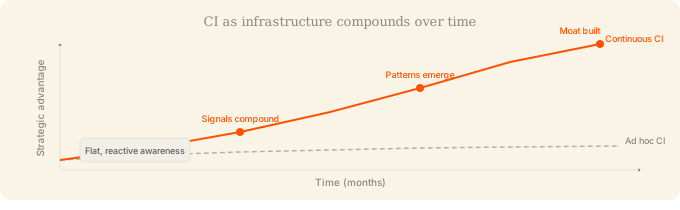
The product teams that use competitive intelligence most effectively don't treat it as a quarterly ritual or a research deliverable. They treat it as living infrastructure — a continuous signal layer that feeds directly into roadmap decisions, GTM positioning, and customer retention strategy.
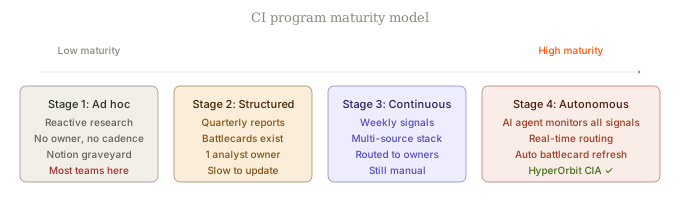
Building that infrastructure manually is possible at a small scale but becomes operationally unsustainable as your competitor set grows and your product surface area expands. The ceiling of a manual CI program is usually one analyst running three competitors at a monthly cadence. The ceiling of an autonomous CI agent is every competitor, every signal source, every day — routed to the right person the moment it matters.
Start by answering the three questions in Step 1. Then audit your current signal stack against the four tiers. Most teams discover they're covering one tier well and ignoring the other three. That's the gap between your current win rate and what it could be.