
9 Minutes
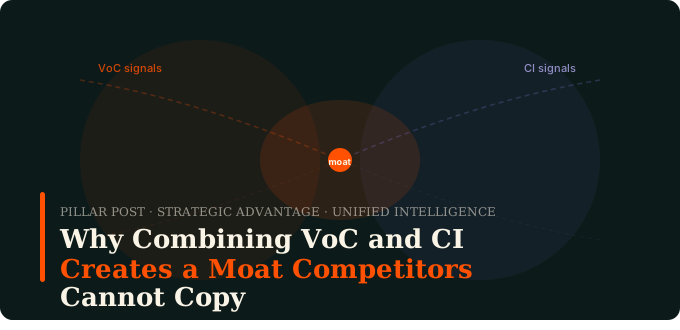
Most SaaS companies treat Voice of Customer and Competitive Intelligence as parallel but separate disciplines. VoC sits with product or CS. CI sits with product marketing or strategy. They run on different cadences, different tools, different owners — and their outputs rarely meet in the same room at the same time.
This separation feels natural. VoC is about your customers. CI is about your competitors. Different subjects, different data sources, different audiences.
But that separation is where a massive strategic blind spot lives. Because the most important customer intelligence questions are never purely about your customers or purely about your competitors. They live at the intersection — and that intersection is where the real competitive moat is built.
What VoC alone cannot tell you
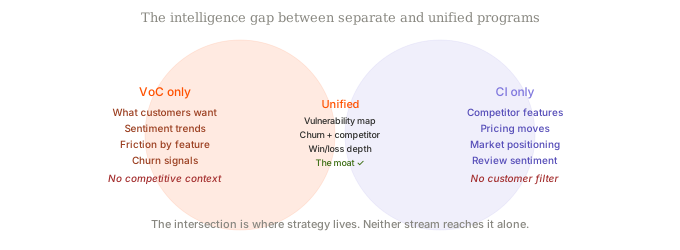
A VoC program running in isolation gives you a clear picture of what your customers want. What it cannot tell you is whether what they want is already available from a competitor, whether a competitor is actively building it, or whether the customer's frustration is about your product specifically or about an industry-wide gap that nobody has solved yet.
Without competitive context, every piece of customer feedback is interpreted in a vacuum. "Customers want better reporting" could mean you're behind your main competitor by one quarter — or it could mean every tool in the category has the same limitation and first-mover advantage is available. VoC alone cannot distinguish between the two. The response strategy is completely different in each case.
What CI alone cannot tell you
A CI program running in isolation gives you an accurate map of the competitive landscape — what features competitors have shipped, how they're positioning, where their pricing is moving, what their customers are saying on review sites.
What it cannot tell you is whether those competitor moves actually matter to your customers. A competitor could launch ten new features this quarter. Without VoC data telling you whether those features overlap with your customers' active pain points, you have no basis for prioritising your response. CI without VoC produces competitive noise — a lot of information with no filter for what actually affects your retention and revenue.
What the combination unlocks
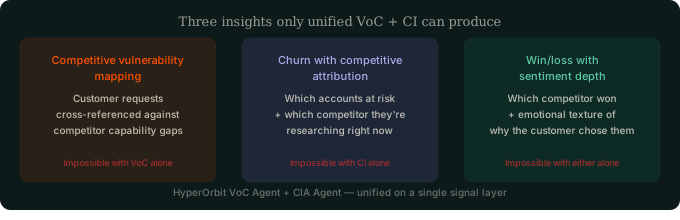
When VoC and CI are unified in a single intelligence layer, a new class of insight becomes possible — insights that neither stream can produce alone:
Competitive vulnerability mapping: Cross-referencing customer feature requests against competitor capability gaps reveals where you have a first-mover window before a competitor closes the gap. This is the highest-value input to quarterly roadmap prioritisation.
Churn risk with competitive attribution: Knowing an account is at churn risk is useful. Knowing that account has been researching a specific competitor who just launched the feature they've requested three times — that's the intelligence that determines what the CS team actually says in the retention call.
Win/loss intelligence with sentiment depth: CI tells you which competitor you lost a deal to. VoC tells you why — with the emotional texture of what the customer actually valued. The combination produces win/loss intelligence that sales teams can operationalise, not just read.
Why this moat compounds — and why tools can't replicate it
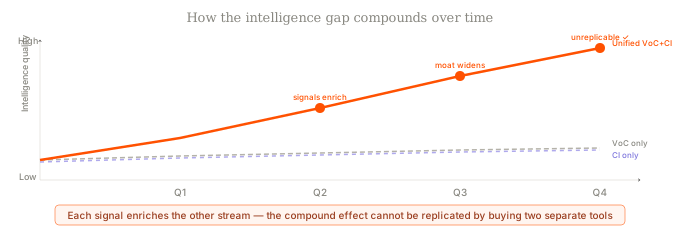
The moat created by unified VoC and CI intelligence isn't just additive — it's multiplicative, and it compounds over time in a way that creates durable competitive advantage.
Here's the compounding mechanism: every customer signal your unified system processes improves the accuracy of your competitive vulnerability map. Every competitor move your CI agent captures gets immediately cross-referenced against your active customer sentiment — telling you within hours which accounts are now at elevated risk and what the CS team should say. Over time, the system builds a proprietary understanding of exactly which competitor moves matter to which customer segments — an intelligence asset that no competitor can replicate by buying the same tool, because the asset is the accumulated signal history, not the software.
A company that runs separate VoC and CI tools never builds this asset. They have two data sets that never enrich each other. The gap between that approach and a unified intelligence system widens with every passing quarter.
Why single-agent tools fall short
The market has responded to the demand for AI-driven customer intelligence with a wave of single-agent tools — platforms that do VoC well, or CI well, but not both in a unified system. The limitation is architectural, not cosmetic.
A VoC-only agent has no competitive signal layer. When a customer expresses dissatisfaction, the agent has no basis for determining whether that dissatisfaction represents a competitive risk or an industry-wide gap. Its recommendations are necessarily incomplete.
A CI-only agent has no customer sentiment layer. When a competitor launches a feature, the agent has no basis for determining which of your customers care and how much. Its alerts are necessarily untriaged.
Only a platform with both agents operating on a shared signal layer — where every customer signal is automatically contextualised against the competitive landscape and every competitive move is automatically filtered through customer sentiment — produces the class of intelligence that drives real retention and revenue decisions.
How to start building the unified intelligence layer
For most teams, the practical starting point is not a platform migration — it's a signal mapping exercise. Take your three most recent unexpected churn events. For each one, ask: what VoC signals preceded this, and what competitive activity was happening in the same window? In almost every case, you'll find both types of signal were present — just never visible in the same place at the same time.
That exercise makes the value of unification concrete and immediate. It also gives you the business case for building the unified layer — not as a future investment, but as the fix for a problem you've already paid for.
Conclusion
The moat is not the tool — it's the unified signal history
The competitive advantage created by unified VoC and CI intelligence is not primarily a technology advantage — it's a data advantage that builds over time. Every quarter you run a unified system, you accumulate a richer, more cross-referenced understanding of exactly which competitor moves threaten which customer segments, which customer signals precede competitive-driven churn, and where your roadmap has the highest strategic leverage.
That accumulated intelligence asset is what no competitor can copy by buying the same software. The software is the same for everyone. The proprietary signal history, cross-referenced and compounded over years — that's the moat.
The teams that start building it earliest build it deepest. And the cost of starting late is not just slower intelligence — it's the quarters of compound enrichment you can never get back.