
7 Minutes
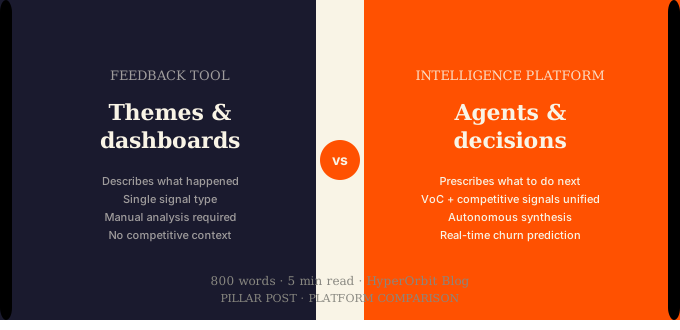
The SaaS market has a terminology problem. "Customer intelligence," "voice of customer platform," "feedback analytics tool" — these phrases are used interchangeably in vendor marketing, in analyst reports, and in procurement conversations. They're not interchangeable. They describe fundamentally different categories with different capabilities, different use cases, and a significant gap in business outcome.
A feedback tool organises and themes what your customers have already told you. A customer intelligence platform actively synthesises signals across every touchpoint — including what customers haven't explicitly said — and routes specific, timely recommendations to the people who can act on them.
Most SaaS companies start with a feedback tool. The right question isn't whether it's a good tool — it's whether you've outgrown it. Here are five signs that you have.
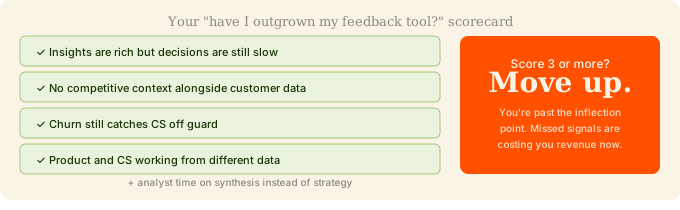
Sign 1: Your insights are rich but your decisions are still slow
You have beautifully clustered themes, sentiment trends, and weekly digest reports. Your team reads them. They nod in meetings. And then the roadmap doesn't change for another quarter, the CS team keeps getting surprised by churn, and the same friction points keep appearing in reviews six months later.
This is the classic sign that you've hit the ceiling of a feedback tool. It's excellent at producing insight — and it stops there. A customer intelligence platform doesn't just produce insight. It routes a specific recommendation to a specific person with enough context to act immediately. The bottleneck isn't the data. It's the last mile between insight and decision.
Sign 2: You have no competitive context alongside your customer data
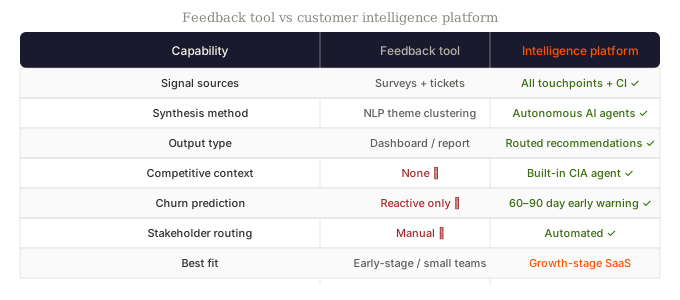
A customer says "your reporting is too limited compared to what I've seen elsewhere." Your feedback tool logs and themes that comment. It does not tell you which competitor they're referring to, whether that competitor just released a new reporting feature, whether three other accounts in the same segment made similar comments this month, or whether this represents a genuine competitive vulnerability in your current quarter.
Customer feedback without competitive context is only half the picture. When the two are unified — voice of customer signals alongside competitive intelligence — the insight becomes actionable in a way that neither stream achieves alone.
Sign 3: Churn still catches your CS team off guard
If your CS team is regularly discovering churn risk at the 30-day mark or later, your current tooling is not giving them enough lead time. Feedback tools surface what customers say when they're already frustrated enough to say something. The earlier, quieter signals — declining engagement depth, stakeholder changes, passive NPS drift — require a system that's actively monitoring account health across multiple data dimensions, not waiting for a survey response.
If churn surprises are a recurring pattern on your CS team's calendar, it's a signal that your intelligence infrastructure needs to evolve beyond feedback aggregation.
Sign 4: Your product team and CS team are working from different versions of customer reality
Product sees themes from feature requests. CS sees patterns from support escalations. Sales hears objections from lost deals. Each team has a legitimate but partial view — and because the data lives in different tools with different tagging conventions, the three views almost never synthesise into a shared picture of what customers actually need right now.
This cross-functional fragmentation is a structural problem that feedback tools aren't designed to solve. A customer intelligence platform creates a single unified signal stream that all three teams pull from — so when product, CS, and sales walk into a quarterly business review, they're working from the same ground truth.
Sign 5: You're spending analyst time on synthesis instead of strategy
If your most valuable customer insights analyst is spending 60% of their week pulling data, tagging themes, and building slide decks — rather than making strategic recommendations — your tooling is running your analyst, not the other way around.
A customer intelligence platform automates the synthesis layer entirely. Your analyst's job shifts from data wrangling to decision support — interpreting what the automated signals mean, stress-testing the recommendations, and connecting insights to strategy. That's the role you hired for. That's where the value is.
The decision framework: which stage are you at?
Use this as a quick self-assessment:
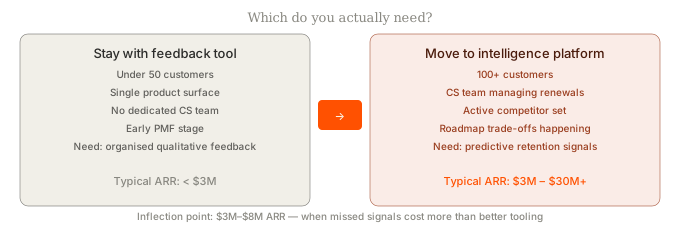
Stick with a feedback tool if: You have fewer than 50 customers, a single product surface, no dedicated CS team, and your primary need is organised qualitative feedback for early product-market fit validation.
Move to a customer intelligence platform if: You have 100+ customers, a CS team managing renewals, a product team making roadmap trade-offs, a competitor set you're actively tracking, and a need to predict retention risk before it becomes a revenue problem.
The inflection point is typically somewhere between $3M and $8M ARR — when the cost of missed signals starts to exceed the cost of better tooling. If you've hit three or more of the five signs above, you're likely past that inflection point already.
Conclusion
The right tool for the right stage
Feedback tools are not inferior products — they're the right tool for a specific stage of company growth. The mistake isn't using one. The mistake is continuing to use one when your business has grown beyond what it's designed to handle.
When churn surprises your CS team, when insights don't reach decisions, when your analyst is wrangling data instead of informing strategy, when competitive context is missing from every customer conversation — these aren't tool failures. They're growth signals. They're telling you that your intelligence infrastructure needs to evolve alongside your business.
The good news is that the transition from feedback tool to customer intelligence platform doesn't require a rip-and-replace. The best platforms integrate with your existing tool stack and layer intelligence on top — so you keep the feedback workflows that work and add the autonomous synthesis and competitive context that you've been missing.