

16 Minutes
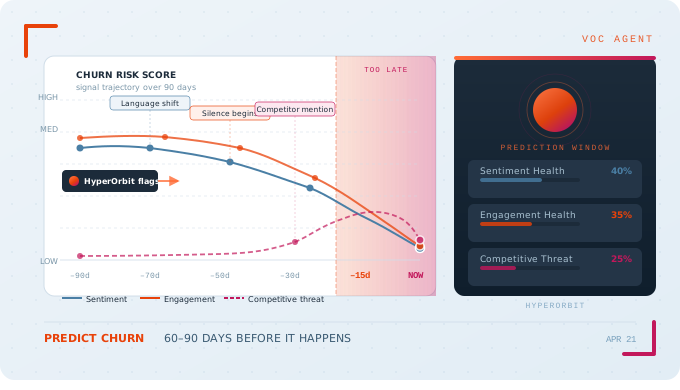
By the time a customer cancels, the decision was made weeks ago. Here's how to read the feedback signals that predict churn 60–90 days in advance — before product usage data shows a single warning sign. Target keyword: predict customer churn 60 days before Secondary keywords: churn prediction feedback signals, customer sentiment churn SaaS, early churn warning signs, AI churn prediction Publish date: April 21, 2025 Word count: ~1,600 words CTA: Customer Intelligence Maturity Assessment
By the time a customer sends the cancellation email, they have already made the decision. Usually weeks ago. Sometimes months ago.
The email is not a signal. It is a recorded outcome. The signal came earlier — in a support ticket that used different language than usual, in a QBR they declined to attend, in the absence of the feature requests they used to submit every other week. The signal was there. It just was not being read.
This post is about how to read it — 60 to 90 days before the cancellation, when there is still time to change the trajectory.
Why Traditional Churn Detection Always Arrives Late
Most CS teams run their churn detection on product usage data. Login frequency. Feature adoption. Session length. These are real signals, and they matter. But they have a structural problem: behavioral signals like purchase decline and login drop typically lag emotional signals like tonal flattening and engagement withdrawal by one to two weeks. A customer decides to leave emotionally before they act on it transactionally. (Eclincher)
By the time usage drops are measurable, the customer has mentally already left. The decision was made when they stopped believing your product was worth their attention — not when they stopped logging in to prove it.
By the time a customer tells you they're leaving, the decision was made weeks ago. The cancellation email is not the signal — it is the outcome. (Appliedai)
The teams catching churn earliest are not the ones with the best product analytics. They are the ones reading feedback signals — specifically, the emotional and linguistic patterns in customer communication that change weeks before behavior does.
The Three Feedback Signals That Predict Churn
Feedback leaves a trail before churn happens. It does not announce itself. It shifts gradually, in ways that are easy to miss when you are reading hundreds of tickets and calls manually — and nearly impossible to miss when a system is monitoring it continuously.
The most reliable churn signals fall into three categories: engagement decay (login frequency drops, feature usage narrows), support escalation (ticket volume spikes, sentiment turns negative), and commercial pullback (downgrades, delayed payments, reduced seat count). (Prospeo)
But there is a fourth category that precedes all of those — and it lives exclusively in feedback.
Signal 1: Language shift from specific to vague
Customers who are engaged ask specific questions. They want to know how to configure the webhook. They are trying to get the export to work a particular way. They reference features by name and describe exact use cases.
Customers who are disengaging switch to different language. Customers stop using feature-specific language and start using goal-oriented frustration. Before: "How do I set up the webhook integration?" After: "This isn't working for our workflow." (LoopJar)
This shift is a structural change in how the customer relates to the product. Specific questions come from someone who is invested in making something work. Vague frustration comes from someone who has stopped trying to figure it out and started evaluating whether the product is worth the effort.
The shift typically happens 6–10 weeks before cancellation. It is invisible in product analytics. It is visible in every support ticket and call transcript.
Signal 2: Silence where there used to be requests
A 2024 study published in the Journal of Service Research found that communication cessation is a stronger predictor of customer defection than complaint frequency. The study analyzed over 840,000 customer interactions and concluded that silence — not anger — is the most reliable churn signal. (Eclincher)
The customer who stops submitting feature requests has not run out of ideas. They have stopped believing their feedback will be acted on. Or they have found a competitor who already has the features they were requesting. Either way, the silence is resignation, not satisfaction.
This signal is particularly dangerous because it looks like a healthy account. No complaints. Stable usage. Clean health score. The dashboard says green while the customer is actively evaluating alternatives.
Signal 3: Tonal flattening in communication
A customer who previously wrote enthusiastic and friendly messages might shift to shorter, more formal communication. Their support tickets may begin to include words like "frustrated," "disappointed," or even hints that they are "considering alternatives." (Lucid)
This tonal change is gradual. A single ticket is meaningless. But a pattern over four to six weeks — shorter replies, less collaborative language, increasing formality — is one of the most reliable early warning signals that exists in customer data.
Most predictive sentiment models can identify churn risk two to four weeks before cancellation, depending on interaction volume and data quality. The detection window opens when a customer enters the tonal flattening phase. (Eclincher)
Catch it at the start of that phase rather than the end, and the intervention window extends to 60–90 days.
The Three-Component Churn Model
Feedback signals become most powerful when they are combined rather than read in isolation. HyperOrbit's VoC Agent scores churn risk across three components simultaneously:
Sentiment Health (40% weight): The trajectory of emotional tone across all feedback channels — not just whether sentiment is positive or negative, but whether it is trending toward disengagement. A customer moving from strongly positive to mildly positive over six weeks is a different risk profile than one who has been stable at mildly positive for six months.
Engagement Health (35% weight): The quality and frequency of customer interaction — feature requests submitted, questions asked, QBRs attended, product update emails opened. Declining engagement signals a customer who is mentally stepping back from the relationship before they step back from the product.
Competitive Threat (25% weight): Mentions of competitors in support tickets, sales calls, or review responses. When a customer who has never mentioned a competitor begins citing one in feedback, the competitive evaluation process has already started. AI leverages Natural Language Processing to sift through unstructured sources like emails, call transcripts, and support tickets, identifying negative sentiment or mentions of competitors. (Lucid)
The three-component model matters because no single signal is reliable in isolation. A customer can have declining sentiment but high engagement — they are frustrated but still invested. That is a very different risk profile from declining sentiment plus low engagement plus a competitor mention, which is the combination that predicts imminent churn with the highest accuracy.
Intervention timing — acting early enough to change trajectory — is most effective 60 to 90 days before renewal. (Getmonetizely) The three-component model, run continuously across all feedback channels, reliably surfaces that window.
What Happens Without Feedback-Based Prediction
The alternative is what most CS teams are doing today: waiting for product usage signals, running quarterly health score reviews, and relying on CSMs to flag at-risk accounts based on their gut feel from the last call.
The first 30 to 90 days after a customer signs up are the most important in defining the lifetime of that account. Most churn signals emerge during this window, often silently. (Vitally) But the same pattern repeats at every renewal cycle. The warning signs appear weeks before the renewal date, silently, in feedback channels that nobody has time to read manually.
For a B2B SaaS company at $10M ARR with a 3.5% monthly churn rate, that is $350K walking out the door every month. Acquiring a replacement customer costs 5–25× more than retaining the one you already have. (Appliedai)
The math on early detection is not complicated. If feedback-based prediction extends the intervention window from two weeks to eight weeks, the CS team has four times as long to engage the account, address the friction, and change the outcome. Even a 25% improvement in retention on at-risk accounts represents hundreds of thousands of dollars in preserved revenue at that ARR.
Why Feedback Signals Outperform Usage Data Alone
Product usage data answers one question: what is the customer doing? Feedback data answers a different and more predictive question: how does the customer feel about what they are doing?
A customer can have steady usage numbers while actively evaluating a competitor. Their login frequency is unchanged because they are still doing their job. But the language in their support tickets changed six weeks ago. The feature requests stopped four weeks ago. The tonal flattening started three weeks ago.
Models that fuse directional sentiment with intensity, trajectory, and contextual cues like escalation language, renewal timing, and feature gap mentions convert fragmented feedback into a unified churn risk score with recommended actions. (Pedowitzgroup)
Usage data, combined with that kind of feedback signal, produces a prediction that neither source could generate alone. Usage confirms behavior. Feedback reveals intent. Intent comes first.
Conclusion
The Signal Existed. The System Did Not.
Every company that has lost a customer to churn has, somewhere in their support tickets, call transcripts, and survey responses, the signal that predicted it. The language shift was there. The silence was there. The tonal change was there.
It was not caught because catching it manually requires reading every interaction, tracking trends at the individual account level across multiple channels, and doing it continuously — not quarterly. No CS team has the bandwidth to do that at scale.
Continuously evaluating sentiment across tickets, QBR notes, call transcripts, NPS and CSAT comments, and community posts to predict churn cuts analysis time from 8–12 hours to 30–60 minutes. (Pedowitzgroup)
The companies preventing churn at 60–90 days out are not doing it because they have better instincts or more experienced CS teams. They are doing it because they have a system that reads the signals their customers are leaving — the ones that have always been there, quietly announcing the decision weeks before it becomes irreversible.
The question is not whether your customers are leaving signals. They are. The question is whether your system is reading them.
Take the Customer Intelligence Maturity Assessment to find out how far upstream your current process actually catches churn risk — and what it would take to move that window back by 60 days.