
8 minutes
Most "voice of customer examples" articles are folklore. The same three companies get cited, the causal claim ("they did X because customers asked") was never actually verified, and the outcome numbers tend to be invented somewhere along the retelling.
This is a different kind of list. Every example below links back to a primary source — a company blog post, a founder's own words, an official changelog. Where we can't prove customer feedback caused the change, we say so. Where the outcome is unprovable, we don't pretend otherwise.
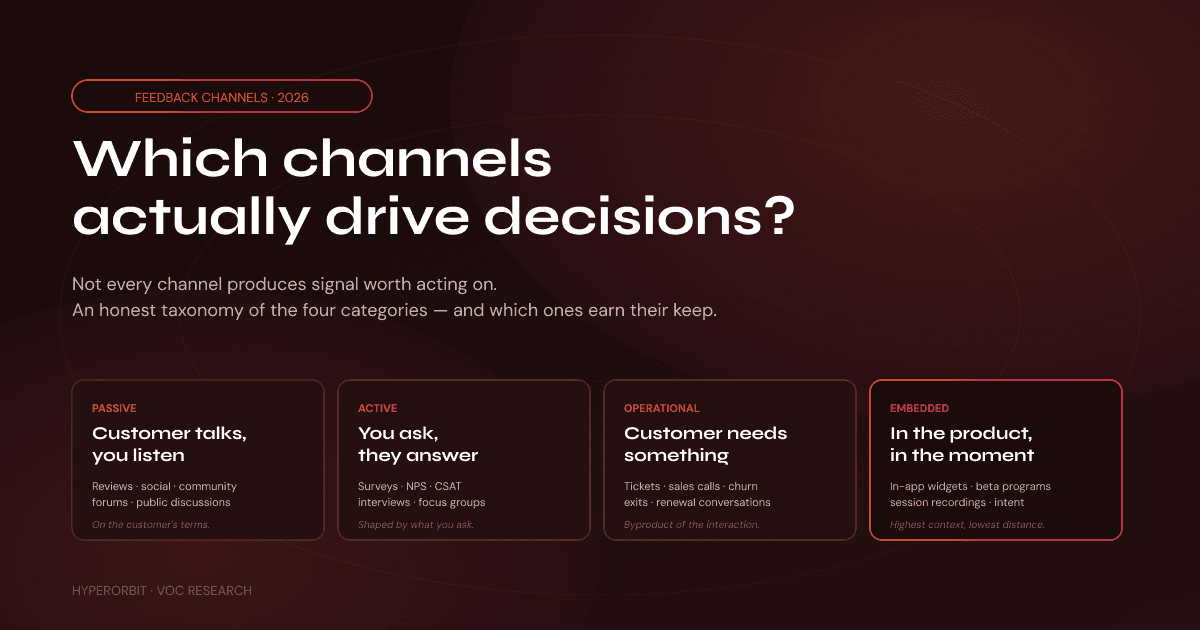
We've organized the twelve examples by VoC source rather than by industry. If you're scoping a VoC program, what you actually need to know is which feedback channels produce decisions and which produce noise. Industry barely matters; the channel does.
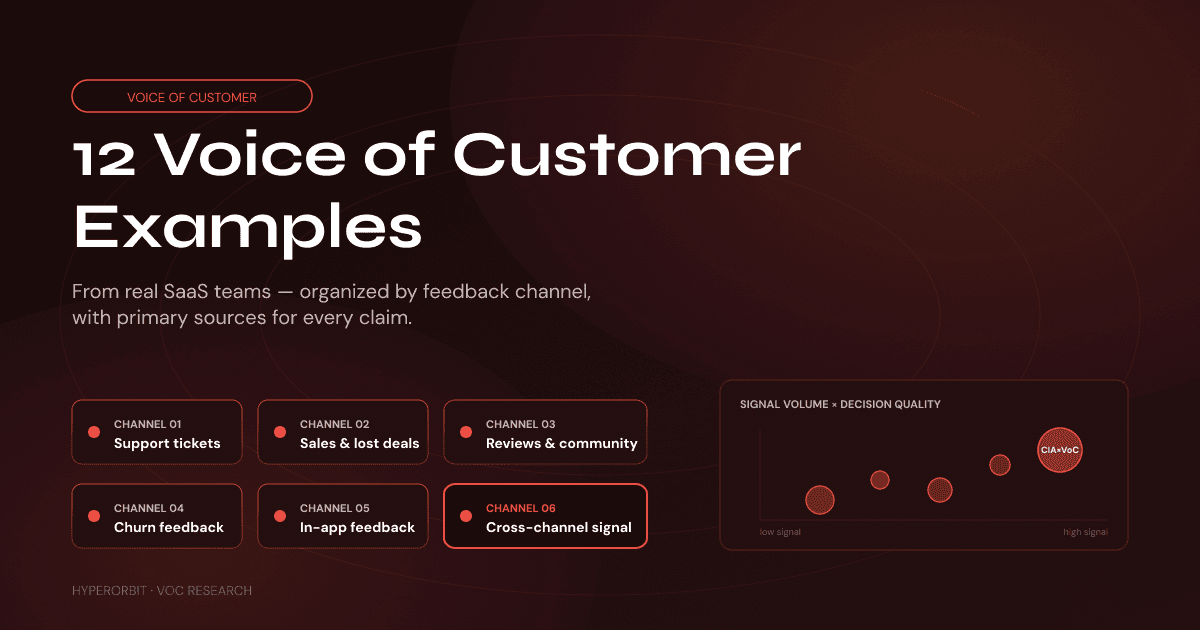
The six channels we'll cover:
Support tickets and conversations — the highest-volume, most operational signal
Sales calls and lost-deal interviews — the highest-intent signal, most underused
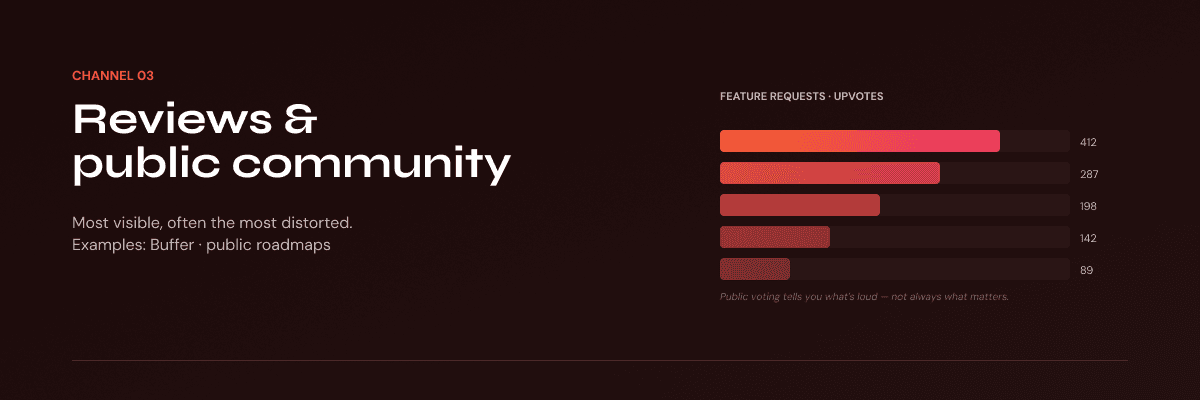
Reviews and public community — the most visible, often the most distorted
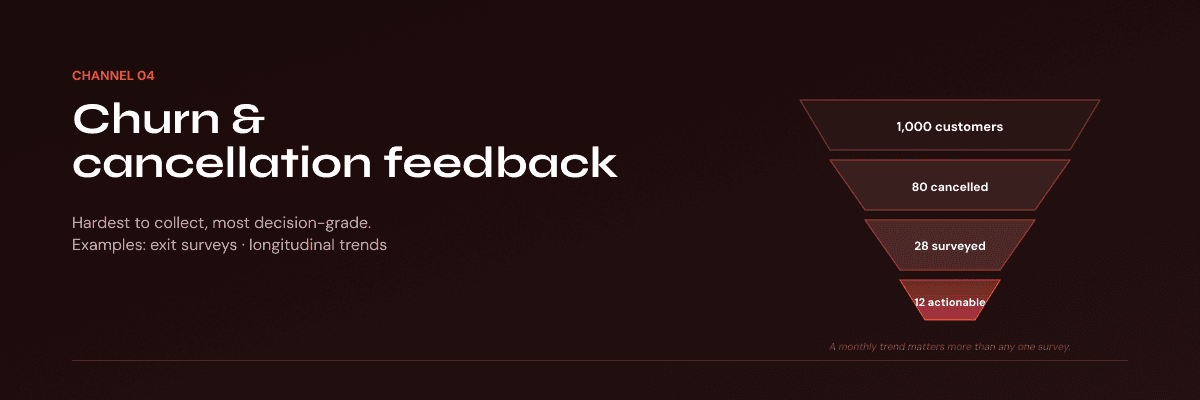
Churn and cancellation feedback — the hardest to collect, the most decision-grade
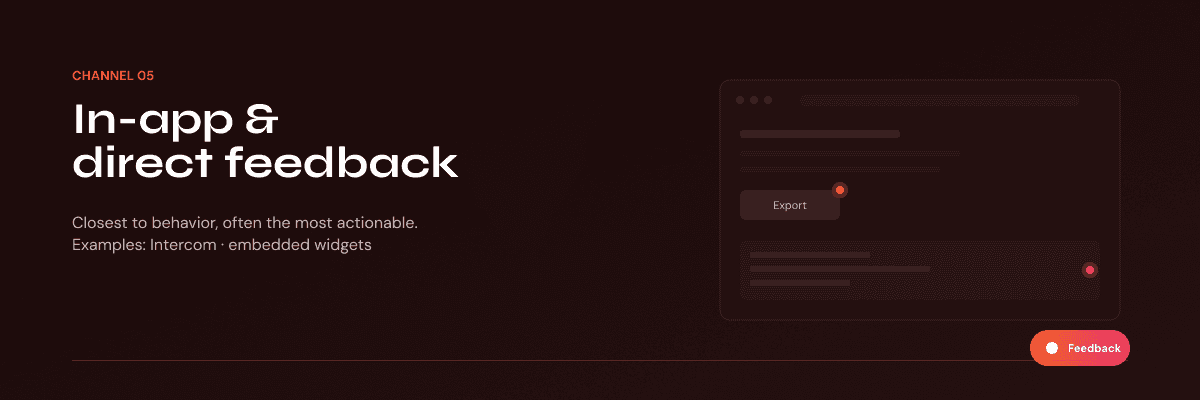
In-app and direct feedback — the closest to behavior, often the most actionable
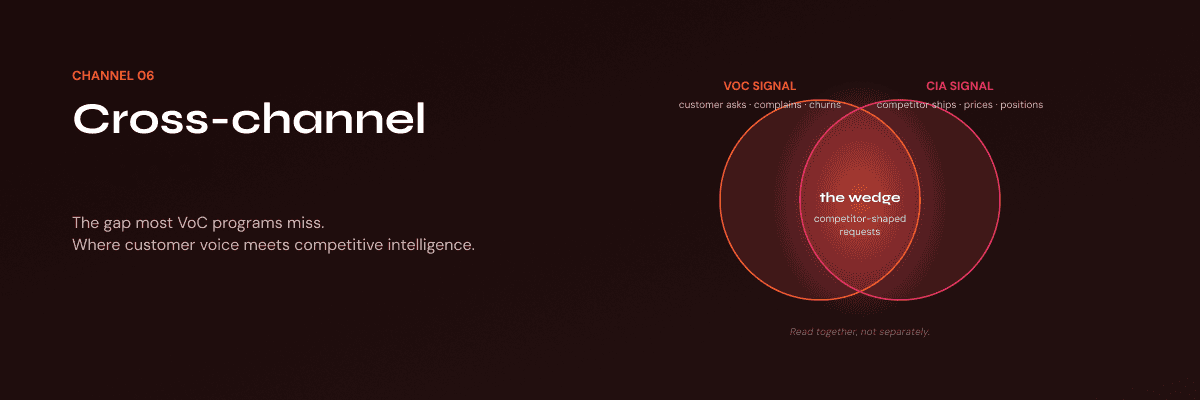
Cross-channel signals (including competitive) — where most teams have the biggest gap
Let's go.
Channel 1 — Support tickets and conversations
Example 1: Slack pauses its classic apps deprecation (twice)
In 2024, Slack announced it would deprecate "classic apps" — the older method developers used to build Slack integrations — on a fixed timeline. Then it paused. Then it paused again. Then it paused indefinitely.
Each time, Slack's own changelog said the same thing in plain language: "After much consideration and feedback, we have decided to pimageush back the deprecation date for classic apps". The most recent update from December 2025 went further: "Based on feedback from our customers and developer community, we have decided to pause this migration. Classic apps will continue to work for the foreseeable future."
The signal source: Developer feedback flowing through support, community forums, and direct outreach about how disruptive the migration would be to existing integrations.
What this teaches: The most useful VoC outcomes are often not shipping a new feature — they're slowing down or reversing a planned change. If your VoC program only measures features built, you'll miss half of what good listening produces. Reversals are wins.
The honest caveat: Slack didn't publish numbers on how many developers complained, what the dollar exposure was, or what specific feedback tipped the decision. We can verify the pattern, not the math behind it.
Example 2: Intercom's "Built for You" framework
Intercom has run a series called "Built for You" since at least 2020 — a podcast and blog format where R&D team members talk about how customer conversations shaped what they shipped. One quote from the show captures the structural argument: "the gap between the folks that build products and the customers that use products is closing. And that's really exciting to me as a researcher."
The format itself is the example. It's not a single product change — it's a public ritual of connecting product decisions back to specific customer conversations.
The signal source: Support conversations, customer interviews, and research sessions, surfaced through a recurring company-wide artifact.
What this teaches: A VoC program is more durable when it has a publication cadence, not just a collection mechanism. The act of regularly explaining "what we heard, what we shipped, what we didn't" creates internal accountability that surveys and dashboards don't.
Channel 2 — Sales calls and lost-deal interviews
Example 3: Stripe's leadership-meeting customer guest
In April 2025, Patrick Collison tweeted about a Stripe practice that's been running for some time: "Every other week, we have a customer join for the first 30 minutes of our management team meeting: they share their candid feedback, and ~40 leaders from across Stripe listen. Even though we already have a lot of customer feedback mechanisms, it somehow always spurs new thoughts."
That last clause is the part most VoC programs miss. Stripe already has feedback systems. The customer-in-the-room ritual generates a different kind of signal — the kind that surfaces when senior leaders are forced to listen synchronously, in front of each other, without pre-processing.
The signal source: A live customer conversation routed directly to decision-makers, bypassing the usual aggregation layer.
What this teaches: Aggregation has a cost. Themes, dashboards, and weighted scores are useful, but they also smooth out the rough edges of how customers actually talk. The most senior people in a product company should hear at least one unmediated customer voice per month.
The honest caveat: This is hard to scale. Stripe runs this ritual because the founders prioritize it. It works because the leaders are required to be there. Most companies cannot replicate this from a process change alone.
Example 4: Crayon's framework for spotting competitor-customer requests
Crayon (a competitive intelligence platform) wrote about how to read competitor announcements through customer-request signals. One of their examples: "If you know that your competitor's customers have been asking for an email marketing tool for years, then that blog post probably indicates that something is in the works."
The interesting move here isn't that Crayon spots competitor signals — it's that they pair competitor signals with what those competitors' customers are asking for. The signal isn't "what is the competitor doing"; it's "what gap in the competitor's product are their own users complaining about."
The signal source: Public reviews of competitor products, community discussions, and competitive marketing intelligence — read together.
What this teaches: Your competitor's review pages are part of your VoC dataset. The customers complaining about a competitor are often the customers you should be talking to. Most VoC programs ignore this entirely.
Channel 3 — Reviews and public community
Example 5: Buffer's transparent roadmap (and what it actually changed)
Buffer's public roadmap is one of the most-cited examples in this category. It's worth looking at what Buffer themselves said about it rather than the third-party retellings. In their announcement: "Feedback has a beautiful way of compounding!" The post showed a wireframe shared with the community that returned dozens of comments overnight.
Buffer's later v2 announcement is more honest about the operational reality. They moved off Trello to a purpose-built tool because they needed: "a number of integrations. Their product felt intuitive." The point: even Buffer, the poster child for transparent roadmaps, found the operational burden non-trivial.
The signal source: Public roadmap voting, comments, and integrations into their existing feedback loops.
What this teaches: Public roadmaps are a real VoC channel, but the maintenance cost is the part nobody talks about. Buffer's own writing makes clear that the tooling and the upkeep matter as much as the principle.
Example 6: The "no roadmap" counter-example
Not every story is about building more feedback channels. One product management writer summarized the counter-position bluntly: "Saying yes to every customer request: It's tempting—especially when you're trying to win deals, retain high-value customers, or prove responsiveness. But building everything customers ask for doesn't make your product better. It just makes it bloated, inconsistent, and harder to maintain. The hard truth? Not all feedback is equally valuable."
Why this matters in a VoC examples post: Half the discipline of VoC is filtering — saying no, deprioritizing, and ignoring requests that don't fit your product direction. A program that ships everything customers ask for is failing at VoC, not succeeding.
The signal source: N/A — the lesson here is about how you respond to signal, not where you collect it.
Channel 4 — Churn and cancellation feedback
Example 7: The "close the loop" effect on churn
CustomerGauge, a VoC vendor, published research with a specific claim: "Closing the loop within 48 hours increases retention by 12% and boosts NPS by an average of 6 points (CustomerGauge research). Companies that close the loop at every level -- frontline through executive -- reduce churn by a minimum of 2.3% per year. Those that don't close the loop increase churn by at least 2.1% per year."
Important caveat: This is vendor-published research, not peer-reviewed academic work, and the directional bias is what you'd expect from a VoC vendor. The numbers should be treated as suggestive rather than precise. But the direction — that closing the loop reduces churn — is consistent across multiple independent sources, which is more than can be said for many VoC claims.
What this teaches: If you have to pick one VoC practice to start with, picking up the phone after a customer gives you negative feedback is probably it. It's also the practice most teams skip because it doesn't scale cleanly.
Example 8: Churn surveys as a longitudinal asset
A pattern worth naming directly: churn surveys are most valuable when they're compared over time, not analyzed in isolation. As one industry write-up puts it: "Over time, churn survey data allows you to track trends in why customers leave. You might discover, for instance, that a year ago 30% of churned customers complained about pricing, but after a pricing restructure, that figure dropped to 10%. Meanwhile, concerns about product quality might be on the rise."
The signal source: Exit surveys, cancellation flow questions, and post-churn outreach.
What this teaches: A churn survey you run once tells you almost nothing useful. A churn survey you've run every month for two years tells you whether your interventions are working. Most teams don't keep the data structured well enough to answer that question — which is the operational gap a VoC program can fix.
Channel 5 — In-app and direct feedback
Example 9: The feedback widget origin story (Intercom)
Intercom's own product was, in a real sense, built from VoC inputs about other products in the category. From a 2014 TechCrunch piece on their early messenger: "the team focused on five key areas — the impersonal nature of customer messages, the poor targeting and timing of those messages, the lack of context, the fact that those messages aren't very conversational, and the fact that many of those tools in this market treat the web and mobile as two separate things."
This is interesting as a meta-example: a company that now provides VoC infrastructure was built from observation of customer-feedback gaps in adjacent tools.
The signal source: Market observation and direct conversations with prospective customers about what existing tools didn't do.
What this teaches: In-app feedback widgets aren't valuable because they collect feedback. They're valuable because they collect feedback at the moment of friction, when context is highest. A general NPS survey gets you "the dashboard is hard"; an in-app widget gets you "this specific button on this specific screen at this specific moment."
Example 10: The unglamorous reality of in-app feedback at scale
Every team that has run an in-app widget for more than a year has discovered the same thing: most submissions are either duplicates of existing requests or bugs, not new ideas. This is well documented across the VoC vendor space. From one summary: feedback management is necessary because "When you ship a feature that your customers have been asking for, they feel heard."
The reverse is also true: when 200 customers ask for variants of the same feature and you can't tell that they're variants of the same feature, you don't ship anything, and 200 customers feel ignored.
What this teaches: The single biggest operational gap in most VoC programs is deduplication. Without it, the volume of in-app feedback becomes a liability, not an asset.
Channel 6 — Cross-channel patterns (including competitive)
Example 11: When a feature request mirrors a competitor's release
This is the channel most VoC programs underinvest in. A request that shows up in a sales call ("does your product do X?") that also shows up in a support ticket ("can your product do X like [Competitor] does?") that also shows up in a review ("would switch from [Competitor] if you had X") is a different kind of signal than any of those three in isolation.
The Crayon framework we cited earlier captures one half of this — reading competitor announcements as a signal. The other half is reading your own customer conversations through the lens of what competitors just shipped. A CI workflow that detects competitor launches early gives sales a head start, but only if it's connected back to your own VoC data.
From a competitive intelligence write-up: "The companies that detect competitor feature launches early and distribute that intelligence to their sales teams before prospects bring it up have a structural advantage in every competitive deal."
The signal source: Competitor monitoring + customer conversation analysis, joined together.
What this teaches: Most VoC programs treat competitive intelligence as a separate team's job. The product teams that win are the ones that read both streams together — they know which customer requests are competitor-shaped, and they know which competitor launches are about to generate inbound questions from their own customers.
This is where HyperOrbit's product lives. We mention it once and only here because the rest of this article is about VoC done well in general; this specific gap is what our two agents are built to close.
Example 12: The signal that closing the loop itself is a signal
A final pattern worth naming: when you close the loop with a customer who gave you feedback, their next feedback is more honest and more specific. The act of telling them you heard them changes the quality of what they tell you next.
This shows up indirectly in the CustomerGauge research — promoter rates triple when loops are closed — but the deeper mechanism is that customers learn whether feedback is worth giving. Programs that close the loop get higher-quality input over time. Programs that don't end up with declining response rates and increasingly vague feedback.
What this teaches: VoC programs compound. The first year is hard because you're building habits. The third year is easier because customers know their feedback matters and they tell you better things.
What these examples don't show
Twelve examples is a lot, and most of them sound clean in the retelling. They aren't, in practice. Here is the part of VoC work that almost no listicle covers:
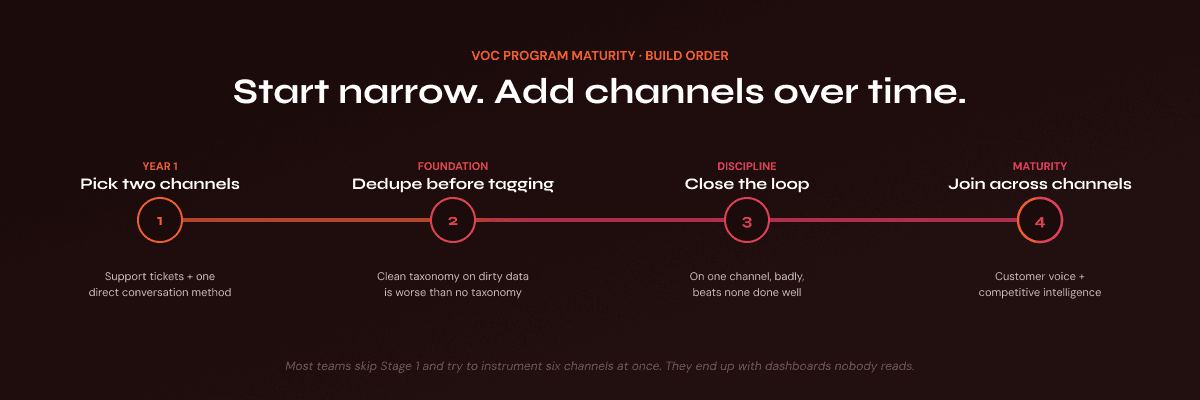
The 80% of the job is deduplication and tagging. Slack's pause didn't happen because someone read one ticket. It happened because someone (or some system) noticed that hundreds of tickets across multiple channels were saying variations of the same thing. The pattern-detection work is invisible from outside. It's what most of a VoC team's hours actually go into.
Most "examples" are unprovable. A lot of the famous SaaS VoC stories — Linear's roadmap as a feedback magnet, Notion's templates emerging from community demand, Figma's community as a VoC channel — are mostly third-party retellings. The companies themselves rarely publish the causal claim that "we did X because of customer feedback Y." We dropped several planned examples from this list when we couldn't find primary sources.
Outcome metrics are usually invented. "Reduced churn 40%." "Increased NPS by 25 points." Almost none of these numbers are independently verifiable. The VoC vendor space publishes a lot of them; the companies themselves publish far fewer. Be skeptical of any VoC example that comes with a precise outcome number and no source.
The boring channels do most of the work. Support tickets are not glamorous. Sales call recordings are not glamorous. Cancellation surveys are not glamorous. They produce most of the decision-grade signal anyway. The interesting parts of VoC are usually downstream of the boring parts.
Conclusion
A note on what comes next
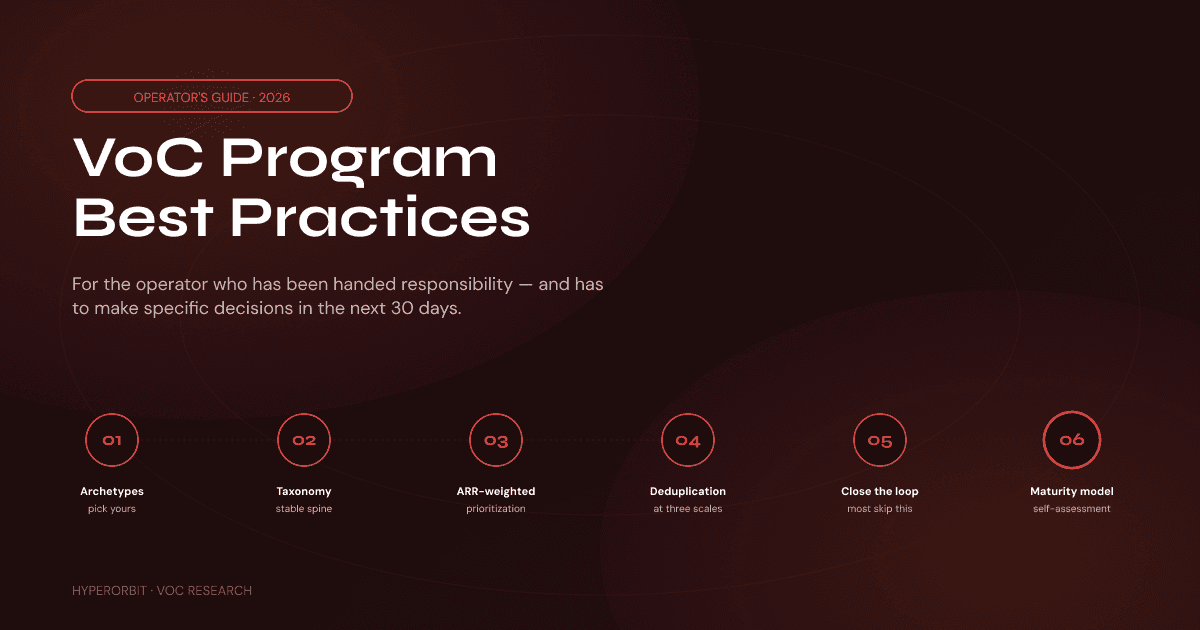
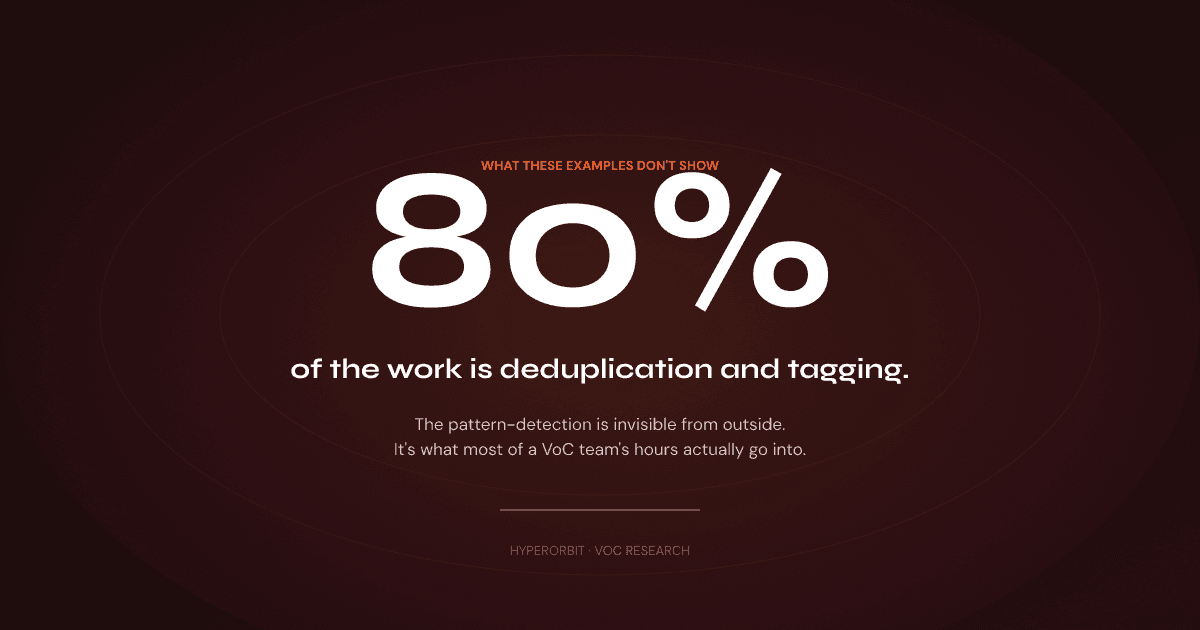
If you've read this far, you're probably building or rebuilding a VoC program. The honest sequence is:
Pick two channels first. Almost no team should start with six. Support tickets and one form of direct customer conversation (calls, exit surveys, or in-app widget) is usually enough for year one.
Build a deduplication habit before a tagging taxonomy. A clean taxonomy on dirty data is worse than no taxonomy. Get the duplicates out first.
Close the loop on at least one channel. Closing the loop poorly on one channel is better than closing it on none.
Add cross-channel signal joining once you have two channels working. This is where the competitor-customer overlap (Example 11) becomes real rather than theoretical.
A lot of teams skip step 1 and try to instrument six channels at once. They end up with dashboards nobody reads and signal nobody acts on. The companies in this article that built durable VoC practices — Stripe, Intercom, Buffer — all started narrow and added channels over time.