
11 Minutes
MCP is now how AI agents read external data. But a pipe is only as good as what you connect it to, and most teams are connecting things that miss half of what matters.
Your developer opens Cursor to ship a feature. The agent writes clean code, the tests pass, and the PR looks great. But it has no idea which customer the feature is for, what they actually asked for, how much revenue is at stake, or that the account is three weeks from churning. It also doesn’t know that a competitor shipped the same thing last month, which is why requests are spiking.
Every AI tool in your stack works like this. Cursor knows your code. Claude Code knows your docs. Your internal search knows your wiki. None of them know your customers, and none of them know your market.
MCP is the standard that finally lets us solve this problem. That’s why we’re building HyperOrbit the way we are, and why what you connect to your agents will soon matter more than which agents you use.
What MCP is, quickly
The Model Context Protocol is an open standard that Anthropic introduced in late 2024 to provide AI applications with a consistent way to read from external systems. Instead of hand-building a custom integration for every AI-tool-and-data-source combination, you expose your data once through an MCP server, and any MCP-compatible client can read from it. People call it “USB-C for AI”: one connector, every tool.
It isn’t niche anymore. Anthropic handed MCP to neutral governance under the Linux Foundation at the end of 2025 — the move that turned it from “Anthropic’s protocol” into industry infrastructure. Every major AI client speaks it now: Cursor, Claude Code, ChatGPT, Copilot, Gemini. By late 2025, there were already well over ten thousand public MCP servers. As for how agents get data, the protocol war is over.
The setup is simple: a host, which is the AI app someone uses, a client inside it, and a server that shares a data source. One host can read from many servers at once. That’s it. The real interest isn’t in the protocol itself, but in what you connect to it.
Product is the function that feels this gap hardest.
Every other team produces output that goes into a system of record. Engineering writes code into a repo. Sales logs calls in a call tool. Support files and tickets in a help desk. Product is different. Its job is to gather signals from all those sources and turn them into decisions about what to build. This work is all about synthesis, and product has no system of record of its own.
Right now, that synthesis happens in one person’s head. A PM reads everything, keeps it all together, and writes the spec. The PM’s bandwidth limits how many good decisions the team can make. Adding an AI agent doesn’t change that because the agent can’t see the signals the PM is using. It might write the PRD faster, but it won’t find a better answer.
This is the gap HyperOrbit is built to close: moving synthesis out of one person’s head and into a layer that the PM, engineer, coding agent, and CRO can all access. When decisions live in shared infrastructure instead of someone’s memory, your decision-making can scale with your AI tools, not just with the people reading the data. Without this, you get the worst combination: shipping faster while roadmap quality stays flat, and the whole team moves quickly in the wrong direction.
MCP is just the pipe. The real value is in the decisions on the other end.
Here’s what people often miss: MCP standardizes the connection, but it doesn’t control what flows through it. The protocol will send either great insights or bad data to your agents with the same accuracy.
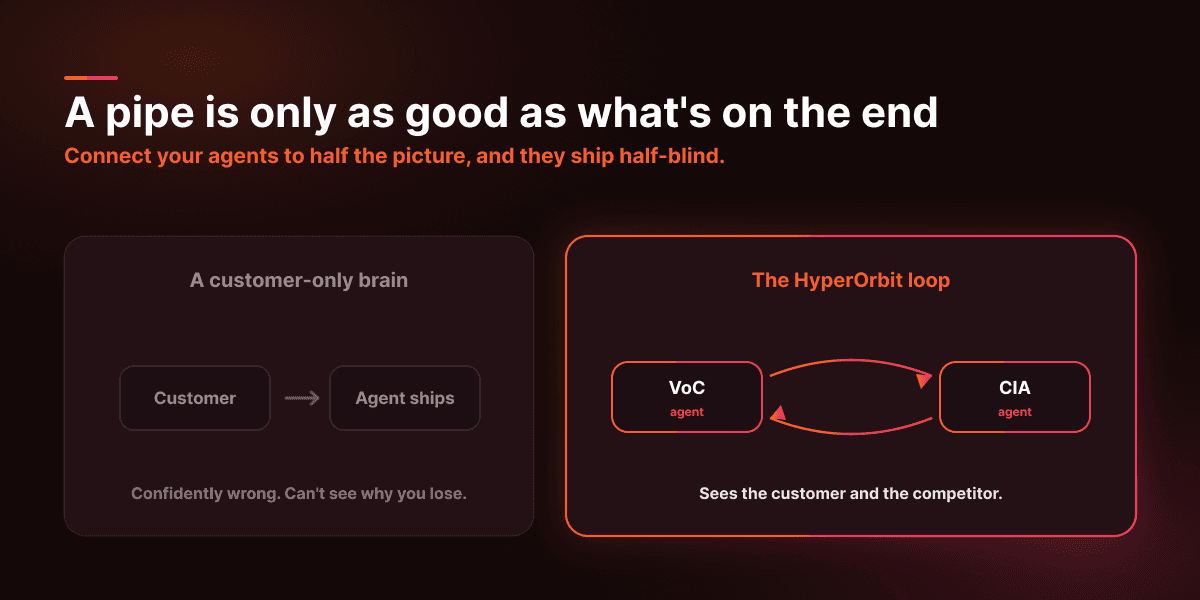
That’s the choice that really matters. If you connect your agents to a tidy dashboard, that’s all they’ll see. If you connect them to a layer that only looks at customer feedback—which is what most “decision layers” do—you end up with agents that deliver exactly what customers ask for, quickly, but without understanding why you’re losing. They won’t notice that SAML requests spiked the week a competitor launched it, or that your last five churn calls mentioned the same rival. You’ll have turned a blind spot into something your tools act on, shipping faster than ever, but still missing the bigger picture.
If your agents only see half the picture, they won’t get smarter. Instead, they’ll make mistakes with confidence in production.
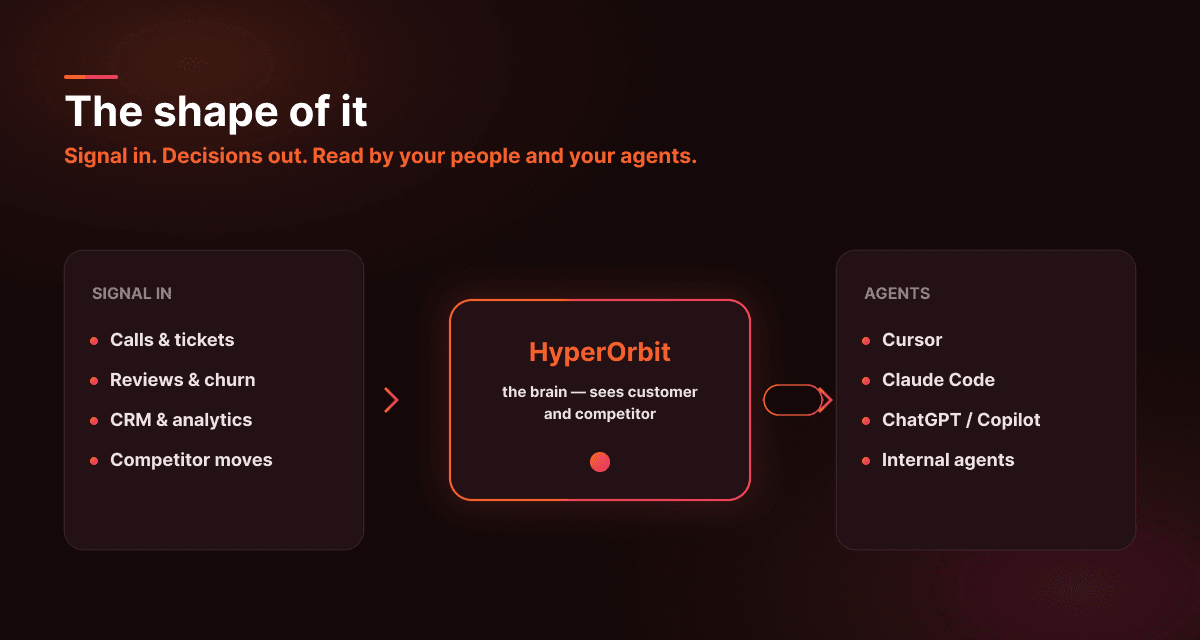
That’s why we built HyperOrbit, and it’s what we care about most: the system on the other end of the pipe needs to see both sides of the loop.
What HyperOrbit puts on the other end
HyperOrbit runs two agents that share their findings. The Voice of Customer agent continuously reads what customers say—tickets, calls, reviews, churn notes—and ranks patterns by impact, not just volume. The Competitive Intelligence agent tracks the market. What sets HyperOrbit apart is that these agents talk to each other. When a competitor shows up in a churn call or a lost deal, both agents see it, so customer pain and competitive moves are linked. The result isn’t just a stream of feedback. It’s a focused decision: what to build, why, what it’s worth, and what happens if you don’t.
That’s the context worth handing an agent before it writes a line of code.
A quick note on timing: HyperOrbit is in private beta with design partners, and making this loop available to your agents over MCP is on our roadmap. It’s not available yet. So, the workflows below show what HyperOrbit is designed to deliver as MCP distribution expands. This is the architecture we’re building toward, not a demo you can try today.
Here’s what that looks like once your agents can read from HyperOrbit:
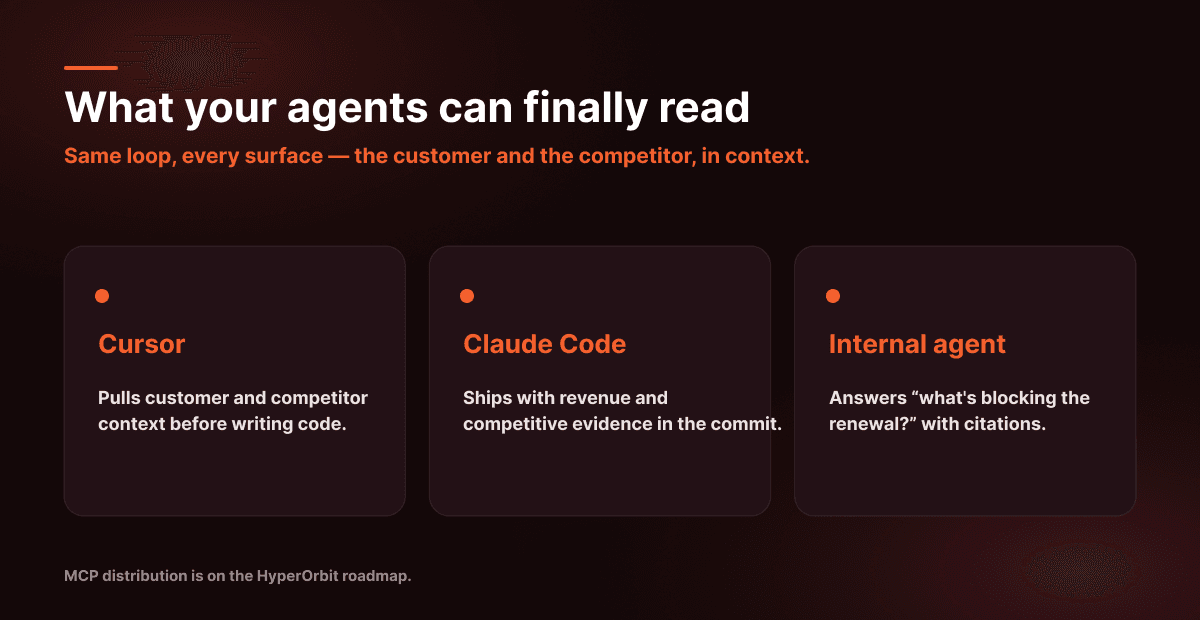
A developer picks up a ticket: “add SAML for enterprise.” Before writing any code, the agent checks HyperOrbit for which customers recently asked for SAML, the deal value for each, the requirements mentioned on calls, and whether two requests came right after a competitor launched the feature. The agent then proposes an implementation based on this evidence, and the competitive context is included in the PR.
An engineer works with Claude Code on a feature for a major account. HyperOrbit shows that this work is blocking the real pipeline across accounts in active renewal, and one of those accounts mentioned a competitor in its last call. The agent flags this, ships the feature, and writes the revenue and competitive context into the commit, creating an audit trail from that commit to the deal it helped protect.
A CSM asks an internal agent, “What’s blocking the Acme renewal?” Instead of guessing, the agent checks HyperOrbit for Acme’s open tickets, recent requests, roadmap status, and whether a competitor has come up in their account. It then returns a structured answer with citations.
It’s the same loop, just on different surfaces and for different roles. The question is separated from the tool that asks it, and every answer can now see the competitor, not just the customer.
We take the governance seriously because MCP’s adoption has outrun its security.
Here’s an honest caveat that doesn’t get mentioned enough amid the MCP hype: the protocol’s adoption has outpaced its security improvements. Researchers have found real attack types against MCP-connected systems, including prompt injection (where models can’t reliably separate data from instructions), “confused deputy” problems where an agent acts with more authority than it should, and poisoned tools that steal data through other connected servers.
That’s why, as we work toward MCP distribution, we treat authentication, scoped credentials, and audit logging as core parts of the product, not afterthoughts. Any layer you connect to your coding agents must let you control who can query what, log every request, and limit access so one leaky agent can’t pull customer data from across the organization. “Wire everything to everything and move fast” is how the first serious MCP breach will happen. We’d rather avoid being the cautionary tale.
What your stack needs
Three pieces, plainly:
A host that speaks MCP — you almost certainly already have one, since Cursor, Claude Code, ChatGPT, and Copilot all support it. That side is solved; you won’t need to switch tools.
You need a layer that exposes decision-level context, which is usually missing. Your CRM, support tool, and call platform all store data, but none of them answer questions like “which customers asked for X, ranked by revenue, scoped against the roadmap, with the competitive context attached.” That’s the gap HyperOrbit is built to fill. You can set up an MCP server for a single source in an afternoon, but building one that brings together signals from every source into decisions you can trust—and that see competitors as well as customers—takes months of data engineering and ongoing maintenance. The pipe is easy. The brain is hard.
Governance — auth, scoping, audit, as above.

Conclusion
The bottom line
In a year or two, every AI tool in your stack will read external context through MCP by default. The clients on top—like IDEs, agents, and chat surfaces—are becoming interchangeable quickly; you could swap any of them next quarter. What really matters is the layer underneath, where your product brain lives. Once your agents read from a certain decision layer, everything above it adapts to whatever is on the other end.
So the real choice now isn’t about the protocol. It’s about the brain. Choose one that understands both your customers and your competitors, or accept that you’ve paid to make your agents get things wrong more quickly.
That’s the one we’re building.
HyperOrbit is in private beta. It’s a decision layer that tracks customers and competitors together, with MCP distribution on the roadmap. Come see what your stack is already telling you.