
16 Minutes
Two companies are looking at the same customer signal. Account TechCorp has submitted three support tickets in two weeks citing frustration with your reporting module. Sentiment is declining. Renewal is in 45 days.
Company A has a VoC platform. It detects the sentiment trend, generates a churn risk flag, and routes an alert to the CSM. The CSM calls TechCorp to address the reporting concerns.
Company B has the same VoC signal — but also has a competitive intelligence layer running simultaneously. The CIA Agent has logged that TechCorp mentioned a competitor's analytics module in a sales call six weeks ago, and again in a support ticket last week. The combined signal is not just "declining sentiment." It is "declining sentiment in the exact functional area where an active competitive evaluation is underway, 45 days from renewal."
Company B does not make a service recovery call. It makes a strategic account call — with a competitor battlecard, a roadmap commitment, and a retention offer tailored to the specific gap the competitor is filling.
Same underlying data. Completely different outcome. The difference is the flywheel.
Why Single-Signal Intelligence Has a Ceiling
Every VoC platform tells you something true about your customers. Every competitive intelligence tool tells you something true about your market. Both are valuable. Both have a ceiling.
The most powerful insights emerge when these two approaches converge. Combining VoC with competitive intelligence reveals the highest-value workflow improvements — the ones that are both customer-validated and competitively differentiated. (10eqs)
The ceiling of a standalone VoC platform is this: it can tell you how your customers feel and what they want, but it cannot tell you what they will do about it. A customer with declining sentiment might stay — if they see no better alternative. A customer with declining sentiment who is actively evaluating a competitor has already decided to leave. The VoC signal looks identical. The strategic response is completely different.
The ceiling of a standalone competitive intelligence platform is the inverse: it can tell you what competitors are doing, but not whether your customers are responding to it. A competitor feature launch is a marketing event. A competitor feature launch that your customers are citing in support tickets in the same week is a strategic threat. External monitoring cannot tell you the difference. Customer feedback can.
Firms can develop a more holistic strategy by integrating customer intelligence with traditional competitive intelligence — knowing competitors' actions and customers' responses and why. This dual view sparks innovations in product development, pricing, and customer experience. (Octopusintelligence)
The flywheel is what happens when these two data streams are not just available in parallel but actively cross-referenced in real time.
How the Flywheel Works
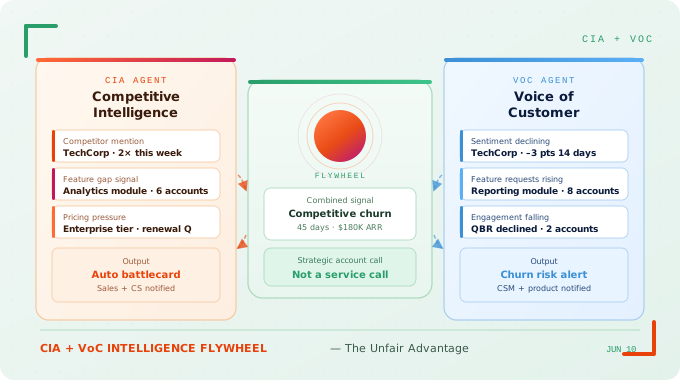
The CIA + VoC intelligence flywheel operates in three stages. Each stage feeds the next, and the cycle reinforces itself with every signal processed.
Stage 1: VoC Agent surfaces internal sentiment and patterns
The VoC Agent continuously monitors feedback across 50+ channels — support tickets, NPS surveys, Gong calls, in-app responses, G2 reviews, renewal conversations. It detects sentiment trajectories for individual accounts, clusters feature requests by revenue impact, generates product requirements, and routes churn risk alerts.
This is its primary function: making the customer's voice audible to every team that needs to act on it, without a human in the middle of every step.
Stage 2: CIA Agent surfaces competitive context
Running simultaneously, the CIA Agent scans the same feedback data specifically for competitive signals — competitor mentions, feature gap language, pricing comparisons, sentiment inversion on product categories where a competitor has just shipped something.
When a competitor name appears in a support ticket, the CIA Agent logs it. When the same name appears in two different accounts in the same week, it surfaces the pattern. When the pattern is concentrated in enterprise accounts approaching renewal, it flags it as a strategic signal.
Stage 3: Cross-agent correlation produces the combined intelligence
Here is where the flywheel effect begins. The CIA Agent's competitive signal is cross-referenced against the VoC Agent's account data in real time.
Account TechCorp: VoC Agent flags declining sentiment trend (churn risk: HIGH). CIA Agent has logged two competitor mentions in TechCorp's tickets in the past three weeks. Combined signal: active competitive evaluation in a declining sentiment account 45 days from renewal. Priority: critical. Route to: CSM + sales + product, simultaneously.
Neither agent would generate this signal alone. The VoC Agent knows the sentiment is declining but has no context for why. The CIA Agent knows the competitor is being evaluated but has no view into account health. The cross-reference creates a third data point — competitive churn risk — that is more actionable than either source produces in isolation.
Over time, this cross-reference builds a map: which competitors are most often mentioned by accounts showing churn signals, which product categories are most vulnerable, which account segments are most susceptible to competitive displacement. That map compounds. Each signal makes the next one more accurate. The flywheel turns faster the longer it runs.
What This Changes for Each Team
For Customer Success: The difference between a routine check-in and a strategic intervention. When CSMs know not just that an account is unhappy but that the account is actively evaluating a competitor in the exact category they are unhappy about, the conversation changes. The preparation changes. The outcome rate changes.
For Product: Feature prioritization becomes defensively strategic rather than just customer-demand-driven. When a feature request cluster from your VoC data is cross-referenced against CIA Agent data showing a competitor recently shipped the same capability, that feature moves from "nice to build" to "need to build before next renewal cycle."
For Sales: Renewal conversations become competitive conversations with preparation, not surprises. Crayon's State of CI data shows sellers face direct competition in 68% of deals, while teams rate their competitive selling preparedness at just 3.8 out of 10. (StartUs Insights) Cross-agent intelligence closes that preparedness gap by delivering competitive context at the account level, not just the category level.
For Leadership: The combined signal creates a strategic picture that neither standalone tool produces — which parts of the product are most competitively vulnerable, which customer segments are most at risk of displacement, and which competitive moves are already registering in customer feedback before they show up in churn data.
Why No Single-Agent Competitor Can Replicate This
The cross-agent flywheel is not a feature. It is an architectural property. You cannot add it to a VoC platform by building a competitive intelligence tab, and you cannot add it to a CI platform by bolting on a VoC module.
The reason is data flow. For the flywheel to work, VoC signals and competitive signals must be processed against the same account data, in real time, with cross-reference logic that runs continuously rather than on a reporting schedule.
A VoC platform that adds a CI module can tell you that your customers are mentioning competitors. It cannot continuously correlate those mentions against individual account sentiment trajectories, revenue weights, renewal timing, and churn risk scores in real time. It processes feedback and competitive data as separate streams that a human must connect.
A CI platform that adds a VoC module has the same problem in reverse. It can aggregate customer feedback. It cannot autonomously detect that a declining sentiment pattern in a specific account segment precisely tracks with a competitor's recent feature release — and route that combined insight to the right team before the renewal conversation.
Relying solely on VoC can be risky as it narrows focus to current customers and may miss broader market shifts, competitive threats, or emerging opportunities users aren't yet articulating. Organizations should continuously evolve roadmaps based on real-time feedback and market shifts. (Contify)
HyperOrbit is the only platform in the customer intelligence space where VoC and competitive intelligence were built as co-equal agents with a shared data layer and live cross-reference logic from day one. The flywheel is not an add-on. It is the architecture.
The Compounding Effect Over Time
The flywheel metaphor matters because it captures something important about how the value accumulates.
In the first month, the cross-agent correlation surfaces a handful of high-priority accounts where competitive risk and churn risk overlap. The CS and sales teams intervene. Some accounts renew that might have churned. The signal is valuable.
In the third month, the flywheel has accumulated enough cross-reference data to start showing patterns: which competitor's mentions most reliably predict churn in which account segments, which product categories are most consistently at the intersection of customer frustration and competitive evaluation.
By the sixth month, the combined intelligence is not just surfacing individual account risks. It is shaping roadmap prioritization, informing renewal strategy by segment, and identifying the competitive gaps most worth closing based on both customer demand signals and competitive threat concentration.
This is the compounding return that standalone VoC and CI platforms cannot generate. They produce valuable signals. The flywheel produces strategy.
Conclusion
Two Signals Are Not Twice as Good. They Are Exponentially Better.
VoC without competitive context is reactive retention management. You know customers are unhappy. You do not know if they have anywhere better to go.
Competitive intelligence without VoC context is strategic noise. You know what competitors are shipping. You do not know whether your customers care.
Companies that act on VoC insights in near real-time see a 21% increase in customer retention compared to those that review feedback quarterly. (CX Today) But real-time VoC acting on a signal that lacks competitive context still misses half the picture.
The companies that protect the most revenue are the ones who know — continuously, automatically, at the account level — not just how their customers feel, but what competitive alternatives those customers are already exploring. That is not two pieces of information. It is one compound signal that neither piece can generate alone.
The CIA + VoC flywheel is live in HyperOrbit today. Book a demo to see what both agents surface from your own customer data in the first session — and how the cross-reference changes what you do with it.