
8 Minutes
Most teams operate on a quiet assumption: more channels means better understanding. Add NPS, add an in-app widget, add a community forum, add a quarterly survey, add session recordings, and somewhere in the resulting data lake, the truth about the customer will surface.
It mostly doesn't.
What actually happens is that channels accumulate. Each one produces signal of a different quality, with a different cost to collect and a different latency to action. The teams that make better product decisions are not the teams with the most channels; they're the teams that have figured out which channels actually answer the questions they need answered, and stopped over-investing in the ones that don't.
This piece does three things: maps the full channel taxonomy honestly, calls out which channels produce decision-grade signal versus vanity volume, and then deals with the structural problem that every mature program eventually hits — the same customer pain showing up across four to six channels with different language, and nobody having a clean way to see it.
The full channel taxonomy
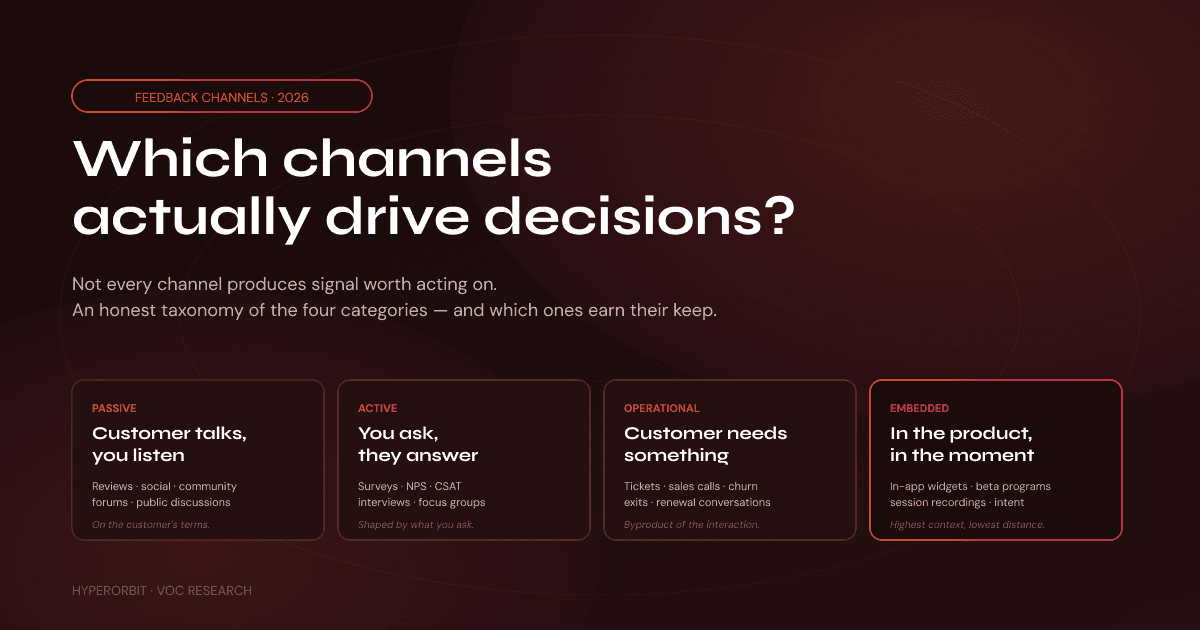
Customer feedback channels split into four categories. Most "voice of customer" content treats them as a flat list. They're not. The categories differ in who initiates, what intent the customer has, and what kind of signal you get out.
Passive channels. The customer talks; you listen. Reviews on G2 and Capterra, social media mentions, community forum posts, product review sites, public Slack communities, public Discord channels. The customer chose to express something on their own terms, in their own venue, often to an audience other than you.
Active channels. You ask; the customer answers. Surveys, NPS, CSAT, customer interviews, focus groups, structured research sessions. The signal is shaped by what you decided to ask, which is both the strength (you control the question) and the weakness (you can only learn things you thought to ask about).
Operational channels. The customer needs something from you. Support tickets, sales conversations, customer success calls, renewal discussions, churn exit conversations. The customer is here for a reason that has nothing to do with giving you product feedback — they want a problem solved or a decision made — and the feedback you get is a byproduct of that interaction.
Embedded channels. The customer is in the product, and feedback is captured in the moment. In-app feedback widgets, beta program responses, feature-flag survey prompts, session recordings, behavior analytics paired with intent capture. Context is highest; cognitive distance from the experience is lowest.
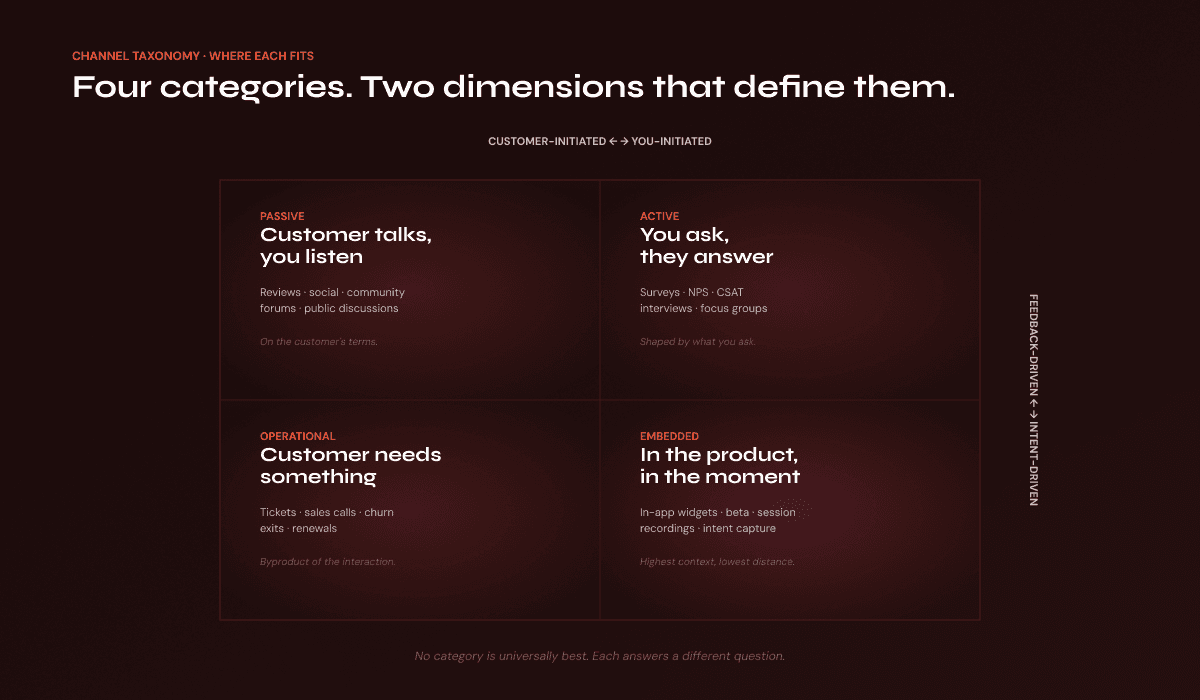
There is no category that's universally best. Each is good at something specific. The mistake most teams make is over-investing in one or two and assuming the others are redundant. They're not redundant — they're answering different questions.
Decision-grade signal vs. vanity volume
Here's the framing that matters more than the taxonomy: not every channel produces signal that drives decisions. Some channels produce signal that drives meetings — dashboards to review, charts to share, numbers to put in board decks — without actually changing what you build, ship, or price.
The single clearest example of vanity volume is NPS.
NPS is the channel most companies over-invest in. It's also the channel most rigorously criticized in academic and industry research. Nielsen Norman Group, an authoritative source on UX research, frames it carefully: NPS "correlates well with perception of usability, is easy to understand and administer, but has limitations for understanding and evaluating UX when used in isolation." Other research is more direct. Multiple studies have found that NPS performs worse than basic satisfaction measures in predicting growth, that the three-bin grouping (promoter, passive, detractor) discards most of the information in the underlying ratings, and that the predictive validity of the scale is low. In B2B specifically, the critique is sharper still — NPS surveys typically go to product users rather than purchase decision-makers, and the two are often different people.
None of this means NPS is useless. It means NPS is a directional sentiment metric, and most teams treat it as if it were a diagnostic system. The distinction matters because the operating moves you take based on a directional metric are different from the operating moves you take based on diagnostic signal. NPS tells you whether the trend is roughly improving or roughly worsening; it doesn't tell you what to do about it.
The single clearest example of decision-grade signal that most teams under-invest in is the lost-deal interview.
A 20–30 minute structured conversation with a prospect who chose to buy from a competitor (or chose to do nothing) produces signal that almost no other channel produces. Pragmatic Institute, which has been running win-loss analysis methodology for years, makes a specific operating point: lost-deal interviews are typically more valuable when conducted by product managers or third parties rather than the salesperson who lost the deal, because the buyer is more candid with someone who isn't emotionally attached to the outcome. The signal that comes out — specific competitive differentiators, pricing-vs-value perceptions, positioning gaps, real objection patterns — drives decisions about messaging, pricing tiers, and roadmap priorities in ways that NPS cannot.
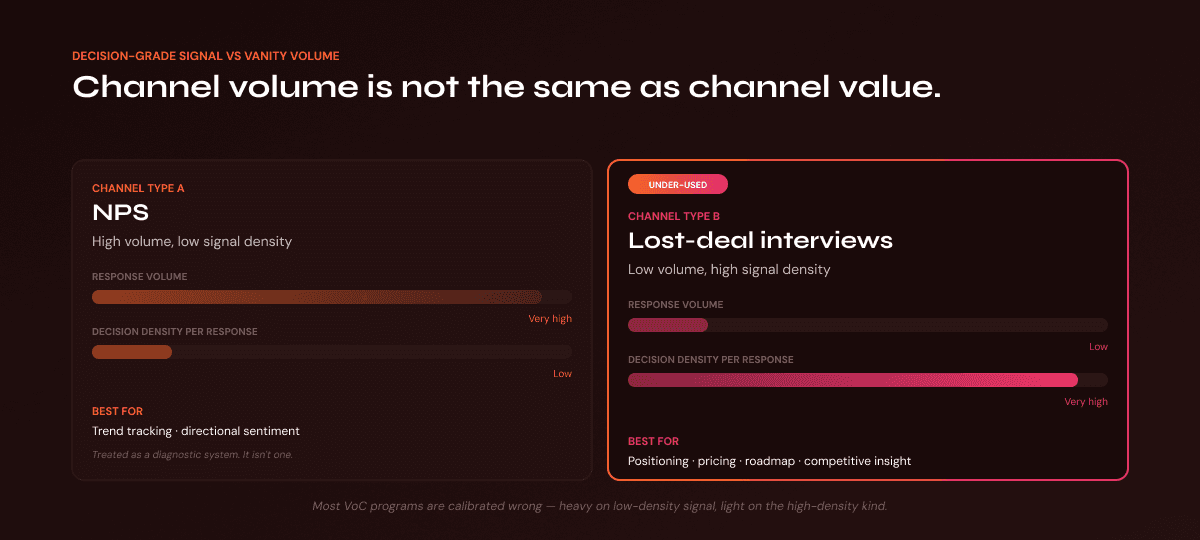
The asymmetry is striking. NPS is high-volume, low-cost-per-response, low-decision-density. Lost-deal interviews are low-volume, high-cost-per-response, high-decision-density. The teams that get the most signal per hour of investment lean toward the latter, not the former.
This isn't an argument against NPS specifically. It's an argument that channel volume is not the same as channel value, and most VoC programs are calibrated wrong — they collect a lot of low-density signal and very little high-density signal. Fixing that imbalance is one of the highest-leverage moves a CS leader or Head of Product can make.
What each channel is actually good at
The honest channel-to-decision mapping looks like this:
Channel | What it's actually good at | What it's bad at |
|---|---|---|
NPS | Trend-tracking sentiment over time; flagging when something has gotten meaningfully worse | Diagnosing root cause; predicting individual customer behavior; B2B decision-maker insight |
CSAT | Measuring transactional satisfaction (post-support, post-purchase); identifying friction in specific moments | Strategic positioning or roadmap signal |
Support tickets | Surfacing recurring product friction and bug patterns; high-volume operational signal | Strategic positioning or competitive insight |
Sales calls | Pricing pushback, positioning objections, competitive comparisons, decision-maker priorities | Existing-customer experience signal |
Lost-deal interviews | Positioning gaps, competitive differentiation, real reasons deals don't close | Existing-customer satisfaction; ongoing usage signal |
Customer interviews | Deep behavioral and motivational understanding; "why" behind observed patterns | Statistical generalization; signal at scale |
Reviews (G2, Capterra) | Public-facing competitive positioning signal; SEO impact; buyer-stage objections | Existing-customer usage patterns |
In-app widgets | Feature-level friction at the moment it occurs; high-context signal | Strategic feedback; long-arc satisfaction |
Session recordings + intent capture | UX friction, specific friction points in flows, "why did they abandon this step" | Strategic or positioning signal |
Community forums | Power-user feedback; feature-request volume from engaged customers | Representative cross-section of customer base |
Churn exit conversations | Positioning gaps and unmet-need patterns at the highest-intent moment | Existing customer signal (by definition, it's too late) |
Beta programs | Feature-level usability and adoption signal pre-GA | Pricing or positioning insight |
Two things about this table worth pulling out:
Pricing pushback shows up best in sales calls and lost-deal interviews. It almost never shows up in NPS or in-app feedback. If you're trying to make a pricing decision, the channels you should be reading are the ones where the customer is actively considering the price — not the ones where they've already paid and forgotten.
UX friction shows up best in session recordings, in-app widgets, and support tickets. It rarely surfaces cleanly in interviews — people forget the small frictions they encountered three weeks ago, and they over-remember the dramatic ones. If you're scoping a UX overhaul, the channels you should weight are the ones closest to the moment of friction.
Positioning gaps show up best in lost-deal and churn interviews. These are the conversations where customers explicitly compared you to alternatives and decided you weren't the right answer. NPS and customer interviews tend to surface positioning gaps obliquely if at all; lost-deal and churn surface them directly.
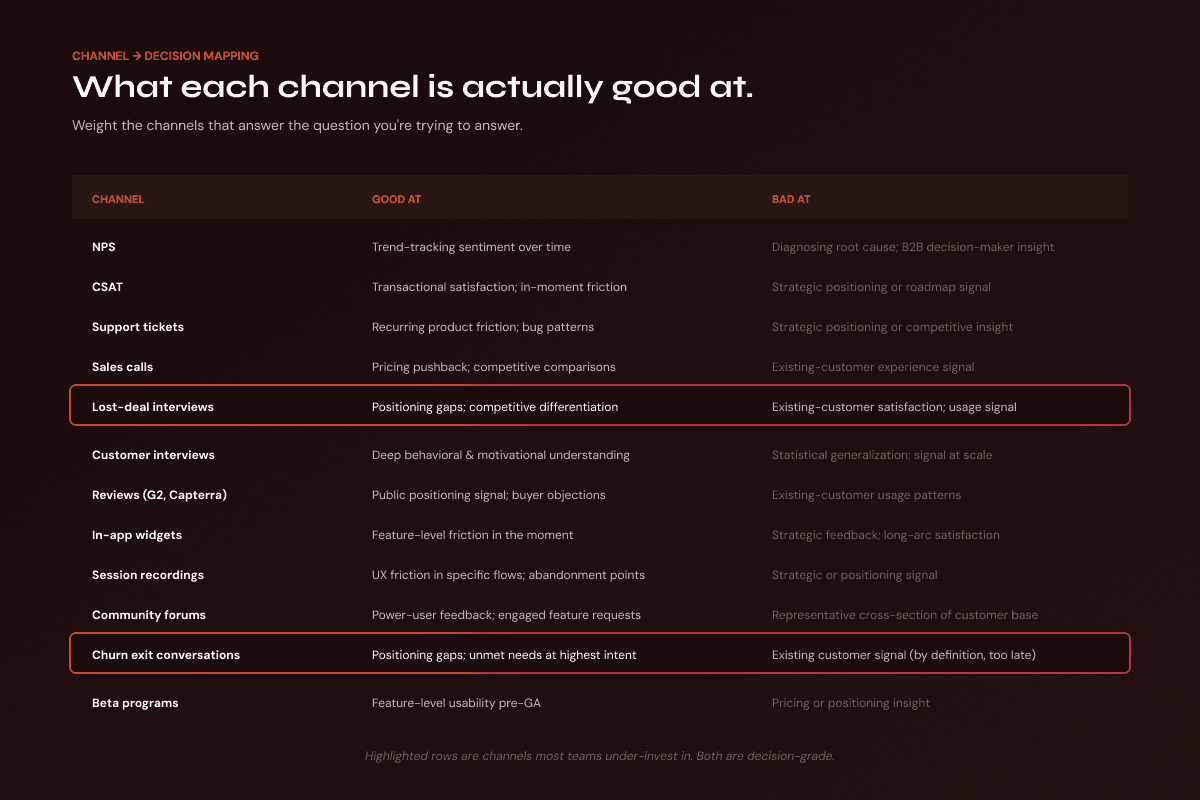
The implication: there's no universal "best" channel mix. There's a channel mix that's right for the questions you need to answer right now. If your most pressing question is pricing, weight sales calls and lost-deal interviews. If it's UX, weight session recordings and in-app. If it's positioning, weight churn exits and lost deals. Most teams use the same channel mix regardless of what they're trying to learn — which is part of why their VoC programs feel like they generate volume without insight.
The deduplication problem
Here's the operational problem that most teams hit once they have three or more channels running: the same customer pain shows up in different channels with different language, and nobody has a clean way to see that it's all the same thing.
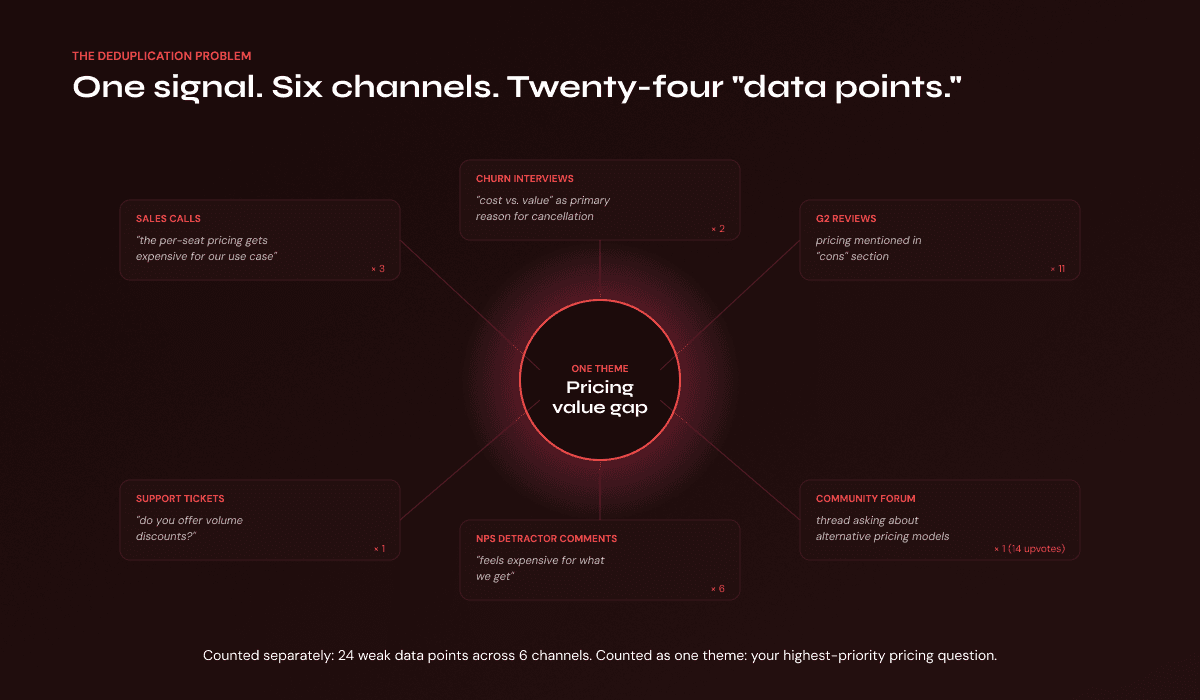
A single pricing objection might show up as:
A passing comment in three sales calls ("the per-seat pricing gets expensive for our use case")
Two churn interviews citing "cost vs. value" as the primary reason
Eleven G2 reviews mentioning pricing in the cons section
A support ticket asking about volume discounts
Six NPS detractor comments mentioning "feels expensive"
A community thread with 14 upvotes asking about alternative pricing models
These are not 24 different pieces of feedback. They are one underlying signal showing up in six channels with different wording, different framing, and different specificity. Counted as separate items, the signal looks like dozens of unrelated weak data points. Counted as one theme, it's the highest-priority pricing question facing the company.
Most VoC programs solve this by not solving it. They tag feedback within each channel, look at top themes per channel, and trust that the cross-channel pattern will surface if it's important enough. It usually doesn't, because the channels are managed by different teams (CS owns NPS, sales owns lost-deal interviews, product owns the in-app widget), and the tags don't share a taxonomy. By the time someone does a "cross-channel synthesis" — usually quarterly, usually for a leadership review — the freshest signals are months stale.
The fix is structural, not procedural. A single canonical taxonomy that spans channels, with deduplication happening across channels rather than within them, is what separates programs that produce decision-grade insight from programs that produce per-channel reports. This is the operational problem HyperOrbit's Voice of Customer agent is built to solve — not by adding another channel, but by making the cross-channel signal visible across whatever channels you've already chosen to run.
The point isn't more channels. It's seeing the same signal across them.
The under-discussed channel: competitor mentions in customer conversations
There's one signal type that almost no traditional VoC program captures, even though it sits inside every channel category above.
It's the moment when a customer mentions a competitor.
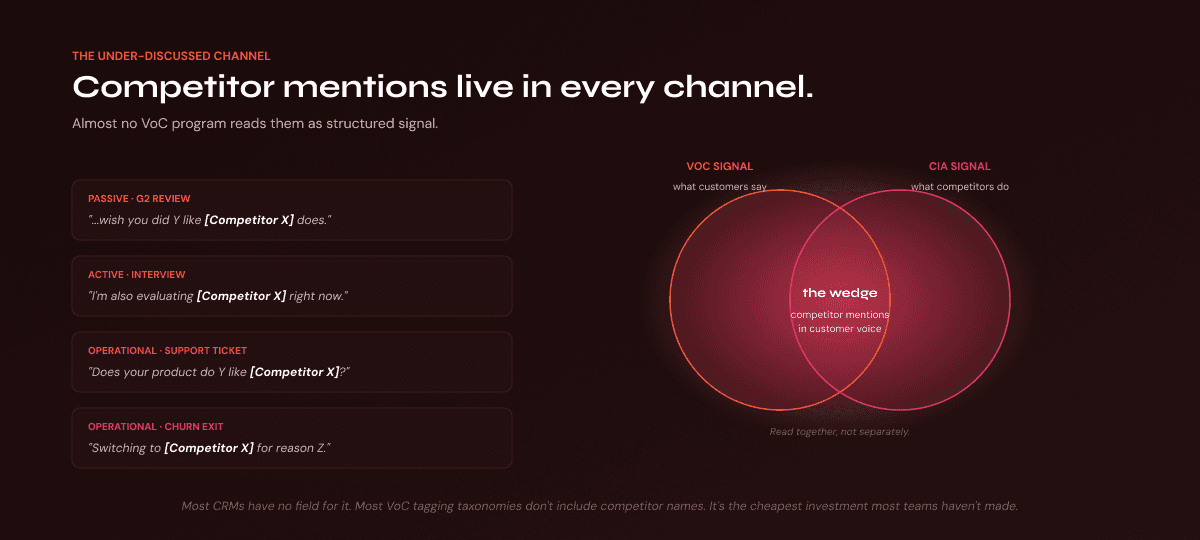
A sales call where the prospect says "I'm also evaluating [Competitor X]." A support ticket asking "does your product do Y like [Competitor X] does?" A G2 review listing what they like about you and what they wish you did "like [Competitor X]." A churn exit mentioning that they're switching to [Competitor X] for reason Z.
These mentions are present in every channel — passive, active, operational, and embedded. They're typically captured as anecdotes ("I heard a deal lose to Competitor X last week") rather than as structured signal. Most CRMs have no field for competitive mentions; most VoC tagging taxonomies don't include competitor names; most support ticket categorizations treat competitor questions as a single bucket if they handle them at all.
This is the gap. The cross-channel pattern that connects "what customers ask for" with "what competitors just shipped" is one of the highest-signal patterns available to a product team, and almost no one is reading it systematically. Crayon, a competitive intelligence tool, frames the inverse pattern explicitly: by watching competitor announcements through the lens of their customers' requests, you can predict feature launches before they happen. The same logic works in reverse — by watching your own customers' competitor mentions, you can detect positioning gaps before they become churn events.
This is the second cross-channel discipline HyperOrbit is built for: the CIA × VoC overlap, where competitive intelligence signals join customer voice signals to surface a class of insight that neither stream produces alone. Most product organizations treat competitive intelligence as a separate function from VoC. The teams that win treat them as one stream with two inputs.

Conclusion
What to actually do
If you've read this far, the practical takeaways:
Audit your current channel mix against the questions you're trying to answer. Most teams have a channel mix that was set up years ago for questions that are no longer the priority. If your most pressing strategic question right now is positioning, and you're spending most of your VoC investment on NPS and in-app widgets, you have a mismatch.
Stop treating NPS as a diagnostic system. It's a directional trend metric. Use it that way. The hours you save by not over-investing in NPS analysis are hours you can redirect to lost-deal interviews and churn exits.
Build the close-the-loop discipline on the highest-density channels first. A lost-deal interview that doesn't close the loop (with the buyer, with sales, with product) is mostly wasted. Programs that close the loop on the high-density channels produce compounding signal quality over time.
Take the cross-channel deduplication problem seriously. Whether you solve it with a manual cross-tagging discipline, semi-automated tooling, or an agentic system depends on your scale. But treating it as a future problem is how programs stay stuck at three channels of vanity volume with no synthesis layer.
Capture competitor mentions as structured signal. Add a field, a tag, a category — something that lets you read competitive mentions across channels without manually re-reading every transcript. This is the cheapest VoC investment most teams haven't made.