The definitive 2026 guide — all 26 external and internal signal sources, the scoring model, auto-battlecard system, and the 90-day build roadmap your team can execute starting today.
📖 55-min read · ✅ Free downloadable guide included · 📶 26 signal sources mapped
73%
of lost deals had an untracked competitor signal that already existed
26
signal sources mapped — external and internal — in this guide
24h
from signal detection to delivered intelligence brief with HyperOrbit
+18%
average win-rate improvement on competitive deals after 90 days
CHAPTER 1
What Is a CI Engine — and Why Most Teams Fail to Build One
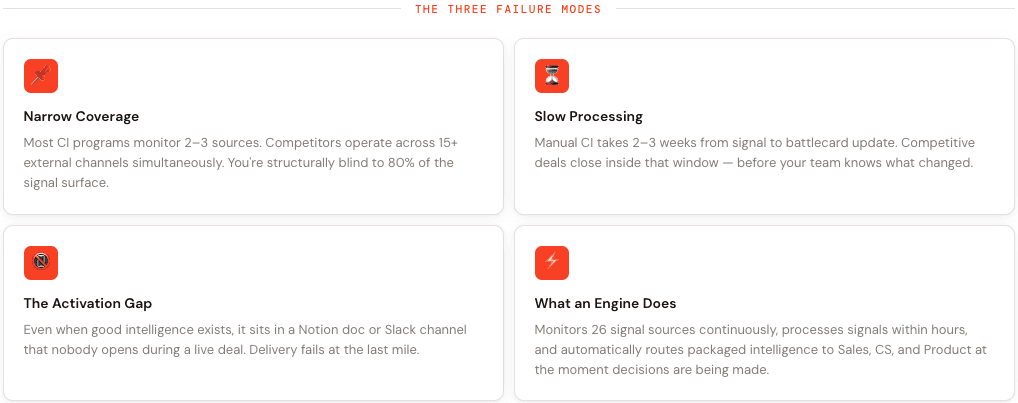
Most companies think competitive intelligence means reading a competitor's blog, checking their G2 page once a month, or running a quarterly win/loss review. That's not an engine — that's a hobby. A Competitive Intelligence Engine is a systematic, always-on, multi-source system that converts raw signals into actionable intelligence and automatically routes it to the teams that need it at the exact moment of decision.
The difference between a hobby and an engine comes down to three capabilities: coverage (how many signal sources you monitor), speed (how fast signals are processed into usable intelligence), and activation (how reliably that intelligence reaches the decision-maker in time to change the outcome of a deal or retention conversation).


CHAPTER 2
A competitive intelligence engine processes two fundamentally different classes of signal: External Signals — what the market and competitors are broadcasting publicly — and Internal Signals — what your own customers are telling you about competitors through their behaviour, conversations, and requests. Both are essential. Most companies build only for external. The most powerful and differentiated intelligence comes from combining both layers.

The Four Engine Layers
01 >> Collection Layer
Automated ingestion from all 26 signal sources — external market signals and internal customer touchpoints. Zero manual scraping. Agents pull and classify continuously without human involvement.
02 >> Processing Layer
NLP classifies every signal by type (pricing, feature, messaging, personnel, financial), competitor, and urgency level. Noise is filtered. Relevant signals are tagged, timestamped, and queued for scoring.
03 >> Intelligence Layer
Processed signals are correlated with historical revenue events — closed-lost deals, churned accounts, expansion blocks — to weight each signal by actual business impact, not signal volume alone.
04 >> Activation Layer
Intelligence is packaged as role-specific outputs — battlecard updates for Sales, churn risk alerts for CS, feature gap briefs for Product — and delivered automatically to the right person at the right moment via Slack, CRM, and email.

CHAPTER 3
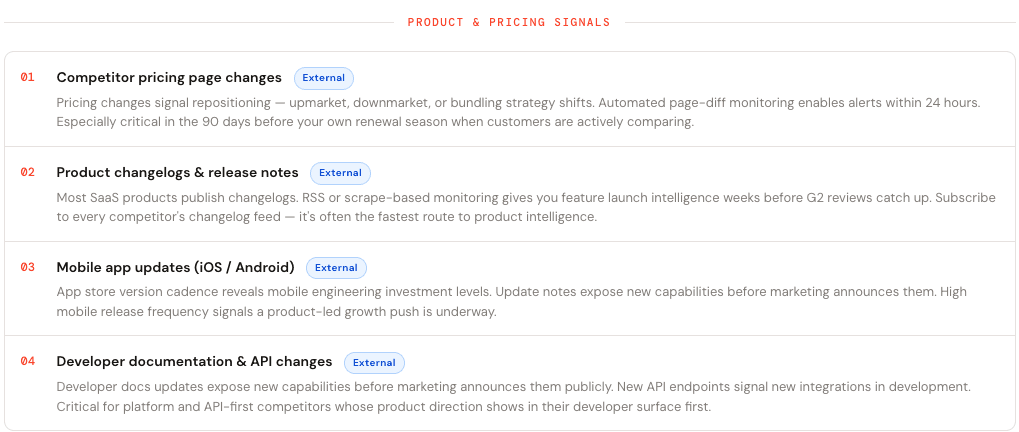
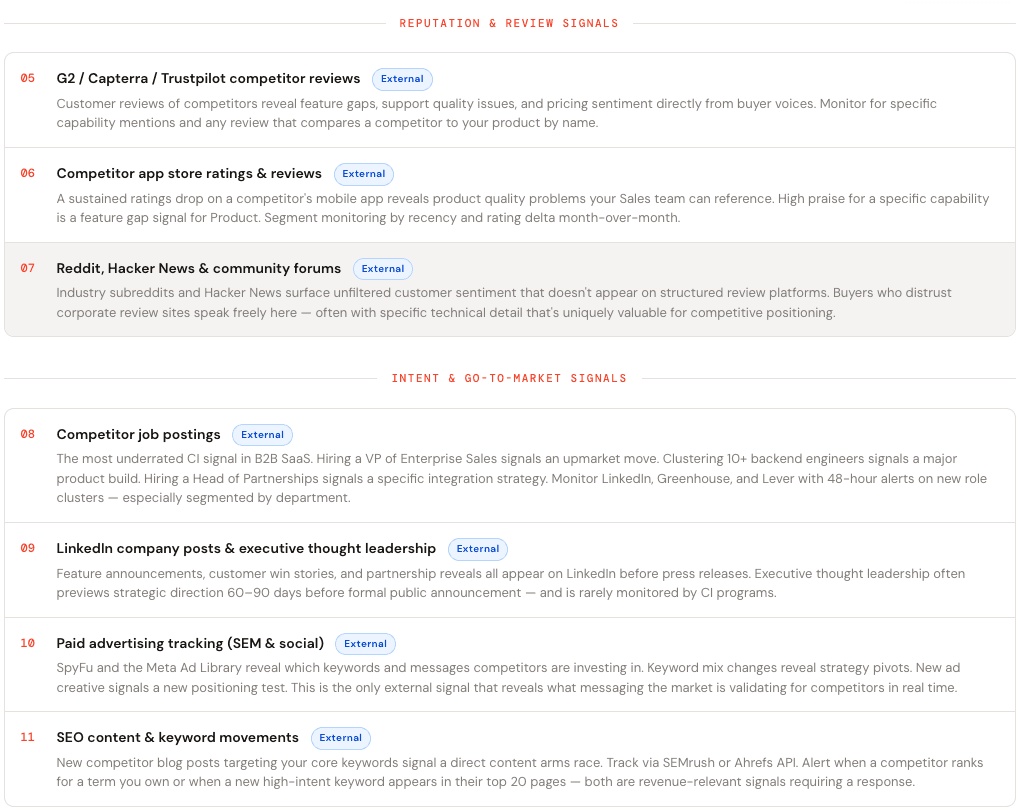
External Signals: All 15 Sources You Must Monitor
External signals are the market's public broadcast about what competitors are doing. They're theoretically available to everyone — but most companies actively monitor only 2–3 of the 15 available sources. Here is the complete external signal surface, organised by category, with monitoring guidance for each.
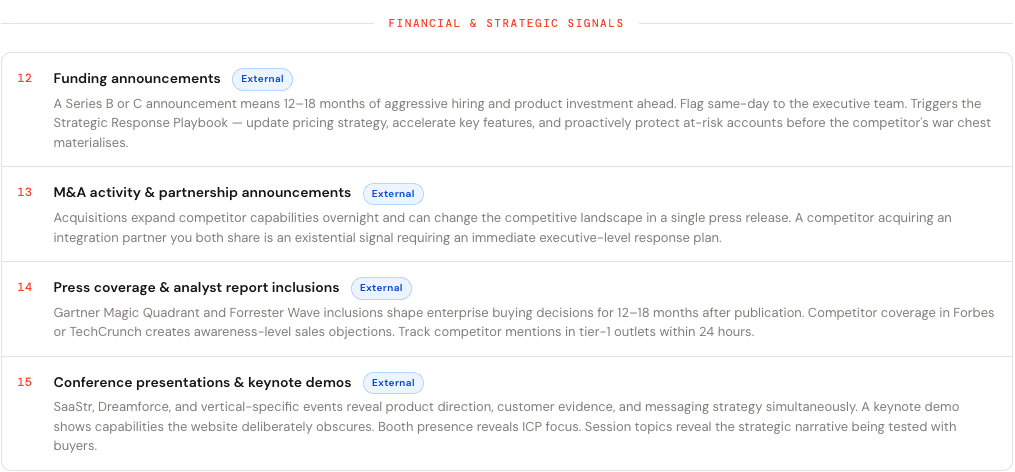

CHAPTER 4
Internal signals are the most underutilised source of competitive intelligence in SaaS. They come from your own customers — through support tickets, sales calls, product usage patterns, and renewal conversations — and they are frequently more timely and more reliable than anything available in the external market.
A customer mentioning a competitor in a Gong call is a richer signal than any G2 review. It tells you exactly which account is at risk, which competitor is being evaluated, and which specific feature is driving the consideration. Most companies never systematically capture this. Here are all 11 internal signal sources.
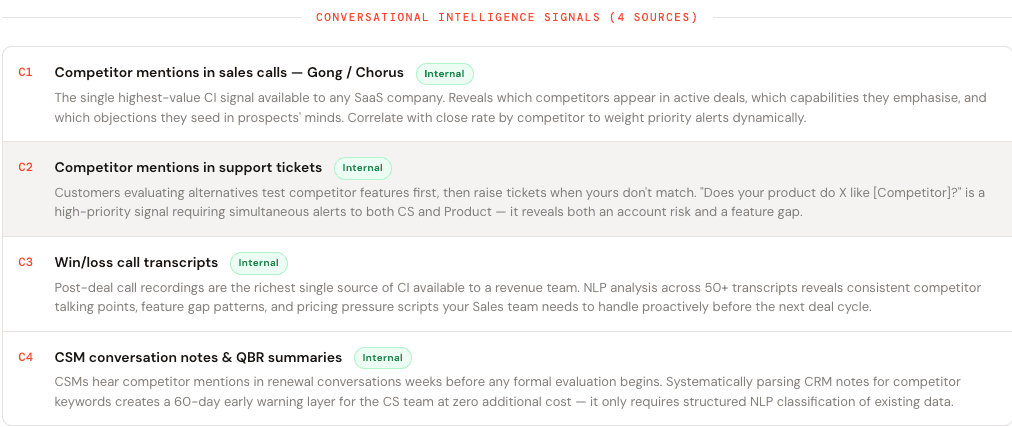
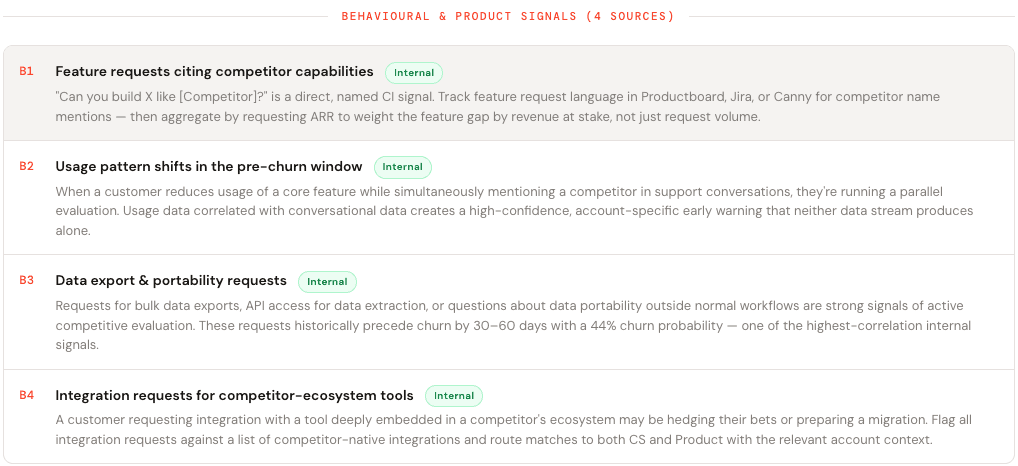
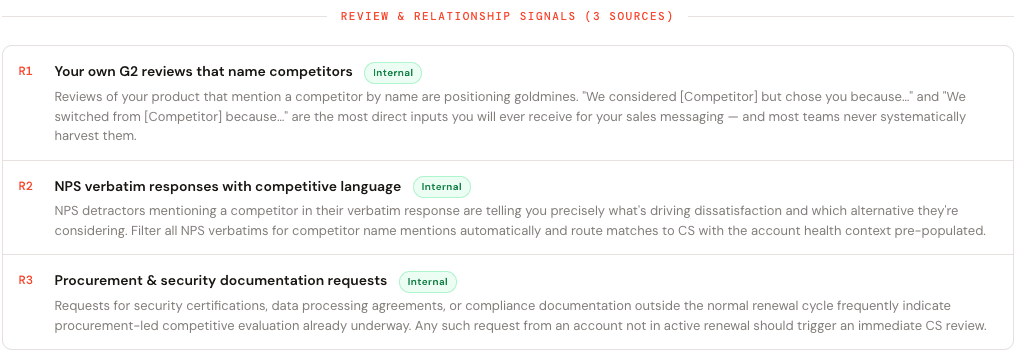

CHAPTER 5
Mapping Signals to Revenue Events
The critical mistake most CI programs make is treating all signals as equally important. They are not. The signals that matter most are those statistically correlated with revenue outcomes — closed-lost deals, customer churn, expansion blocks, and pipeline stalls. Until you run this correlation analysis on your historical data, you don't have a CI engine. You have a news aggregator.Playbook A: The Early Risk Intervention (Day 1–30 of Signal)
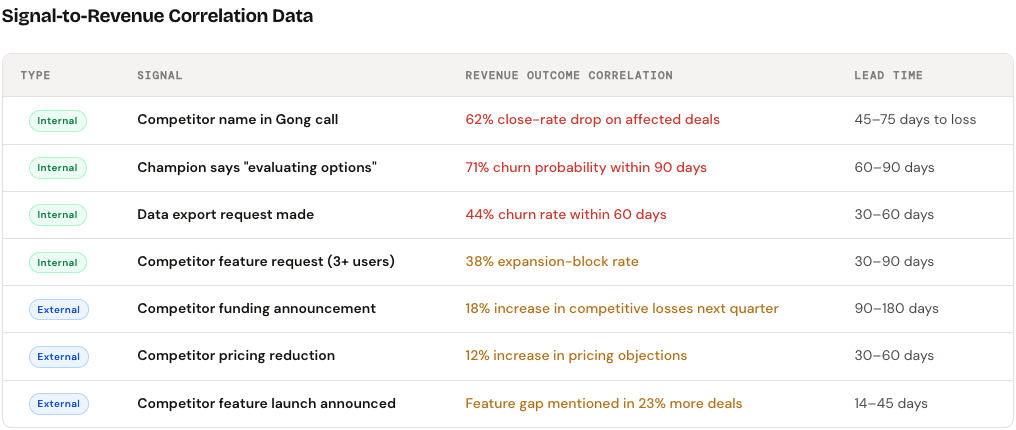
Building Your Revenue-Weighted Signal Stack
Weight by ARR at stake: A competitive signal on a $200K ARR account warrants a higher-priority alert than the same signal on a $5K account — regardless of signal type.
Weight by renewal proximity: Any competitive signal on an account within 90 days of renewal should get escalated priority regardless of ARR — the intervention window is short and closing fast.
Weight by signal recency: A competitor feature launch from yesterday is immediately actionable. The same launch from 6 months ago is history. Freshness is a scoring multiplier.
Weight by historical correlation: Signals empirically correlated with high revenue loss rates (data export requests, "evaluating options" language) should trigger faster escalation paths than low-correlation signals.
Weight by pattern density: A single competitor mention is a signal. Three competitor mentions from the same account within 30 days is a confirmed pattern — patterns require immediate escalation regardless of other score factors.
CHAPTER 6
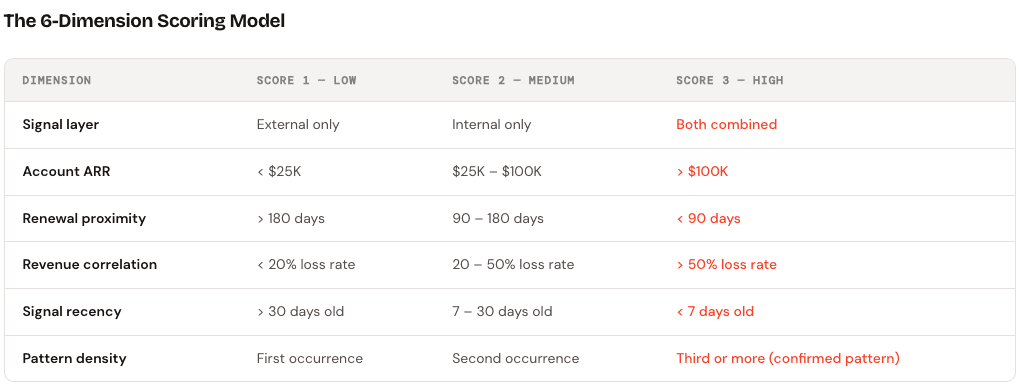
Signal Scoring & Prioritisation Model
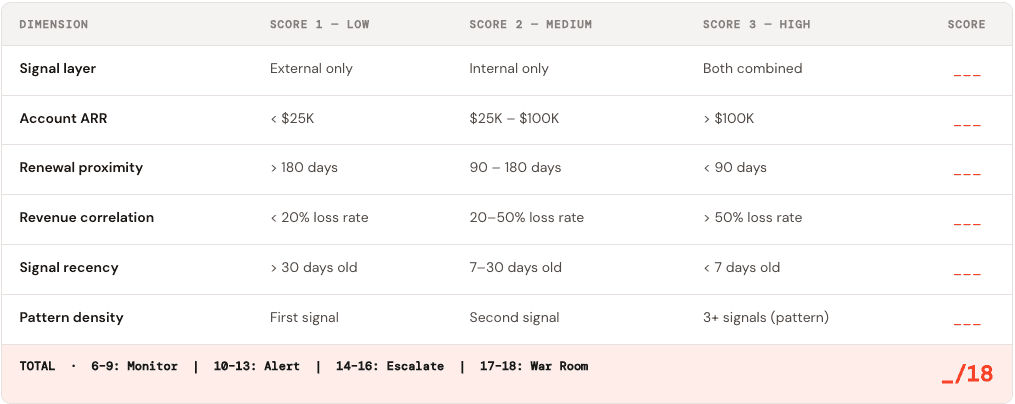
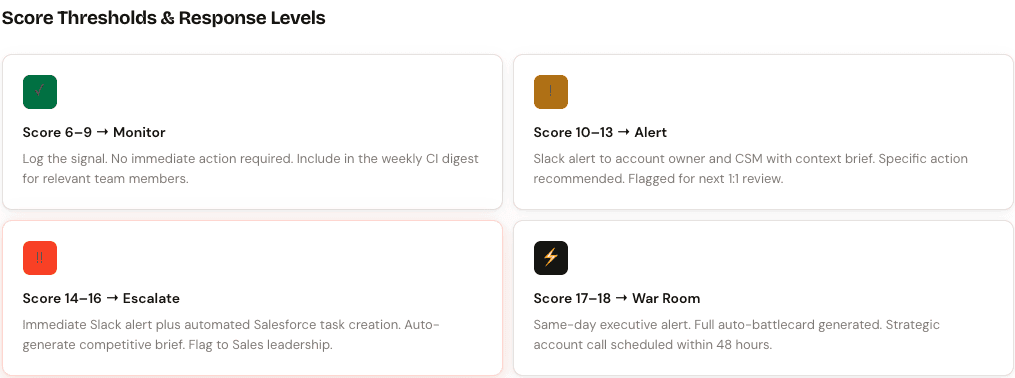
Not every competitive signal warrants the same response. A scoring model prevents teams from drowning in undifferentiated alerts while ensuring no high-stakes signal goes unhandled. Score each signal across six dimensions, then route automatically by total score.

CHAPTER 7
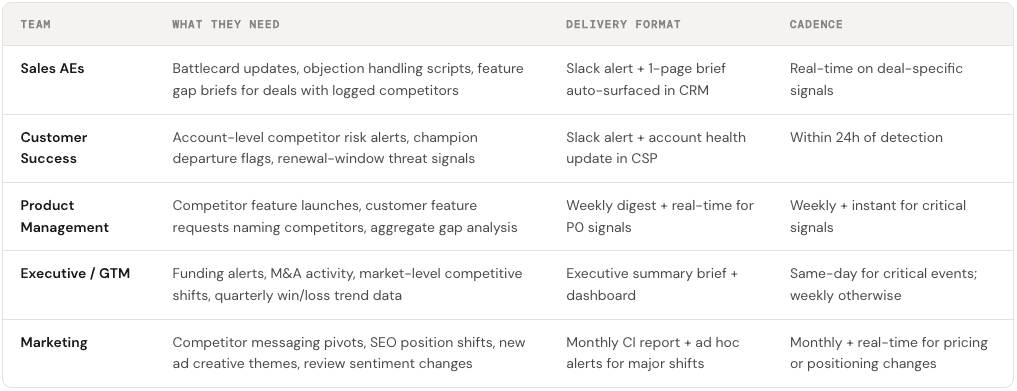
Activating Intelligence Across Teams
The final failure mode of CI programs isn't collection or processing — it's activation. Intelligence that doesn't reach the right person in the right format at the right moment is expensive data storage. Each team needs a different package of the same underlying intelligence — same signals, different formats and cadences.
CHAPTER 8
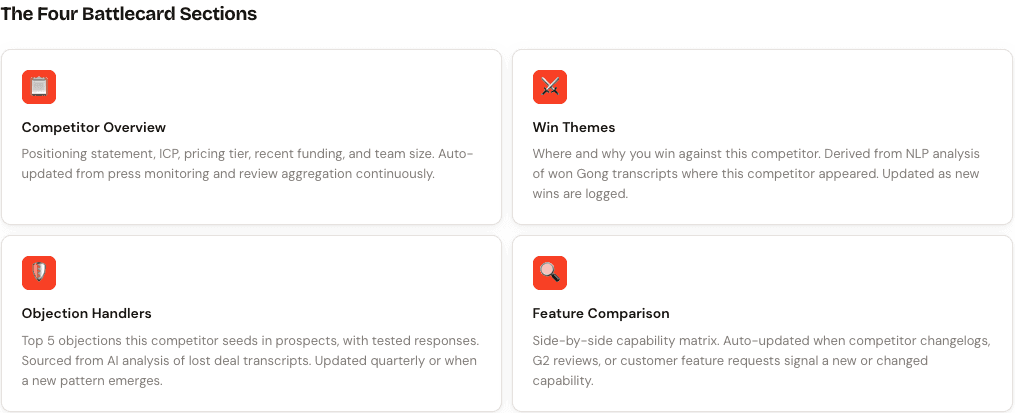
The Auto-Battlecard System
Battlecards are the primary CI activation tool for Sales. The endemic problem: most battlecards are created once and never updated. By the time a rep pulls one in a live competitive deal, it's months stale — the competitor has shipped new features, changed pricing, and updated their positioning since the card was last touched.
An auto-battlecard system eliminates this problem permanently by treating every significant competitive signal as a trigger to refresh the relevant battlecard automatically.
How the Auto-Battlecard System Works
Signal trigger: Any competitive signal scoring ≥ 10 against a tracked competitor triggers an automatic battlecard refresh for that specific competitor.
Automated data pull: The system pulls the latest G2 reviews, product changelog entries, pricing page content, and relevant call transcript excerpts into the battlecard template automatically — no analyst required.
CRM surfacing: When a Sales rep logs a competitor on a Salesforce opportunity, the most current battlecard auto-populates directly in the record. Zero searching, zero Notion hunting.
Version tracking: Every battlecard update is versioned and timestamped. Reps always know how fresh the intelligence is and exactly what changed since the previous version.
Slack distribution: High-score battlecard updates are automatically distributed to the relevant account team channel with a summary of what changed and why it matters.
CHAPTER 9
The 90-Day CI Engine Build Roadmap
Building a competitive intelligence engine is a sequenced process. Trying to deploy everything at once results in an overbuilt system that nobody uses. Here's the 90-day framework that moves you from zero to a fully operational, revenue-connected CI engine in four phases.
Days 1–14 >> Phase 1 — Signal Audit & Source Mapping
Audit current CI practices. Map all 26 sources against your existing tool stack. Identify which signals you already have access to (Gong, Salesforce, G2) and which need new connections. Run correlation analysis on 12 months of closed-lost data to identify which existing signals historically predicted competitive losses. Prioritise the top 5 signal sources by revenue correlation score.
Days 15–30 >> Phase 2 — Collection & Processing Infrastructure
Connect priority external sources — G2 monitoring, pricing page diffs, LinkedIn & job posting alerts, changelog RSS feeds. Connect primary internal sources — Gong/Chorus, Zendesk, CRM notes NLP. Build classification layer to tag signals by competitor, type, and urgency. Generate first auto-produced competitive brief on your top 3 competitors using collected data.
Days 31–60 >> Phase 3 — Scoring, Routing & First Battlecards
Implement 6-dimension scoring model. Configure Slack routing rules by score threshold across all four response levels. Generate first battlecard drafts for top 3 competitors using collected signals. Launch weekly CI digest for Sales and CS. Calibrate score thresholds based on 30 days of live signal volume data. Connect battlecard auto-surfacing to Salesforce competitor field.
Days 61–90 >> Phase 4 — Full Coverage & First ROI Report
Expand monitoring to all 26 signal sources across both external and internal layers. Enable full auto-battlecard update triggers. Measure and report 90-day outcomes: win-rate improvement on competitive deals, churn signals caught, analyst hours reclaimed, and total revenue protected. Present ROI to executive and Sales leadership stakeholders.

CHAPTER 10
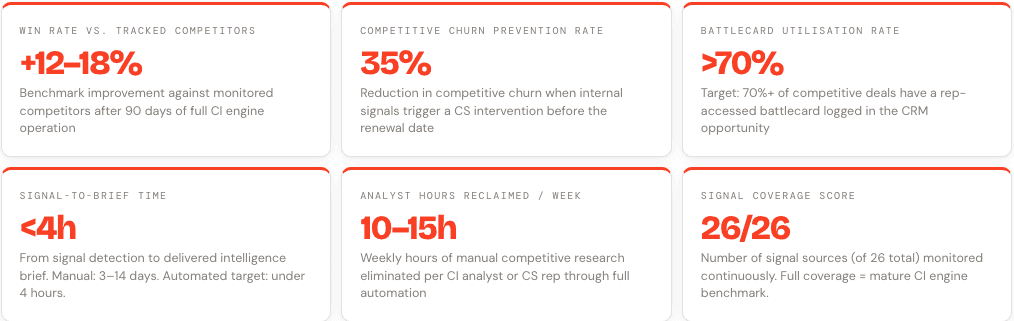
Measuring CI Engine Performance
A CI engine is a meaningful investment. Like any revenue-generating programme, it needs a measurement framework that connects engine activity directly to revenue outcomes — not just operational metrics like "signals processed" or "battlecards generated."

Bonus Resource
Signal Scorecard Template
Use this scorecard to evaluate any competitive signal and determine the appropriate response level. Score each dimension 1–3 and sum for the total score.