

12 Minutes
Almost every product blog has already covered “AI in product discovery” this year, so this post is a bit late. Still, most of those articles treat discovery like a checklist: add AI to market research, feedback analysis, and prioritization, then run the same process, just faster, and probably use some tools that are good for one-time analysis or insights but not something you can use to run continuously without having to tinker around with lots of tools.
That approach isn’t wrong, but it’s not the whole story. Speed isn’t the main thing holding product teams back. The real problem is disconnected signals.
What AI actually changes here
If you look past the vendor product collaterals and vendor sponsored linkedin posts, “AI in product discovery” really means a few key things: language models that can read a thousand support tickets while a PM reads ten, predictive models that highlight which features are likely to succeed before you build them, and agents that can monitor tasks continuously, like tracking a competitor’s changelog or tagging sentiment in reviews, instead of doing it just once a quarter when someone remembers.
This isn’t just hype. Teams that used to spend an entire research sprint pulling together findings can now do the same work much faster and also in a continuous fashion. That’s a real change in how quickly you can move from guessing what users want to knowing for sure and backing it with data to inform your product prioritization and roadmap.
The part most of these articles and blog posts skip
There’s a blind spot here, obviously left behind: almost every AI discovery tool answers one question well but ignores the other. Tools focused on customer feedback are great at showing what users are saying, but they often miss why it matters compared to what competitors just released and how that might impact your sales pipeline or revenue plan for next year. Tools for competitive intelligence can tell you a rival launched a feature last week, but they don’t know if your customers even noticed.
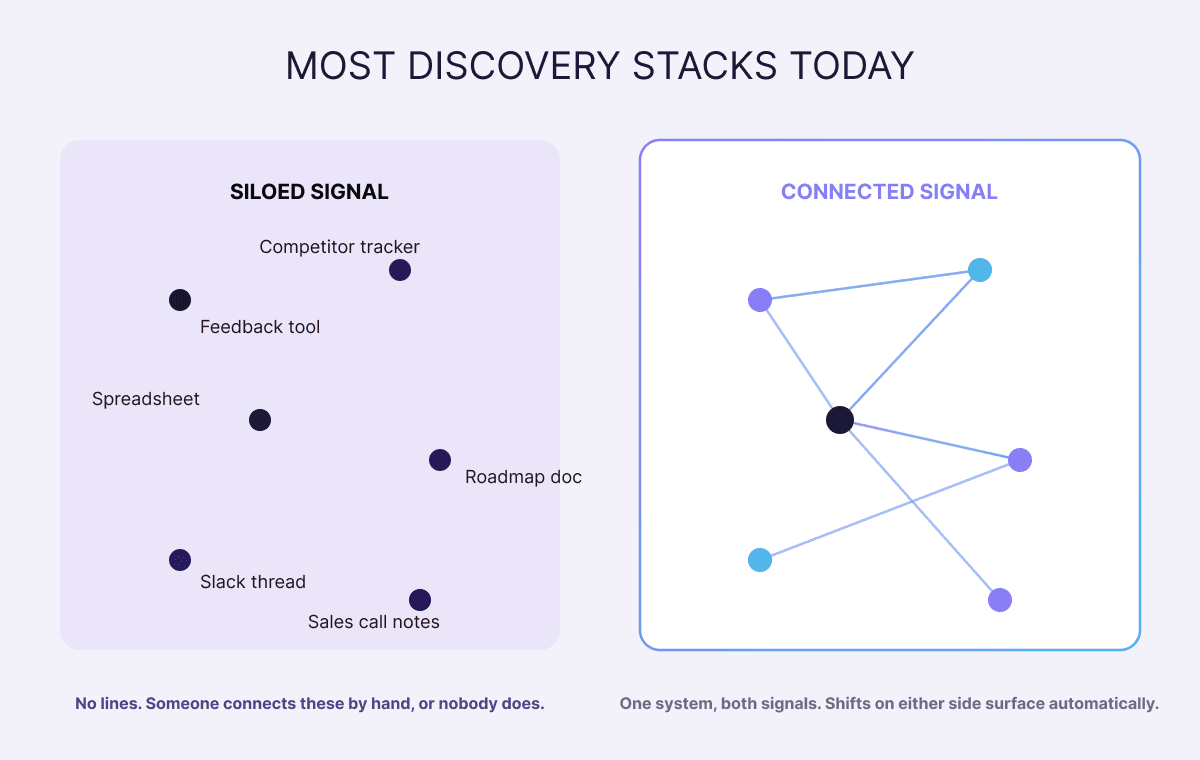
Discovery isn’t just one signal—it’s two, and they should inform each other. For example, a support ticket about a missing integration means something different if a competitor just launched that feature compared to if no one has. A competitor’s pricing change matters more if your churn data shows customers are already sensitive to price. Most tools treat these as separate research tracks with separate dashboards, so someone—often a PM late at night—has to connect the dots manually.
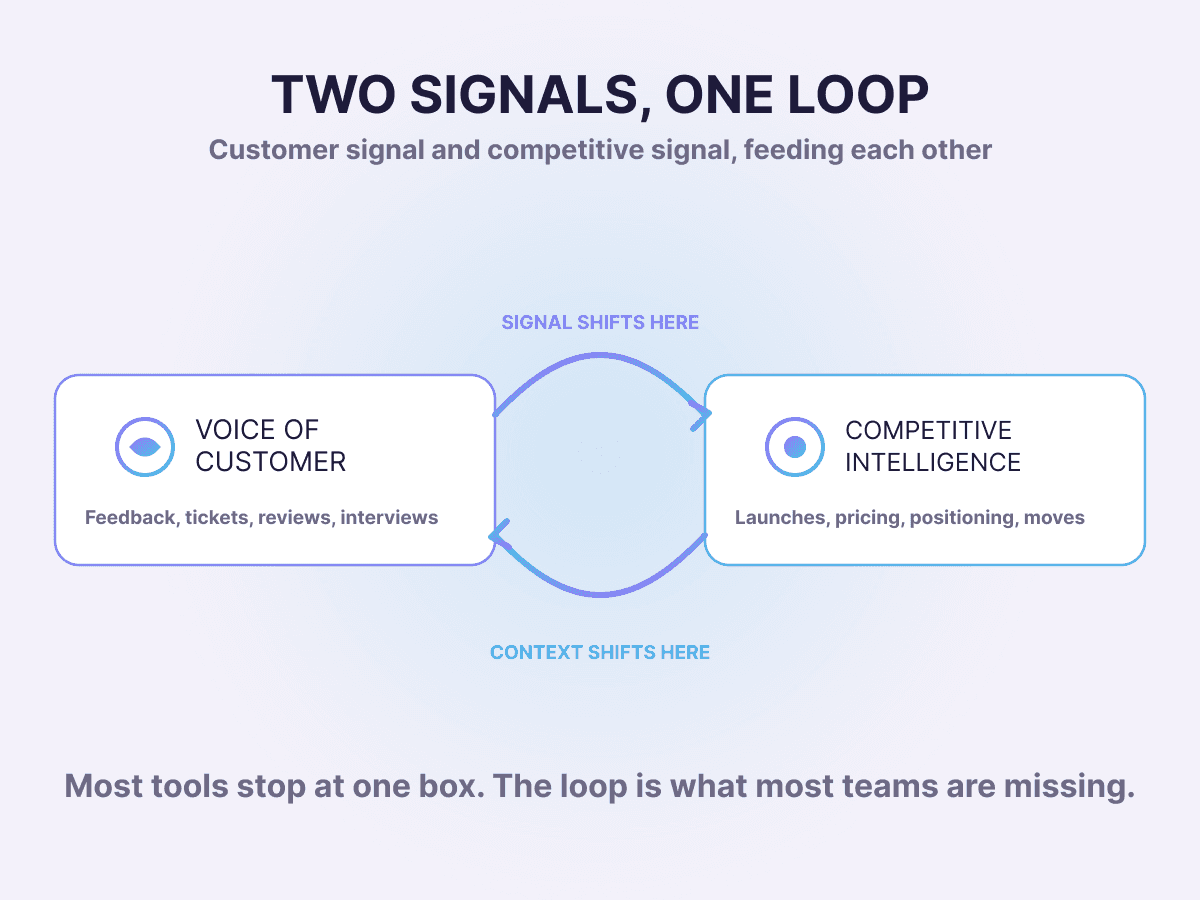
That’s the real gap AI hasn’t closed for most teams. It’s not about whether AI can read feedback or track competitors—those problems are solved. The real question is whether the system lets those two things inform each other automatically, or if a person still has to do it.
This was the challenge we kept running into not just at one company but across all the companies I have worked with, and it’s the real reason we built HyperOrbit: a Voice of Customer agent and a Competitive Intelligence agent that share information in both directions. That way, a change on one side automatically brings up the context from the other, without anyone having to search for it. The real value is in the two-way loop, not just one part by itself.
Where it actually goes wrong
AI in discovery tends to fail in some predictable ways, and it’s important to call them out clearly. Feedback data skews toward your loudest or most engaged users; a model trained on it will confidently recommend building for that same slice of your base, and just as confidently ignore everyone else. You can probably completely rebuild your application and yet fail miserably because AI cannot or does not know how to differentiate whether a feature request is valid or not, or whether it should prioritize it or not.
Relying too much on AI is an even bigger risk. A model might show that a feature scores low on demand signals, but it can’t tell you that this feature is the one thing blocking your biggest renewal next quarter. That kind of context still lives in someone’s head, not in your data warehouse.
And when recommendations feel like a “black box,” trust disappears quickly, and the cost of doing or building the wrong thing is a mistake that you can’t walk back easily. If a PM can’t explain why a prioritization score turned out a certain way, they’ll stop trusting it—and that’s understandable.
None of this means you shouldn’t use AI in discovery. It just means you should treat its output as one input to your decision, not as the decision itself.
How to actually start
Put the platform evaluation spreadsheet aside for a moment. Choose one specific discovery bottleneck—maybe feedback synthesis takes too long, competitive moves keep catching you off guard, or prioritization always turns into a gut-feel debate in meetings—and use AI to tackle that one issue first.
Before you automate anything, make sure your data is actually usable. If a model is trained on messy, duplicated, or poorly tagged feedback, it will give you fast, confident, but wrong answers. Always keep a person involved in anything that affects the roadmap. AI should help you move from signal to decision faster, not take the decision away from people.

Conclusion
Where this is heading
The near future isn’t about adding more dashboards—it’s about having fewer. Instead of quarterly reports, you’ll have real-time trend detection. Instead of triaging feedback right before planning, you’ll handle it as soon as it comes in. All of this means discovery won’t just be a phase before building; it will run quietly in the background, connecting what customers say to what’s happening in the market.
Reaching this point isn’t really about adopting AI. It’s about whether your customer and competitive signals are still stuck in separate tools, managed by different teams, and updated on different schedules. Once you connect those, using AI becomes much easier.