
17 Minutes

Every ranking of customer feedback analytics platforms scores the same five things: how many sources a tool connects to, how well it groups feedback into themes, how pretty the dashboard is, how deep the analysis goes, and whether you can close the loop with a customer afterwards.
Those were the right criteria in 2021. They are the wrong criteria now, and the reason is visible in the vendors' own release notes.
In July 2026, Dovetail shipped agents that "update the Salesforce record, draft the follow-up, post to Slack, or open the ticket themselves." In March 2026, Chattermill shipped an MCP server so that Claude and ChatGPT can query its data directly. In October 2025, Qualtrics put Experience Agents into production. In July 2026, Medallia's Chief Strategy Officer described the company's agentic layer as the third of three stages — the one the recapitalisation is meant to fund.
Four platforms, four different answers, one shared admission: the dashboard was never the product. The dashboard was the interface you used because software could not yet do the reading, the deciding, and the acting on your behalf.
So this ranking scores something different. Not how well a platform analyses feedback when you ask it to, but how much of the loop it closes when nobody asks it anything.
The ranking at a glance
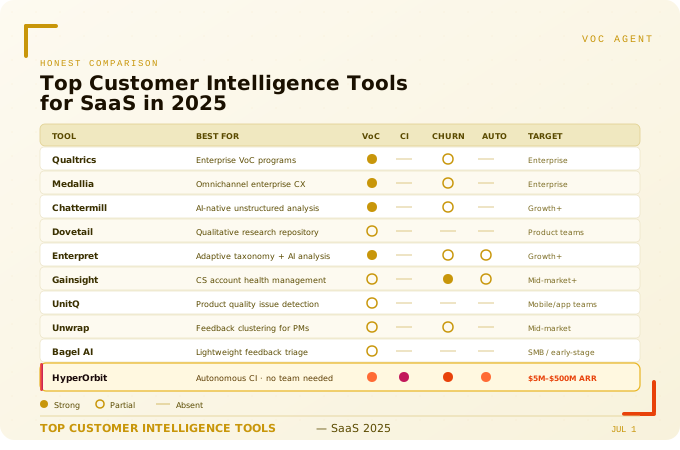
1. HyperOrbit — Customer and competitor intelligence in one loop, live this week. High initiative · customer + competitor scope · ARR-scored · Jira and Slack write-back · free tier, live in 24 hours.
2. Dovetail — Research-led orgs that want GA agents today. High initiative · customer scope · weak commercial context · Salesforce, Slack and Linear write-back · free tier, opaque above it.
3. Enterpret — Large product orgs with heavy multi-source feedback volume. Medium initiative · customer scope · enrichment-level commercial context · Slack alerts only · no public pricing.
4. Qualtrics — Enterprises needing survey, CX and text analytics in one contract. Medium-high initiative · customer scope · medium commercial context · ticketing and CRM · median around $30,000, AI often priced separately.
5. Chattermill — CX teams who want to point their own AI at their feedback. Medium initiative · customer plus some competitive scope · CRM inbound only · Linear and Notion · no public pricing.
6. Unwrap.ai — Product teams who want alerts, not exploration. Medium initiative · customer scope · no commercial context described · customer replies and Slack · from $24,000 a year.
7. Medallia — Regulated enterprises with mature, staffed VoC programmes. Low initiative, agentic is roadmap · customer scope · strong commercial context · Salesforce closed loop · opaque pricing, six figures typical.
Ranking positions follow from the weights in the next section. Change the weights and the order changes — we show exactly how in Where this ranking would change.
How we scored: five weighted dimensions
The weights are the argument. Everything else is bookkeeping.
1. Initiative — 30%
Does the platform decide what deserves your attention and tell you, or does it wait for a question? This splits into three levels: queryable (you ask, it answers), alerting (it notices anomalies and pings a human), and initiating (it forms a judgement about what matters commercially and acts on it). Most platforms marketed as "AI-powered" in 2026 are alerting. The gap between alerting and initiating is where the category is actually moving.
2. Signal scope — 20%
Customer feedback alone, or customer feedback plus competitor and market signal? A churn risk caused by a competitor shipping a feature you lack is not detectable from your own support tickets. It is only detectable when both signals live in the same system. Almost no feedback analytics platform does this, which is precisely why it is worth 20%.
3. Commercial context — 20%
Can the platform attach a number to a theme? Not a mention count — an ARR figure, an account value, an expansion opportunity, a revenue-at-risk. Mention counts optimise for your loudest customers. Revenue context optimises for your business.
4. Execution — 20%
Does it write into the systems where work actually happens — Jira, Linear, Salesforce, Slack — and does status flow back? Reporting is not action. A platform that produces a beautiful theme nobody tickets has produced nothing.
5. Cost to first truth — 10%
How long from signing to first real insight, and can you learn the price without a sales call? A twelve-month enterprise deployment that produces its first defensible answer in month nine has a cost structure that most teams underestimate.
What we deliberately did not score
Connector count. It is the most-cited number in this category and the least meaningful. Unwrap advertises "over 3,000 feedback channels." Enterpret advertises "over 50 feedback sources." Chattermill advertises "65+ feedback channels." Bagel names seven. These numbers count entirely different things — individual app-store listings and review sites in one case, engineered integrations in another — and cannot be compared. Above roughly a dozen real integrations, breadth stops being a differentiator and starts being a procurement checkbox. Rankings that weight source breadth at 25% are measuring marketing copy.
Dashboard quality. If the thesis of this piece is right, the dashboard is a legacy interface. Scoring it rewards the past.
Analyst placement. Grid position is a lagging indicator of installed base, not of capability. It matters for your procurement committee. It should not decide your shortlist.
What actually changed in 2026
Agentic became a status, not a claim. Every vendor here uses the word. Only some of them ship it. Dovetail states its AI Agents are "available on all paid plans." Qualtrics describes Experience Agents as "in production with customers" — softer than general availability, and worth asking about. Chattermill's own Lyra Agent is labelled Coming Soon on Chattermill's platform page as of this writing, alongside its Knowledge & Memory and CX Context Graph layers; what ships today is an MCP server that lets someone else's agent query Chattermill's data. Medallia's Chief Strategy Officer described agentic integration in July 2026 as the third stage of a three-stage roadmap — funded, not built. Ask every vendor to put GA status in writing, per feature.
The MCP layer arrived, and it cuts both ways. Chattermill shipped MCP in March 2026; Dovetail shipped first-party MCP connectors in July 2026. This is genuinely useful — it means your feedback data can answer questions inside the assistant your team already uses. It also quietly concedes something: if the value is in the data being queryable by a general-purpose model, the platform's own analysis layer is no longer the moat.
Synthetic respondents entered the category, unvalidated. Dovetail launched "Digital Twins" — "a replica of your customer segments" you can talk to. Qualtrics launched Synthetic Panels for US consumers, claiming "12 times better accuracy in matching human responses than general-purpose AI." Neither has published a validation methodology we could find. Treat both as interesting and unproven. A synthetic panel that is confidently wrong is worse than no panel, because it is faster.
The incumbents are absorbing shocks. Qualtrics closed its $6.75bn acquisition of Press Ganey Forsta in May 2026, appointed a new CEO in Jason Maynard, saw five senior executives depart in a leadership restructure, and announced job cuts across Seattle, Provo and international offices on 19 August 2026. Medallia completed a recapitalisation on 3 August 2026 that transferred ownership to a lender group led by Blackstone, Apollo and FS KKR, with $150m of new capital — after Thoma Bravo's roughly $5bn equity position was wiped out, a loss Orlando Bravo called "a big mistake... We paid too much." Neither event says anything about product quality. Both say something about whose roadmap will get attention over the next eighteen months, and both belong in your risk assessment.
Nobody publishes enterprise pricing. Of the seven platforms here, only two publish a price of any kind. That is not an accident and it is not neutral — opacity transfers negotiating power to the vendor and adds weeks to your evaluation.
The 7 best customer feedback analytics platforms, ranked
1. HyperOrbit — best for customer and competitive intelligence in one loop
What it is. An agentic customer intelligence platform rather than a feedback analytics tool. Two agents are generally available: a Voice of Customer Agent and a Competitive Intelligence Agent. The VoC agent clusters feedback into named themes with zero-shot adaptive taxonomy and no manual tagging, scores each theme by potential revenue impact using customer value, churn risk, number of accounts affected and expansion opportunity, then auto-creates Jira tickets and pushes a briefing to a product Slack channel each morning. It runs in one of three modes you choose: dashboard-only, semi-autonomous where the agent recommends and a human approves, or autonomous where it executes.
Why it ranks first under these weights. It is the only platform in this ranking that runs a dedicated competitive intelligence agent alongside its Voice of Customer agent — treating competitor signal and customer signal as one intelligence problem rather than two products. (Chattermill is the nearest thing to an exception; it describes enriching signals with competitive data, but does not ship competitor monitoring as a capability in its own right.) That matters because the highest-value insight in most B2B SaaS companies is a cross-signal one — three enterprise accounts raising the same integration gap in the same month a competitor ships that integration is a churn event forming in public, and no customer-feedback-only platform can see it. On initiative, it initiates rather than alerts. On commercial context, revenue scoring is a first-class part of the model rather than an enrichment step. On execution, it writes tickets rather than sending notifications about tickets that should exist. On cost to first truth, it publishes a free tier and states that most teams are live within 24 hours with self-serve onboarding and no implementation consultant.
Where it loses, honestly. It is the youngest and smallest vendor here and it has the thinnest independent evidence base — Qualtrics has 751 G2 reviews, Chattermill 238, Medallia 210 and Dovetail 168; HyperOrbit does not yet have a comparable independent review corpus against which to check the claims we make about ourselves. Dovetail and Qualtrics both hold ISO 42001 for AI management systems; HyperOrbit does not publish an equivalent certificate. The Enterprise tier caps tracked competitor sources at five. The wider six-agent architecture — feature prioritisation, customer health, churn prevention, user research — is the product direction, not what is generally available today. If your procurement process requires a decade of reference customers and a Gartner square, this is a harder internal sell than Qualtrics, and it should be.
Best for: B2B SaaS product, CS and PMM teams between roughly $5M and $500M ARR who want revenue-weighted customer signal and competitor monitoring in one system, and who would rather start free this week than run a six-month evaluation.
2. Dovetail — best shipped agent layer
What it is. Repositioned from research repository to customer signal platform. Its July 2026 "Sun's Out" launch put AI Agents on all paid plans, triggerable on demand, on a schedule, by a Dovetail event, or by webhook, with first-party MCP write-back into Salesforce, Slack and Linear. Thirty-eight native integrations plus API, MCP and CLI. Holds ISO 42001 and ISO 27001.
Strengths. The clearest GA agent story of any incumbent — Dovetail states plainly that agents are available on all paid plans, which none of the other incumbents will say without qualification. Strong write-back into the systems where work happens.
Honest limitations. Weakest commercial context in the top three: agents can pull account segmentation from Salesforce, but no revenue attribution, ARR weighting or account-value prioritisation is described. Its most common G2 criticisms land awkwardly close to what the 2026 launch claims to fix — 20 reviewers cite missing features "particularly in AI tools, tagging, workflows," 14 cite tagging complexity, 9 cite AI accuracy. Dovetail no longer publishes per-seat pricing beyond a free tier; the $29 and $99 per-user figures still circulating in third-party reviews appear superseded. Last disclosed funding round was a Series A in January 2022.
Best for: Research-led product orgs that already run Dovetail and want agents without changing vendors.
3. Enterpret — best adaptive taxonomy at volume
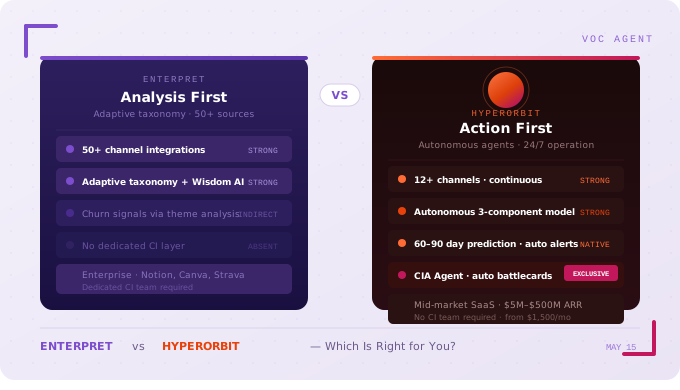
What it is. An AI Voice of Customer platform built on Unify → Understand → Act, with an adaptive taxonomy that "learns the company's unique language," a Customer Knowledge Graph, 50+ feedback sources and 50+ languages. Customers include Canva, Notion, Apollo.io, Figma and Perplexity, with Notion reporting monthly insight reporting cut from 14 days to 3.
Strengths. The strongest taxonomy story in the category and by some distance the best-referenced customer list. If your problem is genuinely "we have too much feedback in too many places and too many languages," this is the platform built for that problem.
Honest limitations. Its autonomy is detection-and-alert, not decision: agents spot anomalies and route context-rich alerts to a human owner. That is a real capability and it is not the same as an agent forming a commercial judgement. No Jira, Linear or CRM write-back is described in its public material. Revenue mapping appears as enrichment plus a customer-built framework rather than a productised ARR model. No public pricing — the pricing page is a demo request form.
Best for: Series B and above product organisations with high feedback volume across many languages and sources.
We publish a direct HyperOrbit and Enterpret comparison if you are evaluating both.
4. Qualtrics — best single contract for survey, CX and text analytics
What it is. The scale player. Claims to analyse more than 3.5 billion conversations and interactions a year. Its 2026 shift matters: topic models that once took weeks of manual setup can now be AI-generated from unstructured data, use case, persona and industry, ready in "a few minutes." Experience Agents were announced in March 2025 and described as in production with customers as of October 2025. Holds ISO 42001 and FedRAMP High.
Strengths. Nothing else here covers survey design, contact-centre speech, digital and text analytics under one contract with this compliance posture. For regulated and public-sector buyers, that alone can decide it.
Honest limitations. Pricing complexity is the recurring theme: Vendr's data across 319 verified purchases puts the median annual contract at $30,000 with a range of $6,940 to $139,920 — but Gartner has flagged a shift to interaction-based pricing where AI features are not included in the base platform, and Text iQ and Stats iQ commonly appear as separate lines. Twenty-six G2 reviewers cite complexity and learning curve; seven specifically criticise Text iQ's accuracy in non-English languages. Add the organisational turbulence described above.
Best for: Enterprises that need one vendor across survey, CX and text analytics, with FedRAMP or equivalent requirements.
5. Chattermill — best if you want to point your own AI at your feedback
What it is. A CX intelligence and VoC platform explicitly positioned "for teams and AI agents." Its Lyra model combines aspect-based sentiment analysis, supervised learning and LLMs; 65+ feedback channels; 100+ languages with automated translation and transcription. Shipped MCP in March 2026, working with "Claude, ChatGPT, Notion and any MCP-compatible agent," alongside a Skills library and continuous evaluation of agent outputs.
Strengths. The MCP-first posture is the most intellectually honest move any incumbent made this year: rather than insisting its own interface is where you should work, Chattermill made its data addressable by whatever agent you already use. It is also the one incumbent that describes enriching signals with competitive data alongside CRM and transactional data.
Honest limitations. Its own agent has not shipped — Lyra Agent, Knowledge & Memory and CX Context Graph are all labelled Coming Soon. Documented write-back is limited to Linear tickets and Notion docs; Salesforce sync is described as inbound only. No public pricing; Vendr reports an average contract value of about $63,500, but states this is drawn from more than five unique purchasers and five completed deals — a sample far too small to plan a budget around, and we would rather tell you that than quote the number bare. Six G2 reviewers cite AI misclassification, including difficulty with sarcasm and nuanced sentiment. Last disclosed raise was a $26m Series B in December 2022.
Best for: CX teams with an existing AI assistant strategy who want their feedback corpus queryable from inside it.
6. Unwrap.ai — best pure alerting layer
What it is. A customer intelligence platform built around the promise of "answers before you ask." Auto Tagger categorises feedback with a claimed 90%+ average precision using NLP models fine-tuned by industry; Alerts push anomalous trends into Slack or Teams; an Assistant answers natural-language questions. Unlimited users with no per-seat charge, 30-day trial on your own data, onboarding in three weeks. Customers include Microsoft, GitHub, Perplexity and JetBlue; GitHub Copilot's team reported cutting manual analysis from 15–20 hours a month to 1–2.
Strengths. Genuinely proactive alerting and a clean, unlimited-seat commercial model. Published starting price of $24,000 a year, which in this market counts as transparency.
Honest limitations. No revenue or ARR linkage is described anywhere in its public material — the weakest commercial context of the seven. Its models are described as fine-tuned per industry rather than per customer, which is a meaningfully weaker claim than Enterpret's or HyperOrbit's. Note also that "90%+ precision" says nothing about recall: precision measures how many of the tags it applied were right, not how much feedback it missed entirely. And "real-time alerts" sits uneasily beside a stated "average alerting time of under 24 hours" — an average, so the tail is unstated. No ticketing or CRM write-back described.
Best for: Product teams who want to be told when something is trending and will handle prioritisation themselves.
7. Medallia — best for mature, staffed enterprise VoC programmes
What it is. The enterprise experience management suite, now under new ownership after the August 2026 recapitalisation, with $150m of new capital and a stated commitment to invest over $500m in products and services. Shipped AI includes Smart Response, Intelligent Summaries, Smart Topic Builder and Root Cause Assist, which Medallia says reach 40% of its top 300 enterprise customers and $200m+ in ACV.
Strengths. Genuinely deep closed-loop mechanics with Salesforce, including automatic follow-up assignment when feedback triggers fire, plus a dedicated Closed Loop Service on AppExchange. Speech analytics as a first-class source. If you have a staffed VoC function and regulated processes, the depth is real.
Honest limitations. It ranks last here because of what these weights measure, not because the product is weak. Medallia's own Chief Strategy Officer laid out three stages in July 2026: stage one AI features are live, the conversational platform is stage two and underway, and agentic integration is stage three — the future the recapitalisation funds. Five G2 reviewers state plainly that its "AI capabilities are behind compared to competitors." Sixteen cite a steep learning curve, eleven cite complex setup, five report support tickets taking 30 to 60 days. Medallia does not publish pricing, and third-party estimates disagree wildly — one aggregator puts typical enterprise contracts between $200,000 and over $1.5m on three-year terms, while a competitor's analysis suggests entry licences near $20,000. Those cannot both be typical, and the disagreement is itself the finding.
Best for: Large regulated enterprises with an existing Medallia footprint and a team to run it.
Also worth knowing
Bagel AI deserves a mention and an explanation for why it is not ranked. On commercial context it is arguably the strongest small vendor in the market: it connects each piece of feedback to an ARR figure, auto-triages by urgency and revenue impact, routes evidence-backed items into Jira and pushes development status back to Salesforce and Slack. Published pricing starts at $24,000 a year for Pro with no per-seat fee. We excluded it because it is not really a feedback analytics platform — it names Aha!, Productboard and UserVoice as the tools its customers migrate from, which makes it a roadmapping competitor being scored on the wrong axis. Ranking it here would have been a category error dressed up as thoroughness. If your problem is "our roadmap is not connected to revenue," look at it.
Thematic, Lumoa, InMoment and UnitQ appear on competing rankings of this category. They are absent here for one reason: we did not conduct primary research on them for this edition, and we would rather have a short list we can source than a long one we cannot. Treat their absence as a gap in this article, not a judgement on those products.
Where this ranking would change
A ranking published by a vendor that places that vendor first is worth exactly as much as its willingness to say when it would lose. Here is when HyperOrbit loses.
Weight source breadth at 25%, as most rankings do, and HyperOrbit is not first. Enterpret's 50+ sources and 50+ languages, or Qualtrics' 3.5 billion annual interactions, win that dimension outright. If your problem is genuinely one of volume and linguistic coverage across dozens of channels, buy for that.
Weight installed base, audited compliance and reference depth, and HyperOrbit is not in the top three. Qualtrics holds FedRAMP High and ISO 42001. Dovetail holds ISO 42001 and ISO 27001. Medallia has two decades of enterprise deployments. A regulated buyer weighting assurance at 30% should reach a different conclusion than this article does, and that buyer is not making a mistake.
Weight survey design and contact-centre speech analytics at all, and Qualtrics or Medallia wins. Neither capability is scored here, because neither is what an agentic intelligence layer is for. If your VoC programme is built on outbound surveys and call recordings, this ranking is measuring the wrong thing for you.
Weight vendor durability, and every option is uncomfortable. Qualtrics is absorbing a $6.75bn acquisition with a new CEO and August 2026 layoffs. Medallia has just emerged from one of the largest equity wipeouts in private equity history. Chattermill and Dovetail last disclosed funding rounds in 2022. HyperOrbit is early-stage. There is no financially serene choice in this category right now, and any ranking that implies otherwise is not looking.
The dimension we will not concede is initiative. If you accept that the job is to know what changed, why it matters, who it affects and what to do next — and that a human should not have to open a tool to find that out — then autonomy is not one feature among many. It is the product.
How to run this evaluation yourself in two weeks
Write your weights down before your first demo. Five dimensions, percentages summing to 100, agreed with the person who signs. Vendors are very good at making you value what they are good at.
Ask for GA status in writing, per feature. "Available," "in production with customers," "coming soon" and "on the roadmap" are four different things and every vendor here uses at least two of them.
Bring one real cross-signal question. Something like: three enterprise accounts raised the same integration gap last month and a competitor just shipped it — what does your platform do, unprompted? The answers will separate the field faster than any feature matrix.
Run the trial on your own data, not the sandbox. Unwrap offers 30 days on your data; Bagel offers a 30-day pilot; HyperOrbit has a free tier. Use them.
Price the whole thing, including services. Ask specifically whether AI features are in the base platform or metered separately, and what the renewal notice period is.
Check the ticket, not the dashboard. Two weeks in, count how many items reached Jira or Linear with evidence attached. That number is the evaluation.
Frequently asked questions
What is the difference between customer feedback analytics and customer intelligence?
Feedback analytics tells you what customers said and groups it into themes. Customer intelligence tells you what changed, why it matters commercially, who is affected, and what to do next — and increasingly, does something about it without being asked. The first is an analysis layer; the second is a decision layer.
Which platform is best for a mid-market B2B SaaS company?
If your constraint is time and budget rather than compliance, start with a platform that has a free or self-serve tier so you can validate on your own data before committing — HyperOrbit and Dovetail both qualify. If you have heavy multilingual volume, evaluate Enterpret. If you need survey and contact-centre analytics in the same contract, you are in Qualtrics or Medallia territory regardless of the rest of this list.
Do any of these platforms monitor competitors as well as customers?
Almost none. Chattermill describes enriching signals with competitive data, and HyperOrbit ships a dedicated Competitive Intelligence Agent alongside its VoC agent. The rest are inbound-customer-feedback systems. This is the single largest capability gap in the category, and it is why cross-signal detection — a churn risk caused by a competitor's release — is invisible to most of these tools.
How much do customer feedback analytics platforms cost in 2026?
Only two of the seven publish a price. Unwrap starts at $24,000 a year. HyperOrbit and Dovetail both publish free tiers with custom enterprise pricing above. Vendr's verified data puts the Qualtrics median at $30,000 a year across 319 purchases, and Chattermill's average contract at about $63,500 from a much smaller sample. Medallia and Enterpret publish nothing. Assume six figures for enterprise deployments of the incumbents, and ask early whether AI features are metered separately.
Is "agentic" real yet, or is it marketing?
Both, depending on the vendor. Dovetail's agents are stated as available on all paid plans. Qualtrics describes Experience Agents as in production with customers. Chattermill's own agent is labelled coming soon. Medallia's is explicitly the third stage of a three-stage roadmap. The word is doing very different work in each case, which is why you should ask for GA status per feature rather than accepting the category label.
How long does implementation take?
The range is wider than any other variable in this category. HyperOrbit states most teams are live within 24 hours with self-serve onboarding. Unwrap states full onboarding in three weeks. Enterprise deployments of Qualtrics and Medallia are measured in months, and reviewers consistently cite complex setup for both. Ask for a named go-live date and what has to be true for it to hold.
Methodology and sources
Every capability claim about a competing platform in this article is drawn from that vendor's own public material, its published release notes, verified G2 review corpora, or independent reporting, and each is dated. Vendor claims are labelled as such. We did not test these platforms in a controlled comparison, and neither did any other ranking of this category that we are aware of — including the ones that present marketing copy as measured capability. Pricing figures move; GA status moves faster. Where sources disagreed materially, as with Medallia's pricing, we have said so rather than picking the more convenient number.
HyperOrbit publishes this ranking and places itself first. The weights that produce that result are stated in full above, along with four specific weightings under which HyperOrbit does not win. If you disagree with the weights, the honest response is to change them and re-run the comparison — which is the point of publishing them.
Sources: Chattermill platform and newsroom pages; Dovetail Sun's Out Launch '26 and pricing pages; Qualtrics support documentation and October 2025 Experience Agents release; CMSWire reporting on X4 2026 and on Medallia's roadmap, July 2026; GeekWire reporting on Qualtrics, August 2026; Medallia transaction close announcement, 3 August 2026; Vendr buyer guides for Qualtrics and Chattermill; G2 review corpora for Chattermill (238), Dovetail (168), Qualtrics CX (751) and Medallia CX (210); Enterpret, Unwrap.ai and Bagel.ai public product and pricing pages.

Conclusion
The bottom line
Pick your weights before your first demo, or the demos will pick them for you.
That is the whole method. Every platform in this ranking is good at something, and every one of them will spend forty-five minutes showing you the dimension it wins on. The teams that choose well are simply the ones who decided in advance which dimensions they were buying.
Ours are stated in full: initiative, signal scope, commercial context, execution, and cost to first truth. We weighted initiative highest because the category is not ending on account of bad analysis — the analysis has become very good. It is ending because analysis was never the job. The job was the decision, and in most companies the decision is still sitting inside a dashboard, waiting for someone to open it.
Get the weights right and the shortlist picks itself. Get them wrong and in six months you will own a more expensive place for insights to wait.
HyperOrbit's Voice of Customer and Competitive Intelligence agents run free on up to three feedback sources and three competitor sources, and most teams are live within 24 hours. See what your data is already telling you.