
8 Minutes
The phrase "customer intelligence" has been stretched to cover everything from a basic NPS survey to a full AI-agent platform. That's a problem — because the difference between a Gen 1 and a Gen 3 system isn't cosmetic. It's the difference between a rearview mirror and a navigation system.
Here's a plain-English breakdown of what each generation actually does, what it costs you to stay behind, and how to know which generation you're currently in.
Gen 1: Structured surveys and static reports
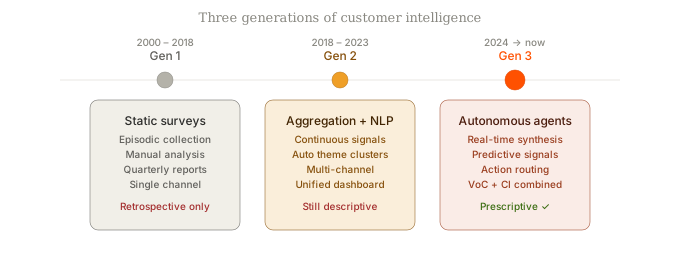
Gen 1 tools are defined by structured data collection: NPS, CSAT, and periodic survey forms. You design a questionnaire, send it to a segment, wait for responses, and a human analyst exports the data into a report. The report is shared in a meeting. The meeting ends. Most of the insights are forgotten by Thursday.
Core limitation: Gen 1 is episodic. You only see what you asked about, when you asked about it. Anything that happens between survey cycles — a competitor launch, a support spike, a churn cluster — is invisible until the next survey wave, which is often months away.
Typical tools in this era: SurveyMonkey, Qualtrics (basic tier), Medallia (entry tier), manual NPS programs.
Gen 2: Feedback aggregation and theme clustering
Gen 2 was a significant leap. Tools in this generation pull feedback from multiple sources — support tickets, app reviews, sales calls, survey responses — and use natural language processing to group them into themes. You get a dashboard that shows you "pricing complaints are up 22% this month" across channels, automatically.
This generation solved the silo problem. It gave teams a unified view of customer sentiment across channels, continuously updated rather than episodic.
Core limitation: Gen 2 is still descriptive. It tells you what customers said. It doesn't tell you what you should do, which accounts are at risk, or how your competitive position is shifting. The insight lives in the dashboard; the decision still requires a human to interpret, prioritize, and act.
Typical tools in this era: Enterpret, Dovetail, Unwrap.ai, Thematic, early-stage Medallia AI.
Gen 3: Autonomous AI agents that drive decisions
Gen 3 is a fundamentally different category. Instead of presenting data for humans to interpret, Gen 3 platforms deploy autonomous agents that continuously ingest signals — customer conversations, competitor moves, support tickets, product usage data — synthesize them in real time, and route specific, actionable recommendations to the right stakeholder.
The defining characteristic of Gen 3 is prescriptive output. Not "pricing complaints are up 22%." Instead: "Three enterprise accounts in the fintech segment have flagged pricing friction in the last 14 days. Recommend a CS outreach this week before renewal window opens."
Gen 3 also collapses the boundary between Voice of Customer intelligence and Competitive Intelligence. The same agent that monitors customer sentiment can simultaneously track competitor feature launches, pricing page changes, and review site shifts — giving GTM and product teams a unified signal stream.
Typical tools in this era: HyperOrbit (VoC Agent + CIA Agent), emerging agentic layers from Salesforce Einstein, early AI copilots in Gong.
How to self-diagnose your current generation
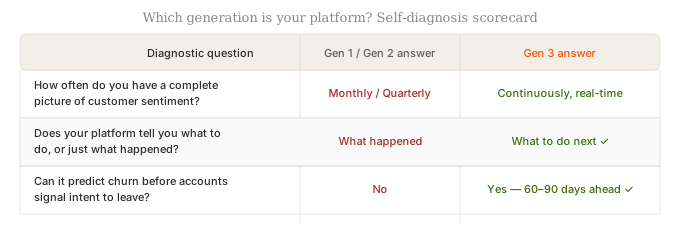
Ask your team three questions:
How often do you have a complete picture of customer sentiment? If the answer is "monthly" or "quarterly," you're in Gen 1.
Does your insight platform tell you what to do, or what happened? If it's the latter, you're in Gen 2.
Can your platform predict which accounts are at risk before they signal intent to churn? If not, you haven't reached Gen 3.
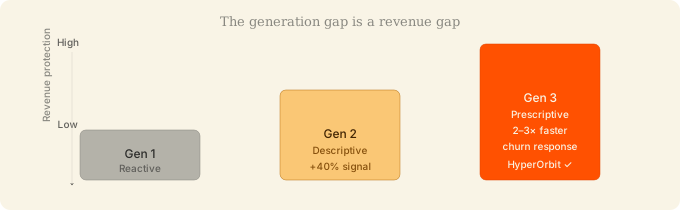
The gap between generations isn't just a feature gap. It's a revenue gap. Companies running Gen 3 systems report 2–3× faster response to churn signals and significantly higher retention in competitive segments — because they're acting on intelligence, not just reading it.
Conclusion
The generation gap is a revenue gap
Most SaaS companies aren't losing to competitors because they lack customer data. They're losing because their intelligence infrastructure is one or two generations behind. Gen 1 tells you what happened six months ago. Gen 2 tells you what's happening now. Gen 3 tells you what's about to happen — and what to do about it before revenue is at risk.
The transition from Gen 2 to Gen 3 is not a tool swap. It's a strategic shift — from passive intelligence consumption to active intelligence deployment. The companies making that shift today are building customer understanding as a durable competitive moat, not a monthly reporting exercise.
Knowing which generation you're in is the first step. The second is deciding how long you're willing to compete with yesterday's tools.