
9 Minutes
Your dashboard is impressive. It has filters, date ranges, NPS trends, and a tab for competitive mentions nobody opens. It took three months to configure and cost $40,000 a year.
And your best customer just churned.
The signal was there. Login frequency dropped 60% six weeks ago. Three support tickets mentioned a competitor. Two renewal conversations went quiet.
But nobody queried the dashboard that week.
This is the Gen 2 problem. Not that the tool was bad — it was actually quite good. The problem is that your company's customer intelligence strategy depends on someone remembering to ask the right question at the right time.
That's not intelligence. That's archaeology.
The Three Generations of Customer Intelligence
Before diagnosing why your dashboard is failing you, it helps to understand where it sits in the broader evolution of how companies understand customers.
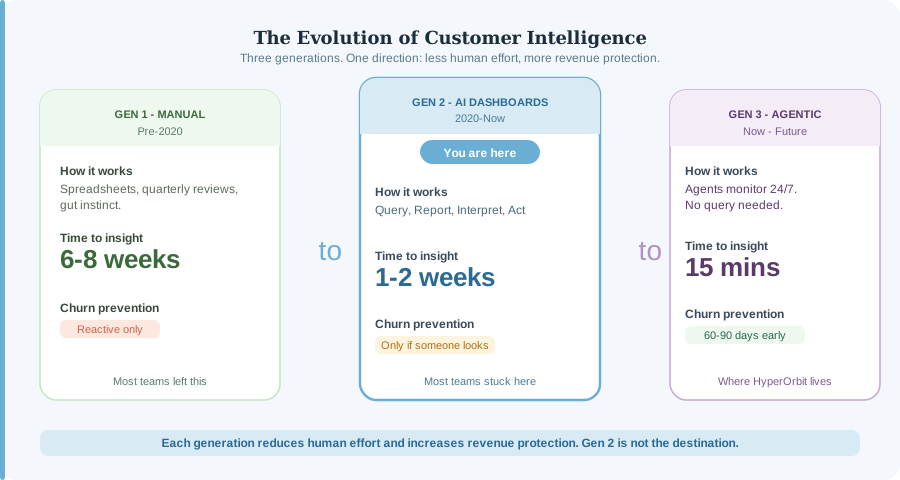
Generation 1 — Manual Analysis
Pre-2020, most companies operated on spreadsheets, quarterly NPS reviews, and the judgment of whoever was loudest in the meeting. Customer intelligence was a person, not a system. It was slow, expensive, and entirely dependent on human availability and attention.
Most teams graduated from Gen 1. You almost certainly have.
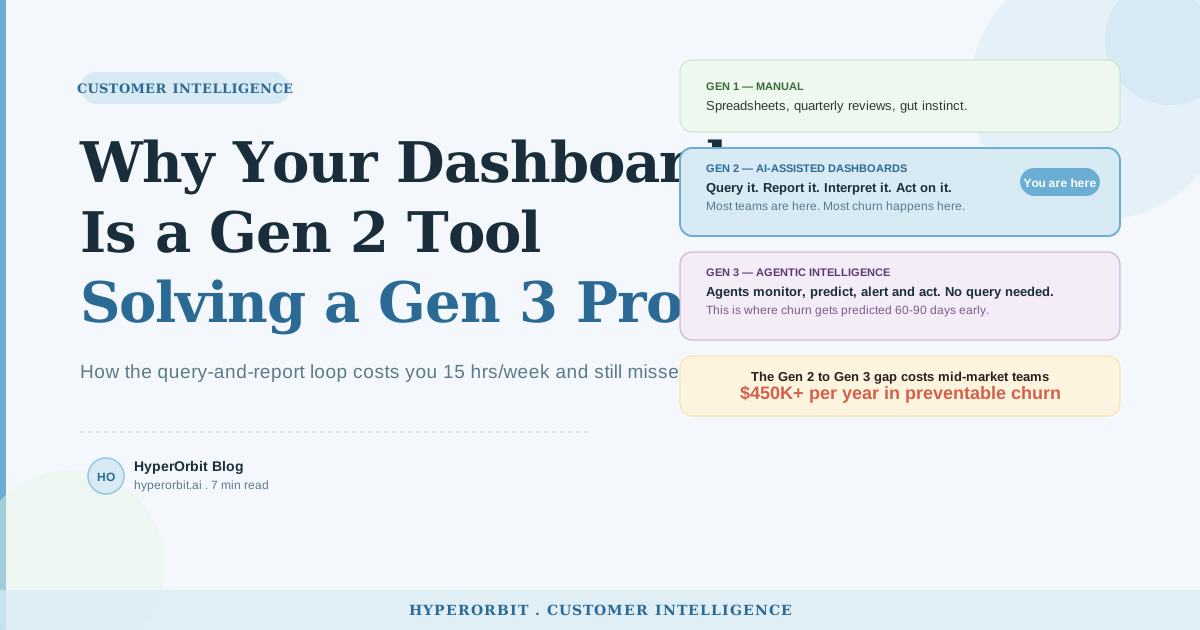
Generation 2 — AI-Assisted Dashboards
This is where most product and customer success teams live today. You have tools — probably several. Zendesk for tickets, Gong for calls, a feedback platform for surveys, maybe Mixpanel for usage data. Some of them have AI features. They produce charts. They let you filter by segment, time range, and account tier.
They are genuinely useful — when someone uses them.
The fundamental architecture of a Gen 2 tool is: you ask, it answers. You query, it reports. You log in, it works. You don't log in, nothing happens.
That conditional is the entire problem.
Generation 3 — Agentic Intelligence
Gen 3 flips the architecture. Instead of waiting to be queried, autonomous agents monitor every customer signal continuously — 24 hours a day, across every channel — and surface what matters before you think to ask.
No query needed. No dashboard to log into. No analyst to commission a report.
The intelligence comes to you. And it arrives with enough lead time to actually do something about it.
The shift from Gen 2 to Gen 3 isn't about better features. It's about a fundamentally different relationship between intelligence and action. Gen 2 informs. Gen 3 acts. |
The Hidden Cost of the Query-and-Report Loop
Gen 2 tools are quietly expensive in ways that don't show up on the invoice.
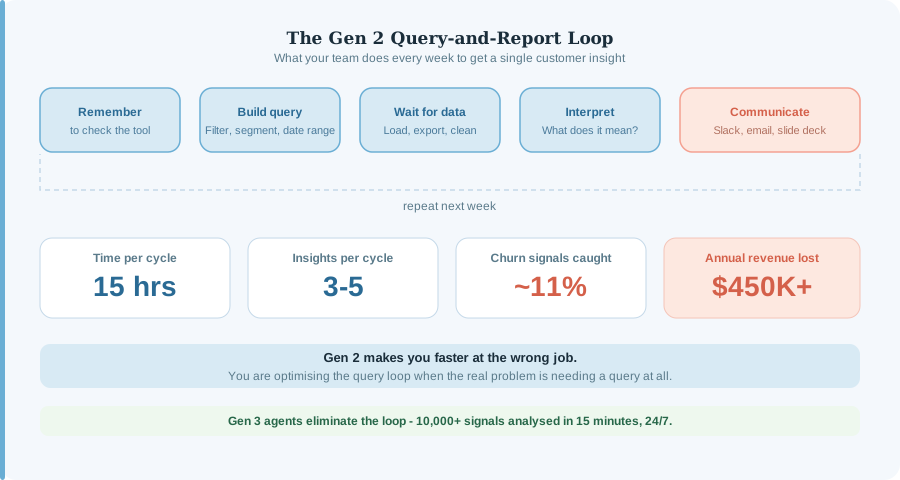
Here's what a single customer intelligence cycle actually costs a mid-market product team:
Someone has to remember to check the tool.
They have to build the right query — the right filters, date range, segment, and metric combination.
They wait for data to load, export it if needed, and clean it.
They interpret what it means in the context of what else they know.
They communicate it to the people who can act on it.
Those people decide whether to act.
If they do, they act — usually 6 to 8 weeks after the original signal.
Add it up and you're looking at 15+ analyst hours per week, per team. That's before you account for the signals that never make it into a query at all because no one thought to look for them.
The churn prediction accuracy for Gen 2 teams? Roughly 11% of at-risk accounts get flagged before it's too late. The other 89% are discovered after the fact — in the cancellation request, the renewal decline, the silent offboarding.
For a mid-market SaaS company with $5M ARR, that gap is worth $450,000 per year in preventable churn.
3 Moments Where Gen 2 Dashboards Fail in Practice
The failure modes aren't theoretical. Here are the three scenarios we hear most often from product and CS teams:
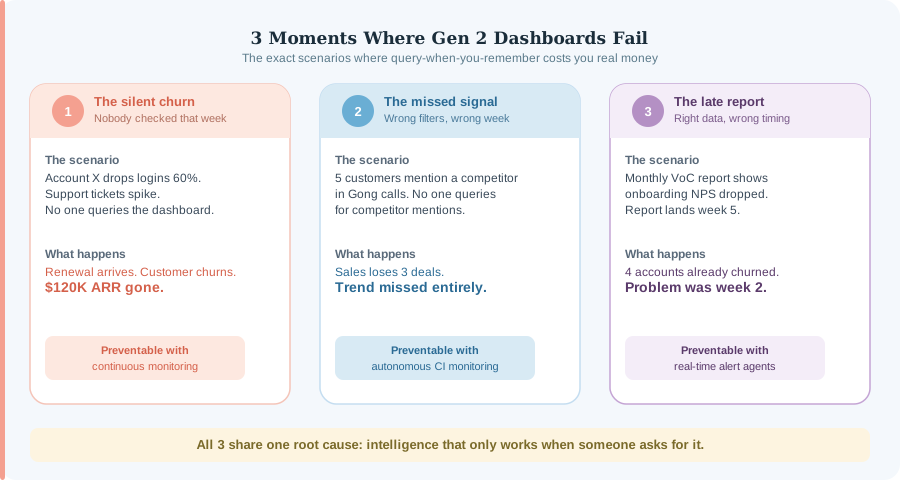
Moment 1 — The Silent Churn
An account quietly disengages. Login frequency drops. Support tickets shift from product questions to frustration signals. The account goes dark on Slack.
Nobody queries the dashboard that week. The next VoC meeting is in 10 days. The renewal is in 6 weeks.
By the time anyone looks, the customer has already shortlisted two alternatives. The churn wasn't sudden — it was six weeks of unread signals.
Moment 2 — The Missed Competitive Signal
Five customers mention a competitor in Gong calls within 10 days of each other. The mentions are casual — 'we've been looking at X' and 'someone on our team showed us Y' — but the pattern is unmistakable.
Nobody queries for competitor mentions that week. The battlecard isn't updated. Sales doesn't know the objection is coming. Three deals close for the competitor.
The pattern was there. It just needed someone to look for it — and no one did.
Moment 3 — The Late Report
Your monthly VoC report lands. It shows that onboarding NPS dropped from 42 to 28 over the last four weeks. Clear trend. Obvious problem.
The report is for last month. Four accounts already churned during onboarding. Two more are at renewal risk.
The intelligence was accurate. It arrived six weeks after it would have been actionable.
All three moments share one root cause: a customer intelligence system that only produces output when someone asks for it. Gen 2 is reactive by design. Gen 3 is proactive by architecture. |
What Gen 3 Looks Like for the Same Three Scenarios
The same signals. Different outcome.
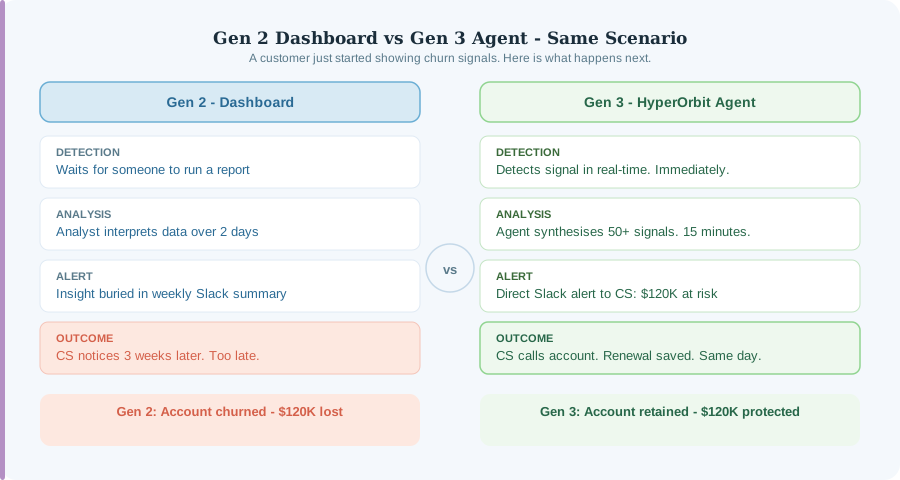
Scenario 1 — Silent Churn
The VoC Agent detects the login frequency drop on day three. It correlates with two support tickets from the same account flagged as frustration signals. It identifies the account is 47 days from renewal and at 73% churn risk.
The CS team gets a direct Slack alert: 'Account X — $120K ARR — elevated churn risk. 2 support escalations, 60% login drop over 3 weeks. Renewal in 47 days. Suggested action: executive QBR.'
That happens automatically. No query. No meeting. No one had to remember to look.
Scenario 2 — Competitive Signal
The CIA Agent has been monitoring competitor mentions across all Gong calls and support tickets continuously. On day eight, it identifies a pattern: five accounts mentioned the same competitor within 10 days. It cross-references with win/loss data and identifies that two of the accounts are mid-cycle on renewal.
Sales gets an alert. The battlecard is flagged for update. The product team gets a feature gap report showing the three capabilities customers are comparing.
The competitive threat was neutralised before it became a lost deal.
Scenario 3 — Onboarding Drop
The VoC Agent flags the NPS decline on week two — not week six. It identifies that the drop correlates with a specific onboarding step where customers are asked to connect their CRM integration. Three accounts submitted tickets about this step in the same week.
Product gets a prioritised requirement: 'CRM integration friction in onboarding — affecting NPS score for 8 accounts — estimated churn risk $340K ARR if unresolved.'
The fix ships before anyone churns.
The Gen 2 to Gen 3 Transition Isn't a Replacement — It's an Evolution
One clarification worth making: moving to Gen 3 doesn't mean abandoning your existing tools. Zendesk still handles tickets. Gong still records calls. Your CRM still manages relationships.
What changes is the intelligence layer on top of them. Instead of a dashboard that aggregates data and waits to be queried, you deploy agents that continuously monitor every signal those tools produce — and surface what matters, when it matters, to the right person.
The dashboards don't disappear. They just stop being where intelligence lives.
Gen 2 tools make your team faster at analysis. Gen 3 agents make analysis unnecessary.
That's not a marginal improvement. It's a structural shift in how customer intelligence works. And it's why teams that deploy autonomous agents consistently outperform those still operating on the query-and-report loop — not because they have better analysts, but because they've stopped needing analysts to catch what matters.
How to Know If You're Stuck in Gen 2
Five questions worth asking your team:
When did you last catch a churn risk before the customer told you?
How many analyst hours per week go into building queries and interpreting reports?
How often do competitive signals from customer conversations reach your sales team within 48 hours?
What percentage of at-risk accounts get flagged before renewal — not after?
If your dashboard product shut down tomorrow, would your customers churn faster?
If the honest answer to most of these is uncomfortable, you're probably in Gen 2. That's not a criticism — most teams are. It's just worth knowing where you are before deciding whether to move.
Conclusion
What Moving to Gen 3 Actually Requires
The transition doesn't require replacing your entire stack. It requires adding an intelligence layer that connects to your existing tools — and deploying agents that monitor, synthesise, and act on the signals those tools already produce.
HyperOrbit's VoC Agent connects to 50+ sources — Zendesk, Gong, Salesforce, Intercom, Slack, G2, survey tools — and begins surfacing prioritised intelligence within 24 hours of deployment. No custom integration work. No data migration. No new dashboards to learn.
The CIA Agent does the same for competitive intelligence — monitoring every customer conversation for competitor signals and linking them to your win/loss patterns and renewal calendar.
The teams winning on customer retention in 2026 aren't the ones with the best dashboards. They're the ones whose intelligence doesn't wait to be asked. |
If you're still on the query-and-report loop, there's a good chance your customer intelligence is six weeks behind your customers' decisions